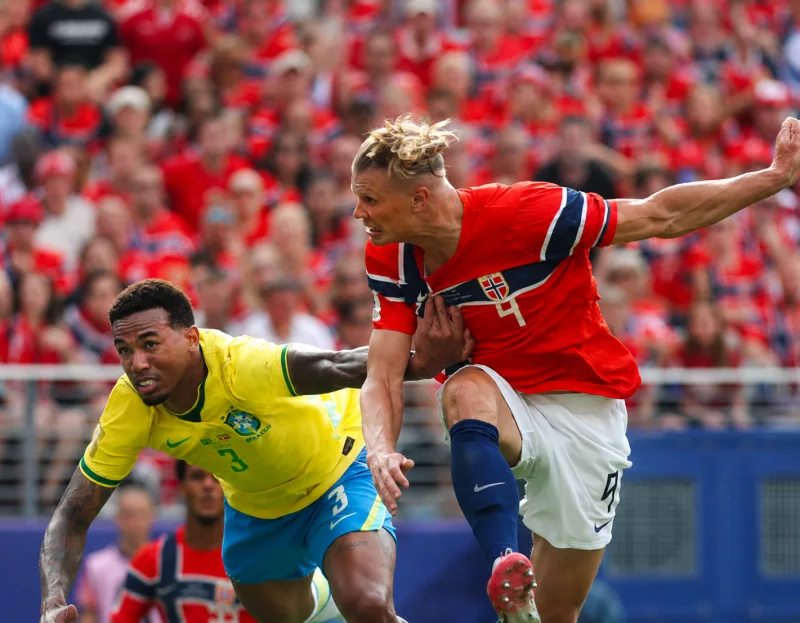
 Erling Haaland heads the ball to score Norway's first goal against Brazil in their 2-1 win to book a quarter final slot in the 2026 Fifa World Cup, July 6, 2026. /HANDOUT
Every FIFA World Cup produces unforgettable goals, dramatic upsets and unlikely heroes. But the 2026 edition has added something else to football's biggest stage: an extraordinary number of historic firsts.
Barely a month into the tournament, history has been rewritten repeatedly—from the competition's expanded format and unprecedented co-hosting arrangement to milestone victories, surprise quarter-finalists and controversial disciplinary decisions that have never before been seen at a FIFA World Cup.
With the race for the quarter-finals entering its decisive phase, the tournament is increasingly shaping up as one that future generations may remember not just for who lifted the trophy, but for how many records, traditions and long-standing narratives were broken along the way.
A tournament like no other
History was made before a ball was even kicked. For the first time, football's biggest spectacle is being jointly hosted by three countries—the United States, Mexico and Canada—in what is also the first 48-team FIFA World Cup.
The expanded format increased the number of matches from 64 to 104, to be played across 16 host cities over 39 days between June 11 and July 19.
Africa also enjoyed its biggest-ever representation, with 10 nations qualifying compared to the traditional five, underlining FIFA's push to make the tournament more globally inclusive.
Of those, Morocco and Egypt advanced to the Round of 16.
Morocco have already secured a place in the quarter-finals where they will meet France on July 9, while Egypt face defending champions Argentina in Atlanta on July 7.
For African football, the tournament has already produced landmark achievements.
Egypt registered their first-ever FIFA World Cup victory, ending a wait stretching back 92 years when they became the first African and Arab nation to qualify for the tournament in 1934.
Morocco, meanwhile, continue to reinforce their growing reputation on the global stage after becoming the first of the first four teams to reach this year's quarter-finals.
The milestone builds on the momentum created by their historic run at the 2022 World Cup when they reached the semi final in Qatar.
The performances have strengthened the argument that African football is steadily closing the gap on the traditional powerhouses.
New rules, new controversies
The 2026 tournament has also ushered in one of the most significant changes to football officiating in recent years.
To discourage time-wasting and improve the flow of matches, FIFA introduced a series of new regulations, including a mandatory 10-second limit for substituted players to leave the field, a five-second countdown for restarts, a 60-second cap on injury treatment, expanded Video Assistant Referee (VAR) powers and automatic red cards for players who deliberately cover their mouths during confrontations.
Paraguay midfielder Miguel Almirón became the first player in World Cup history to be sent off under the new mouth-covering rule after speaking to Turkey's Mert Müldür while obscuring his mouth during their Group D match on June 20.
Even more unprecedented was the case involving United States striker Folarin Balogun.
The 25-year-old, who leads the tournament scoring charts for the co-hosts with three goals, was shown a straight red card for a foul on Bosnia and Herzegovina defender Tarik Muharemovic as the US defeated Bosnia and Herzegovina 2-0 in their Round of 32 clash on July 1.
However, Balogun's one-match suspension was later overturned for a one-year probationary period after US President Donald Trump intervened by speaking directly with FIFA President Gianni Infantino.
The decision, made under Article 27 of the FIFA Disciplinary Code, allowed Balogun to remain available for the Americans' Round of 16 meeting with Belgium Monday night.
The unprecedented development sparked widespread international debate over political influence in football governance.
Established powerhouses challenged
If the new rules have rewritten football administration, events on the pitch have challenged long-held assumptions about the sport's hierarchy.
Norway produced one of the biggest upsets of the tournament by eliminating five-time champions Brazil to reach the FIFA World Cup quarter-finals for the first time in the country's history.
Before this campaign, Norway's best World Cup performances had been Round of 16 appearances in 1938 and 1998.
Erling Haaland scored twice in the closing stages to seal a famous victory, while Norway maintained another remarkable record by remaining unbeaten against Brazil in every World Cup meeting between the two nations.
Brazil's elimination also extended another unpopular statistic. Every one of the Seleção's World Cup exits since 2006 has now come at the hands of European opposition.
The defeat proved even more painful after Bruno Guimarães missed an early penalty before Neymar, introduced from the bench in the second half, scored a late consolation goal from the penalty spot.
Shortly after the match, an emotional Neymar announced his retirement from international football, bringing an end to one of the game's most celebrated national team careers.
Germany, another traditional heavyweight, also suffered a stunning exit after losing to Paraguay on penalties following a 1-1 draw in Boston.
The defeat marked the third consecutive World Cup in which the four-time champions have failed to progress beyond the early knockout rounds, highlighting a worrying decline for one of international football's most successful nations.
Underdogs punching above their weight
The expanded tournament has given emerging football nations an opportunity to demonstrate how quickly the global game is evolving.
New nations are stubbornly refusing to be intimidated at this World Cup.
Cape Verde captured worldwide admiration by defying the odds and pushing defending champions Argentina into extra time in a thrilling Round of 32 contest in Miami on July 3.
Ranked 67th in the world and making their World Cup debut, the Blue Sharks twice fought back before eventually losing 3-2 after 111 minutes.
The Argentina - Cape Verde clash was widely considered one of the biggest mismatches in World Cup history.
Going into the match, the defending champions were massive favourites expected to stage a walkover against the tiny island nation making their tournament debut.
Although Lionel Messi collected the Player of the Match award, several Cape Verde players emerged among the game's standout performers.
Sidny Lopes Cabral produced one of the tournament's finest goals with a spectacular curling effort, while veteran goalkeeper Vozinha made eight crucial saves to keep his side within touching distance of one of the greatest upsets in World Cup history.
Their performance served as another reminder that the gap between football's established powers and emerging nations continues to narrow.
With only half of the quarter-final line-up confirmed by Monday, there is every indication that the tournament's appetite for rewriting history is far from over.
Whether through unlikely underdogs or the fall of traditional giants, the 2026 FIFA World Cup has already secured its place as one of the most transformative editions the competition has ever witnessed.