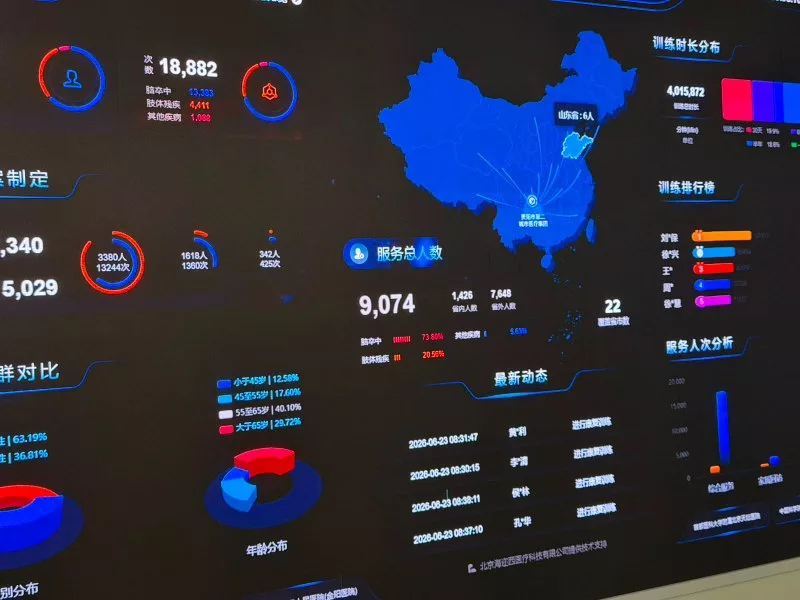
Walking into the National Big Data (Guizhou) Comprehensive Pilot Zone and Exchange Experience Center in China is like stepping into the cockpit of a futuristic city.
The sheer scale of the screens and the hum of the servers behind the glass are overwhelming.
This is the heart of China’s data revolution, and it is not just about storing information; it is about orchestrating life in real-time. The center offers a panoramic view of how data drives society.
On one massive screen, I watched a live heatmap of the province’s hospitals. It didn’t just show how many patients were walking in; it tracked specific diseases and symptoms.
The system immediately highlighted a spike in flu cases in one district and, within minutes, directed health resources to that area. It felt less like observing a system and more like watching the province take its own pulse.
But it was the agriculture section that genuinely stunned me. In Kenya, we talk about the "farm to fork" journey, but here, it’s a data-driven reality.
I could pick a random cow grazing miles away and pull up its entire life history. The screen showed its geology—where it was raised, its age, its fat content, and its complete diet. I could even see the conditions of the shed via live feed.
This isn’t science fiction; this is the standard here. This level of traceability offers a powerful solution to one of Kenya's most persistent headaches: cattle rustling. For decades, successive governments have struggled to curb this menace, particularly in the arid and semi-arid lands (ASALs).
The old methods—police patrols and community barazas—have failed to stem the tide. The numbers tell a grim story. While exact figures fluctuate, it is estimated that thousands of livestock are lost annually to raids, leading to loss of life and displacement.
In counties like Turkana and West Pokot, the cycle of revenge attacks has derailed development for generations. Governments have often resorted to disarmament exercises, which are temporary fixes at best. The problem persists because we have been fighting a physical symptom with physical tools.
Technology offers a different approach. If we can build mini data centers, even starting small, we could register and track every animal electronically.
Just like the Guizhou system, we could know where every cow is, its owner, and its health history. This traceability would create an undeniable ownership chain.
When a cow is stolen and appears in a different market, a simple scan would reveal its true home. It takes the guesswork out of recovery and acts as a deterrent. If you can’t move a stolen animal without being traced, the economic incentive for rustling collapses. Beyond security, the efficiency gains are undeniable.
Here in Guizhou, I saw Artificial Intelligence reducing the design and production time of a suit for an adult from a day to just 30 minutes. By prototyping in seconds, they slash costs and waste.
We need that speed in our public service. Back home, a few visionary leaders like Irungu Kangata of Muranga have tried to deploy technology to improve service delivery, but they are the exception.
Many counties are still relying on rudimentary methods that cannot keep up with a growing population. Of course, building a mega data center like this is expensive and energy-hungry.
But we don’t need to start with a billion-dollar facility to get on this ride. We can start with what we have. We can build mini data centers or leverage cloud infrastructure.
It is about moving the conversation from "why we can't" to "how we can start."
If China can implement smart management for millions of people, surely Kenya can pilot it in its 47 counties to improve health responses, trace our agricultural assets, and bring an end to the age-old problem of cattle rustling.