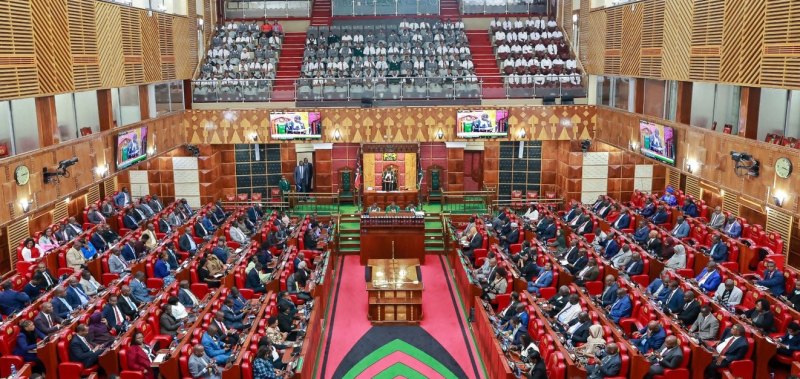
Members of Parliament have renewed calls for a policy shift to reintroduce corporal punishment in schools as part of efforts to prevent a recurrence of student unrest and fire incidents witnessed in learning institutions across the country.
The debate was triggered by West Mugirango MP Stephen Mogaka, who sought a statement from the National Assembly Departmental Committee on Education on measures being undertaken to stop the recurrence of fire incidents in schools within his constituency and nationwide.
"In the recent past, the country has witnessed a disturbing trend of fire outbreaks in learning institutions resulting in loss of life, destruction of property and disruption of learning. Within West Mugirango Constituency, where I am privileged to be MP, several schools have recently experienced fire incidents, raising concerns about disaster preparedness in schools," Mogaka said.
Uasin Gishu Woman Representative Gladys Boss urged Parliament to prioritise thorough investigations involving the Ministry of Interior to establish the root cause of the recent wave of student unrest.
She said it was unfortunate that the eight minors charged over the deadly fire at Utumishi Girls Academy in Nakuru were already before the justice system while the factors that allegedly drove them to commit the offence remained unclear.
"It's a bit unfortunate that the girls are in the justice system. They should actually be studied, sit with psychiatrists and find out what could possess someone so young to do something so heinous. If we understand what the challenges were, we can then work on our other children in our other schools," she said.
"If we do quick fixes, we don't get to the bottom of it. Right now, we are dealing with the symptoms but not the root cause of the issue."
Other lawmakers, however, proposed more drastic measures, including the reintroduction of corporal punishment in schools.
Corporal punishment was officially banned in Kenyan schools on March 13, 2001, when then Education Minister Kalonzo Musyoka issued a Gazette Notice scrapping the legal provisions that allowed caning.
The ban was later reinforced through several legal frameworks aimed at protecting children from physical and mental abuse in learning institutions.
These include the Children Act, 2001, which guarantees children protection from all forms of abuse and violence; the Constitution of Kenya, 2010, which prohibits corporal punishment; and the Basic Education Act, 2013, which expressly outlaws physical punishment and mental harassment of learners while promoting guidance and counselling.
During the debate, lawmakers called for a review of school discipline policies, accusing some parents of abdicating their responsibility to mentor their children and leaving teachers to shoulder the burden alone.
"From the time we stopped this issue of caning students, this is when we started having this problem. Caning students needs to come up again," Bomet East MP Richard Yegon said.
Yegon argued that corporal punishment helped instil discipline in his generation and contributed to their success later in life.
He said restoring caning, alongside stronger parental involvement in raising children, would help address indiscipline in schools.
"Teachers have been left alone to manage the students. We need to make sure that we come together with the teachers, talk to the students and make sure that the discipline comes back to our students," he said.
Mombasa Woman Representative Zamzam Mohamed backed calls for comprehensive investigations to establish the underlying causes of indiscipline among learners and guide long-term interventions.
"The statement our colleague is seeking is very important because even after they see severe punishment being taken against their peers, other children still continue to burn schools. So there is something bad going on that needs thorough investigations," she said.
The debate took place on the same day the Kibera Law Courts ordered the continued detention of the eight minors charged over the Utumishi Girls Academy fire until September 22, when the court is expected to rule on their bail application after considering a pre-bail report.
Lady Justice Diana Kavedza directed that the minors' mobile phones be confiscated and barred them from accessing television, saying exposure to media coverage could further traumatise them.
"You are therefore looking at two months before I get the report so take a deep breath and rest, that ruling will be delivered in September when the court resumes from recess," the judge ruled.
Zamzam urged parents to appreciate the role of the justice system in deterring similar offences.
She recalled the 1999 Nyeri High School tragedy, in which four prefects were locked inside their cubicle and burnt to death, as a grim reminder of the consequences of unchecked indiscipline in schools.
"Children, your parents go through a lot to get school fees, don't go to school and become like devils. You are children who are supposed to worship God and listen to your parents and teachers," she said.
Kitui Central MP Makali Mulu urged caution, saying student discipline is a sensitive issue that requires a comprehensive approach rather than quick fixes.
He said stakeholders across the education sector should have their respective roles reviewed to identify weaknesses in enforcing discipline.
"I see a lot of gaps in these stakeholders, and if we get it right at that point, we will be able to stop this matter because it's not the first time it has happened. It has happened in the past, reports have been prepared, enforcement has been very poor," he said.
Manyatta MP Gitonga Mukunji also attributed the recurring fire incidents to weaknesses in disaster preparedness in schools.
He argued that delayed capitation disbursements have left many schools without adequate resources to install essential fire safety equipment or employ sufficient support staff, including watchmen.
"Simple things such as electrical installations in schools is a problem. They have not been able to hire people such as watchmen who can see children who are misbehaving. I appeal to this House to consider capitation that has not been given to schools as a pending bill," he said.