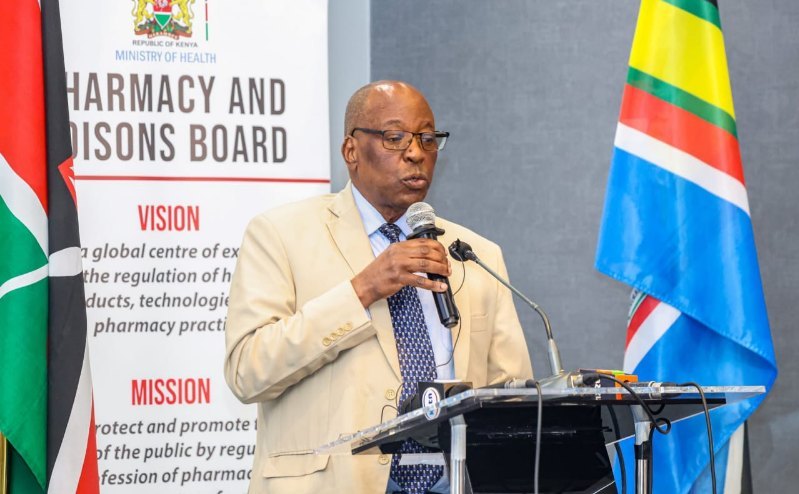
 Pharmacy and Poisons Board Chairperson, Dr. John M. Munyu/HANDOUT
Kenya has intensified efforts to curb circulation of substandard and falsified medical products following the launch of the Interministerial Steering Committee (ISC) to oversee the implementation of the National Action Plan on Substandard and Falsified Medical Products.
The committee was launched by Cabinet Secretary for Health Aden Duale, bringing together government agencies, regulators, county governments and development partners in a coordinated effort to protect public health and strengthen the integrity of Kenya's pharmaceutical supply chain.
Pharmacy and Poisons Board (PPB) chairperson John Munyu called for stronger collaboration among stakeholders, saying the growing threat of counterfeit medicines cannot be addressed by a single institution.
"Safeguarding public health requires coordinated action across government institutions and partners," Munyu said.
He said the initiative marks the beginning of a stronger national partnership to protect lives, strengthen public confidence in the health system and secure the future of healthcare in Kenya.
Munyu said the Pharmacy and Poisons Board has implemented sweeping regulatory reforms over the past eight months to strengthen oversight of health products.
These include mandatory re-registration of legacy medical products, enhanced surveillance at ports of entry, strengthened risk-based inspections and enforcement across the supply chain, as well as expanded post-market surveillance and pharmacovigilance systems to improve early detection and response.
Despite the progress, he warned that counterfeit and substandard medical products continue to exploit weaknesses across supply chains, international trade, border control, law enforcement, digital commerce and criminal networks.
"Substandard and falsified medical products continue to exploit weaknesses across supply chains... making it impossible for any single institution to address the challenge alone," Munyu said.
Duale said counterfeit medicines are a major threat to patient safety, health security and economic development.
"Substandard and falsified medical products remain a major threat to patient safety, health security and economic development,"Duale said, adding that tackling the challenge requires a whole-of-government approach involving regulatory agencies, law enforcement, border control authorities, county governments, healthcare professionals, manufacturers, distributors, development partners and the public.
‘’The proposed National Action Plan provides an opportunity to establish a coordinated whole-of-government approach that brings together all relevant institutions to prevent, detect and respond to substandard and falsified medical products,’’Munyu said.
He urged stakeholders to develop a practical, effective and nationally owned Action Plan that will strengthen Kenya's regulatory system and protect the health of all Kenyans.
The meeting was attended by Council of Governors vice chairperson
and Tharaka Nithi Governor Muthomi Njuki, Council of Governors Chief Executive
Officer Mary Mwiti, PPB Chief Executive Officer Dr. Ahmed Mohamed,
representatives from the World Health Organization (WHO), IGAD, senior
government officials and development partners.