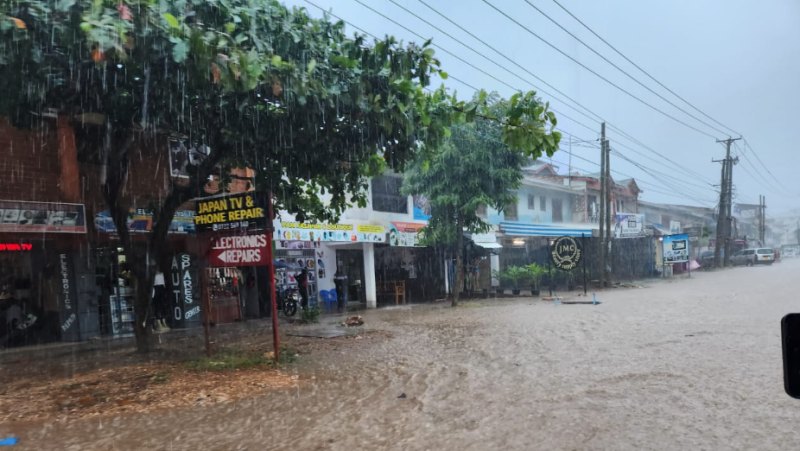
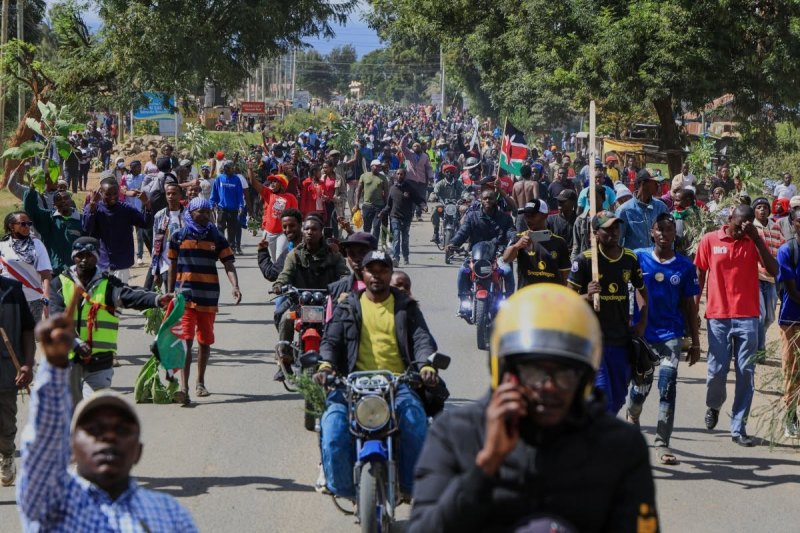
 Nanyuki residents during the recent Ebola protests in the town. /SCREENGRAB
The dispute between the United States and Kenya over an Ebola quarantine centre has grown into one of the most charged confrontations between the two countries in years. It is not the routine friction of diplomacy. Rarely since the eras of colonialism and the neocolonial decades that followed has a disagreement felt this raw. Though the Government of Kenya continues to support the establishment of the centre, the quarrel has been sustained and bitter.
It has already cost lives, and it has spilled out of the meeting rooms and into the streets, the courts and Parliament, hardening into something close to an internal revolt against an American project on Kenyan soil.
The clearest measure of that anger is in Nanyuki, the town beside the Laikipia Air Base where the facility is to be built. Protests there ran for at least two consecutive weeks in June. Demonstrators threw up burning barricades; police answered with live rounds, tear gas and water cannon. The violence was lethal. Two protesters were shot dead by police during the early demonstrations, and at least one more was killed in the clashes that followed, among the dead a 27-year-old identified as Charles Mang'aro Mwangi.
The grievance underlying the unrest is straightforward. The 50-bed centre is designed to hold American citizens, aid workers, military personnel and officials who have been exposed to the Ebola outbreak in the Democratic Republic of the Congo and Uganda. It is not built for Kenyans. Residents see themselves being asked to carry the risk of a deadly virus, with no meaningful consultation, so that Washington can keep that risk away from its own shores. A facility presented as a gesture of preparedness looks, from Nanyuki, like the offloading of danger on to people who were never asked.
What gives the episode its weight is not only the local cost but the strategic signal it sends. African states today are weighing their partnerships in an increasingly crowded field, where the United States, China and others compete for influence and the terms of engagement carry real consequences. Washington's standing on the continent has long rested on a particular claim: that American partnership, unlike that of its rivals, comes with institutional respect and benefits that flow both ways. Episodes like Nanyuki put that claim under strain.
When the United States is seen to act by the same transactional logic it criticises in Beijing, treating a partner's territory as a convenience and its public's objections as an obstacle, it surrenders the very distinction that has set it apart. Critics have argued for years that Washington's talk of shared values was always transactionalism in another language. The current administration's open embrace of a deal-making approach, and its conduct in Africa, has given that argument fresh weight. The reputational damage reaches well beyond this single facility; it colours how the next agreement, and the one after that, will be judged.
There is little reason to expect the pressure to ease. The White House has asked Congress for more than 1.4 billion dollars to confront the Ebola outbreak, including some 800 million dollars tied to the Kenyan centre, even though a Kenyan court has halted the project and the Health Minister was held in contempt for pressing on with it. So long as Washington keeps pushing the money and the project forward, the protests are likely to continue, and with them the cycle of confrontation.
The signs are that the Kenyan Government intends to meet that defiance with a tighter grip rather than concession. After demonstrations on 25 June, the authorities reported 355 arrests across the country, and the Interior Minister dismissed those detained as criminals. In the days that followed, rights groups described something darker still. Amnesty International Kenya and the Kenya Human Rights Commission reported that protesters arrested near Parliament had disappeared into custody, only to be found dumped in different parts of Nairobi with injuries, alleging they had been beaten and tortured, while at least one remained missing. For organisations with long memories of enforced disappearance in Kenya, the pattern was an ominous one.
Against that backdrop, the American military footprint continues to grow. Reports indicate that US Air Force flights have kept arriving in support of the Laikipia facility, and that AFRICOM personnel, among them medical, engineering, security and planning specialists, have been deployed to help build and run it, with Washington declining to say how many. To many Kenyans, the optics are unmistakable: foreign troops arriving to establish a foreign facility, even as local courts order it stopped and local protesters are buried.
This is where the confrontation now rests. A Government in Nairobi caught between an American partner determined to build and a public determined to resist; courts whose orders have been defied; rights groups documenting torture; and a steady flow of US aircraft and personnel into a base at the centre of it all.
The Ebola centre was meant to be a measure of preparedness. It has instead become a test of sovereignty, and of whether the partnership between Washington and Nairobi can survive the way it is being conducted.
The writer is a researcher specialising in African affairs
![[PHOTOS] The new Ngong –Naivasha Road viaduct](https://cdn.radioafrica.digital/image/2026/06/64d4f771-4432-4aee-ba3c-2f304c4436ec.jpg)