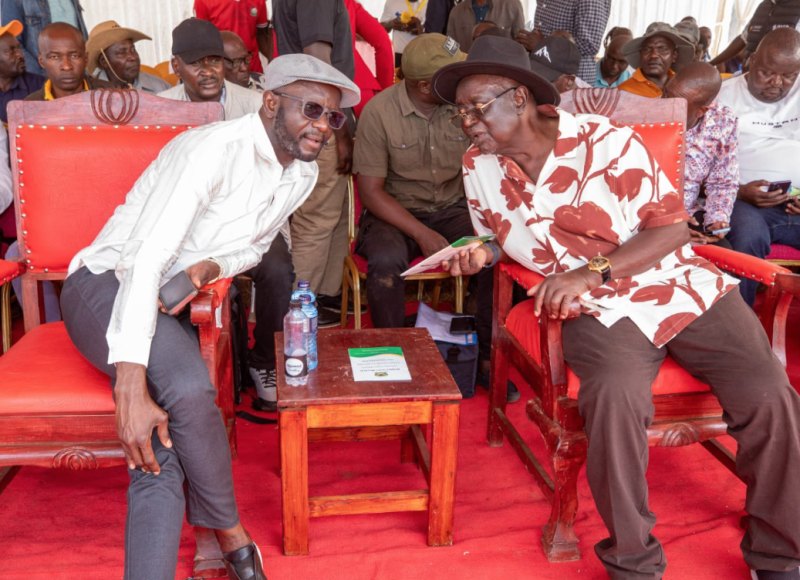
Orange Democratic Movement (ODM) party leader Oburu Odinga has called for the reintroduction of corporal punishment in schools.
Oburu argued that teachers have been stripped of an important tool for maintaining discipline among students.
Speaking in Alego-Usonga, Siaya County, the ODM party leader
questioned how teachers are expected to deal with serious cases of indiscipline
following the outlawing of caning in schools.
"I do not know how you people in the teaching profession are able to instill discipline in your schools without the power of the cane. I do not know how you people manage, but I hope that one day those who removed the power of the cane will rethink the decision and reintroduce it," he said.
He particularly cited incidents of school unrest, including cases where students torch dormitories, saying such offences require firm disciplinary measures.
"I do not understand how you deal with a student who burns the dormitory," he said.
Recalling his own school days, Oburu said corporal punishment was used as part of the disciplinary process before a student could be expelled.
"During our time, if the teacher wanted to expel you from school, they would first discipline you. He would tell you to lie down, give you a few strokes of the cane and then tell you that you are not fit to be in our school-go home," he said.
Despite his support for restoring caning, Oburu praised teachers for their continued dedication to educating young people, describing education as the most powerful tool for transforming lives.
"I hope this noble profession is going to continue to educate our people because education is the game changer in the whole world. Education takes you up to any level you want to go, and there is no age limit for education," he said.
Oburu's remarks are likely to reignite a long-running national debate on discipline in schools, particularly after periodic waves of student unrest and dormitory fires that have prompted some leaders and members of the public to call for tougher disciplinary measures.
However, corporal punishment remains illegal in all Kenyan schools.
The practice is prohibited under the Constitution of Kenya, the Basic Education Act, 2013, and the Children Act, 2022, which classify physical punishment and psychological abuse as forms of cruel, inhuman and degrading treatment of children.
The Children Act, 2022, repealed the common law provision that had allowed parents or other persons to administer "reasonable punishment" to children, while the Basic Education Act expressly prohibits both physical and psychological punishment in learning institutions.
Teachers who administer corporal punishment risk disciplinary action by the Teachers Service Commission (TSC), including dismissal, and may also face criminal prosecution, fines or imprisonment.
Although Kenya formally banned corporal punishment in schools in 2001, reports indicate that the practice still occurs in some institutions despite the legal prohibition.
The Ministry of Education and education stakeholders instead
advocate positive discipline approaches aimed at correcting behaviour without
the use of physical force.
Recommended alternatives include guidance and counselling, positive reinforcement to encourage responsible behaviour, and restorative disciplinary measures such as supervised community service, including cleaning and gardening within schools.