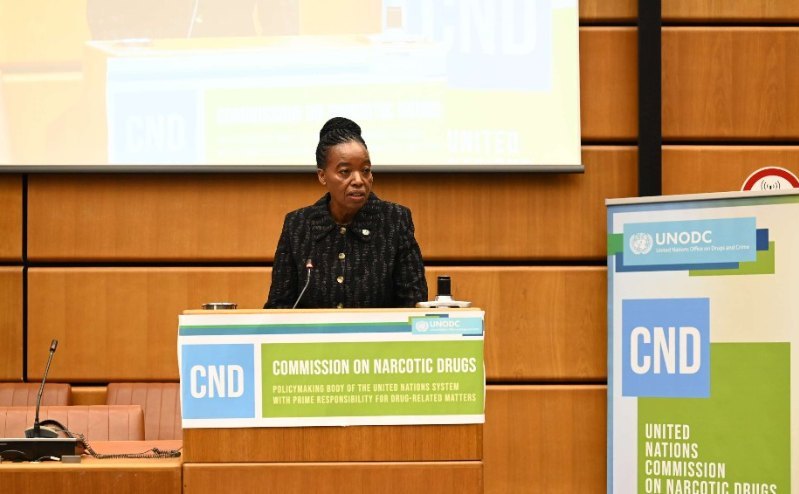
 UNODC director Monica Juma/ UNODC COURTESY
The United Nations Office on Drugs and Crime (UNODC) has called for a rethink of global anti-drug strategies, warning that rapidly evolving drug markets and expanding synthetic drug networks are creating new challenges requiring stronger international coordination.
Marking the International Day against Drug Abuse and Illicit Trafficking, also known as World Drug Day, UNODC said the global drug problem continues to evolve despite decades of international efforts to combat drug trafficking.
This year’s World Drug Day theme is: “World drug problem: persisting issues, new challenges, innovative responses.”
In statements released to mark the day, UNODC warned that the illicit drug trade continues to have widespread social, economic and public health impacts across regions.
“The illicit drug trade persists, and its imprint is visible everywhere: in the harm it causes, the violence it unleashes, the healthcare gaps it exposes, and the millions of lives it erodes,” the agency said.
According to the latest UNODC estimates cited by Executive Director Monica Juma, an estimated 331 million people used drugs globally in 2024, representing a 34 per cent increase compared to a decade earlier.
She said around 63 million people worldwide were living with drug use disorders, with many still unable to access treatment and care.
“Too many still cannot access the treatment and care they need, especially women, young people, and the most vulnerable,” Juma said.
UNODC identified synthetic drugs as one of the fastest-growing concerns in the global drug market, warning that they are becoming easier to manufacture, harder to detect, and increasingly reaching consumer markets across multiple regions.
“The illicit synthetic drug market is expanding exponentially, as these drugs get easier to manufacture, harder to detect, and access consumer markets that are blossoming across all regions of the world,” the executive director said.
The agency also raised concerns over the growing availability of new psychoactive substances, warning that some are highly potent and pose serious health risks.
At the same time, UNODC said traditional drug trafficking networks are adapting their operations.
The agency noted that organised criminal groups are increasingly shifting from plant-based narcotics towards synthetic alternatives, while traffickers continue to search for new routes, methods and vulnerabilities to sustain demand.
Juma said changing drug patterns require governments and international institutions to rethink current responses.
“These persistent challenges and the evolving threats require us to rethink and readjust our responses,” Juma said.
She called for stronger international cooperation through faster intelligence sharing, closer coordination of enforcement efforts, and greater action to disrupt trafficking networks operating through digital platforms.
“We must strengthen cooperation by sharing intelligence faster, coordinating joint operations more closely, and pursuing drug traffickers in the digital space,” she said.
Juma also urged governments to rely more on science, data and technology to anticipate emerging threats while increasing investment in prevention, treatment and recovery programmes.
“We must use data, science, and technology to anticipate and respond more quickly to emerging drug threats. We must invest in alternative livelihoods, as well as prevention, treatment, and recovery-oriented harm reduction,” she said.
UNODC said responses should remain anchored in international law, human rights and global cooperation frameworks.
World Drug Day is observed annually on June 26. It was established by the United Nations in 1987 to raise awareness of the impact of illicit drugs and mobilise international action against drug-related harms.