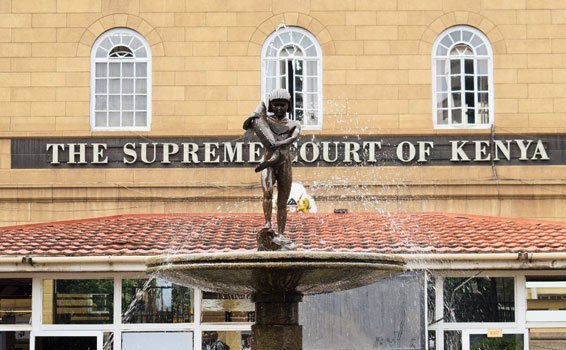
 The Supreme Court /FILE
State agencies cannot seize funds without proving a relationship to crime, the Supreme Court has ruled.
Dismissing appeals by the Ethics and Anti-Corruption Commission and the Assets Recovery Agency, the court ruled that unexplained bank balances alone are insufficient grounds for asset forfeiture under the Proceeds of Crime and Anti-Money Laundering Act.
The decision upholds a Court of Appeal judgment that overturned the forfeiture of Sh19.7 million held in three Equity Bank accounts belonging to businesswoman Pamela Aboo.
The case originated in 2017, when the Assets Recovery Agency received information that funds in Aboo’s accounts were suspected proceeds of crime and obtained orders to freeze them pending investigation.
Investigators alleged the accounts were being used as a conduit for bribes received by Aboo’s husband, Alex Mukhwana Khisa.
Khisa, a Kenya Revenue Authority declarations officer, had been investigated for allegedly soliciting kickbacks from clearing agents to undervalue imports.
"In the course of the investigations, the respondent was invited to explain the sources of her income or the funds in the said accounts," the court heard.
"She replied that the sources of the funds in the accounts were cash deposits from her businesses and trade in: transportation, bananas, sugar cane, perfumes and cereals in Mombasa and Busia."
The EACC, joined as an interested party, insisted that the respondent’s husband had unlawfully obtained the funds deposited into the accounts.
"The commission mainly urged that the respondent had failed to explain any legitimate sources of income and the funds in the accounts amounted to unexplained assets derived from improper benefits, subject to recovery under Section 55(2) of the Anti-Corruption and Economic Crimes Act (ACECA) as read with Section 11(1)(j) of the Ethics and Anti-Corruption Commission (EACC) Act."
In 2018, the High Court ordered the money forfeited to the state, ruling the burden of proof shifted to Aboo once massive unexplained cash deposits were exposed.
However, the Court of Appeal overturned this in 2023, finding that Aboo provided a plausible narrative of her commercial activities, which the state failed to properly investigate.
Dissatisfied, the EACC and ARA escalated the case to the apex court,
In its judgment, the Supreme Court bench — comprising Chief Justice Martha Koome, Justices Smokin Wanjala, Njoki Ndungu, Isaac Lenaola and William Ouko — held that forfeiture proceedings under the Act cannot be based merely on suspicion.
The bench clarified that unlike the Anti-Corruption and Economic Crimes Act (ACECA)—which allows for the seizure of "unexplained assets" simply based on disproportionality to a person’s known income—POCAMLA strictly requires proof that the property is connected to actual criminal activity.
“In civil forfeiture proceedings under ACECA, the commission need not prove a specific crime of corruption. Of course, where the commission decides to prefer criminal charges against a suspect, proof of the crime beyond a reasonable doubt is a must,” the judges noted.
“There is nothing on record to show the funds were used in the commission of a crime.”
The court also found that Aboo’s husband, the alleged perpetrator of the offence, ought to have been joined to the proceedings.
The court ordered costs of the appeal and the first appeals to be borne by the appellants and directed that the Sh19.7 million held in Aboo’s accounts be released.







![[PHOTOS] Raila Odinga Stadium construction enters home stretch](https://cdn.radioafrica.digital/image/2026/06/45f6990c-4882-4cd2-b83c-8fc730dcdce5.jpg)
![[PHOTOS] Calm prevails in Kisumu, Homa Bay](https://cdn.radioafrica.digital/image/2026/06/dff8923b-c99a-4f40-a4be-cc996653e4e0.jpg)