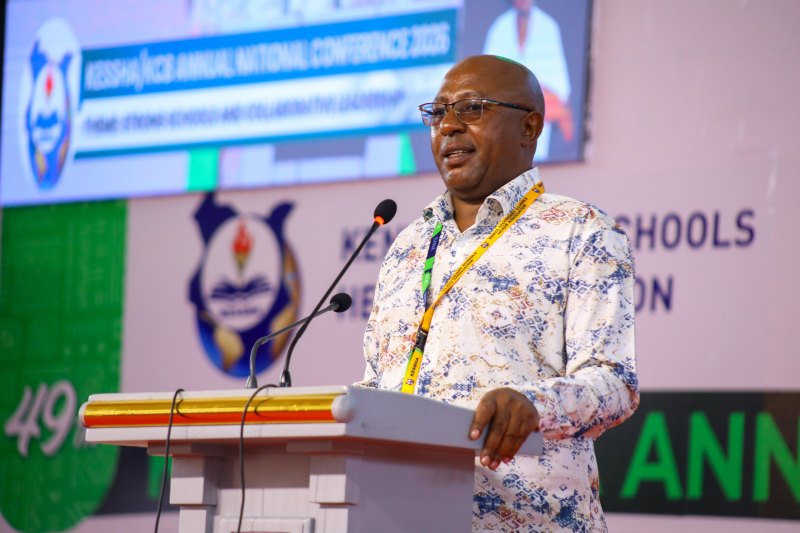
 KESSHA chair Willie Mwangi speaking during day 2 of the 49th Kenya Senior Schools Heads Association (KESSHA) Annual National Conference in Mombasa, June 23, 2026. /KESSHA
Secondary school principals are pushing for an increase in school fees, arguing that the current funding framework no longer reflects economic realities and the rising cost of implementing the Competency-Based Education (CBE).
The principals want school fees calculated using a unit-cost formula that determines the actual cost of providing tuition, meals, accommodation and other operational services per learner per day.
Under the current framework, the government provides a flat capitation of Sh22,244 per learner annually to cover tuition costs in secondary schools, while parents meet accommodation and operational expenses depending on the school's category.
For Cluster 1 (C1) schools, parents currently pay Sh53,554, bringing the total annual cost per learner to Sh75,798 when government capitation is included.
However, proposals presented to the new Basic Education Principal Secretary, John Ololtuaa, by the Kenya Secondary Schools Heads Association (Kessha) indicate that the actual annual cost of educating a learner in a C1 school is Sh110,025.
The association is therefore proposing that parents contribute Sh87,781 annually, representing an increase of Sh34,227.
For Cluster 2 and Cluster 3 schools, the current annual fee stands at Sh62,779, comprising a parental contribution of Sh40,535.
Kessha says the actual annual cost of maintaining a learner in these schools is Sh105,866, meaning parents would be required to pay an additional Sh43,087.
The school heads say the cost of feeding a learner three meals a day has risen to Sh242, covering breakfast, lunch and supper.
This excludes expenditure on kitchen equipment, firewood, cooking gas, cleaning supplies, boarding facilities and wages for cooks.
For day secondary schools, categorised as Cluster Four (C4), where government capitation covers all costs, Kessha is proposing fees of Sh29,919 per learner.
This would require parents who currently pay nothing to contribute Sh7,675 above the current capitation allocation.
Kessha chairperson Willy Kuria said the proposed increases are necessary to cushion schools against inflation and the rising cost of living, factors that were not adequately considered when the current funding framework was developed in 2015.
"It is therefore no longer possible to sustainably run our institutions under the existing framework," Kuria said.
He noted that the price index of goods and services has risen substantially over the past decade, a trend reflected in the steady growth of government spending.
According to Kessha, the national budget has increased by 115 per cent between the 2015/16 and 2026/27 financial years, growing from Sh2.25 trillion to Sh4.82 trillion.
The association argues that the increase demonstrates the government's recognition of the rising cost of delivering public services, including education.
The proposals were presented to Ololtuaa during the 49th Kenya Secondary Schools Heads Association annual conference held in Mombasa from June 22 to 26, 2026.
The five-day event, themed "Strong Schools and Collaborative Leadership for Promoting Competency-Based Education", took place at Sheikh Zayed Hall.
School heads said declining and delayed capitation disbursements has compounded schools' financial woes, saying the situation has left institutions struggling with mounting debts owed to suppliers and non-teaching staff.
While the government's commitment remains Sh22,244 per learner annually, Kessha says actual disbursements have fallen over the years to an average of about Sh15,400 per learner.
The association claimed that schools were owed Sh22.5 billion in unremitted capitation in 2025 alone, amid rising operational costs.
Another concern is the growing financial burden associated with implementing CBE, which has expanded subject choices and introduced learning pathways that require specialised facilities and equipment.
Learning areas such as fine arts, sports, building and construction, music and home science demand additional infrastructure and learning materials, costs that schools say are not adequately covered by government funding.
Kessha argues that while the government provides textbooks, laboratory chemicals, teacher reference materials and teaching aids, it has not sufficiently catered for the technical requirements of the new learning pathways.
The association says that even where laboratory equipment and chemicals are supplied, the quantities are often inadequate to support practical lessons and national examinations.
School heads further note that although the government has constructed laboratories in many institutions, no dedicated funding has been provided to equip them adequately, forcing schools to rely on outdated or insufficient resources, including obsolete computers.
"No grants are provided for desks, chairs, laboratory stools, equipment, chemicals and other essential furniture needed to make these facilities operational," Kuria said.
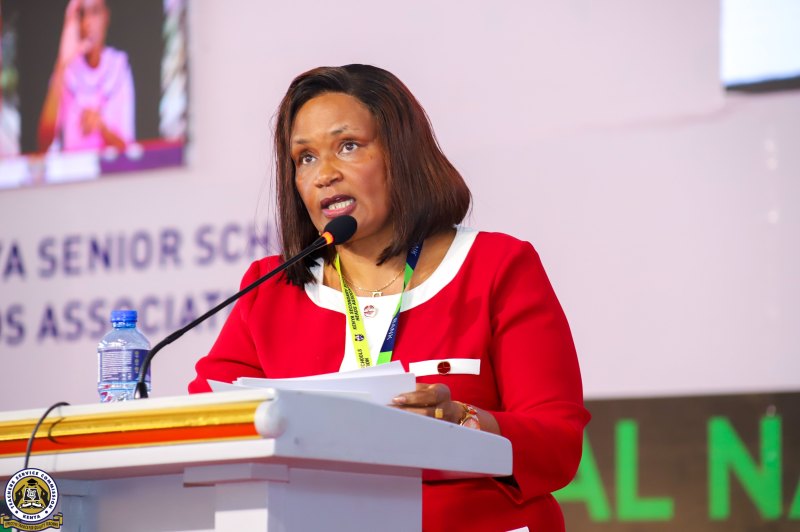
Ololtuaa acknowledged the concerns raised by school heads and pledged a review of the current funding framework, noting that financing challenges stem from competing national priorities.
In the 2026/27 national budget, the government allocated Sh784.5 billion to the education sector, making it the largest recipient of public funding.
While the allocation is intended to support staffing, examinations and institutional capitation, both basic and higher education institutions continue to grapple with significant funding gaps.
![[PHOTOS] The new Ngong –Naivasha Road viaduct](https://cdn.radioafrica.digital/image/2026/06/64d4f771-4432-4aee-ba3c-2f304c4436ec.jpg)



![[PHOTOS] 'Mr Speaker Sir' Gen Z protester in court](https://cdn.radioafrica.digital/image/2026/06/b3e62d8e-25c3-4780-90f9-4eb48b1ce8a7.jpg)