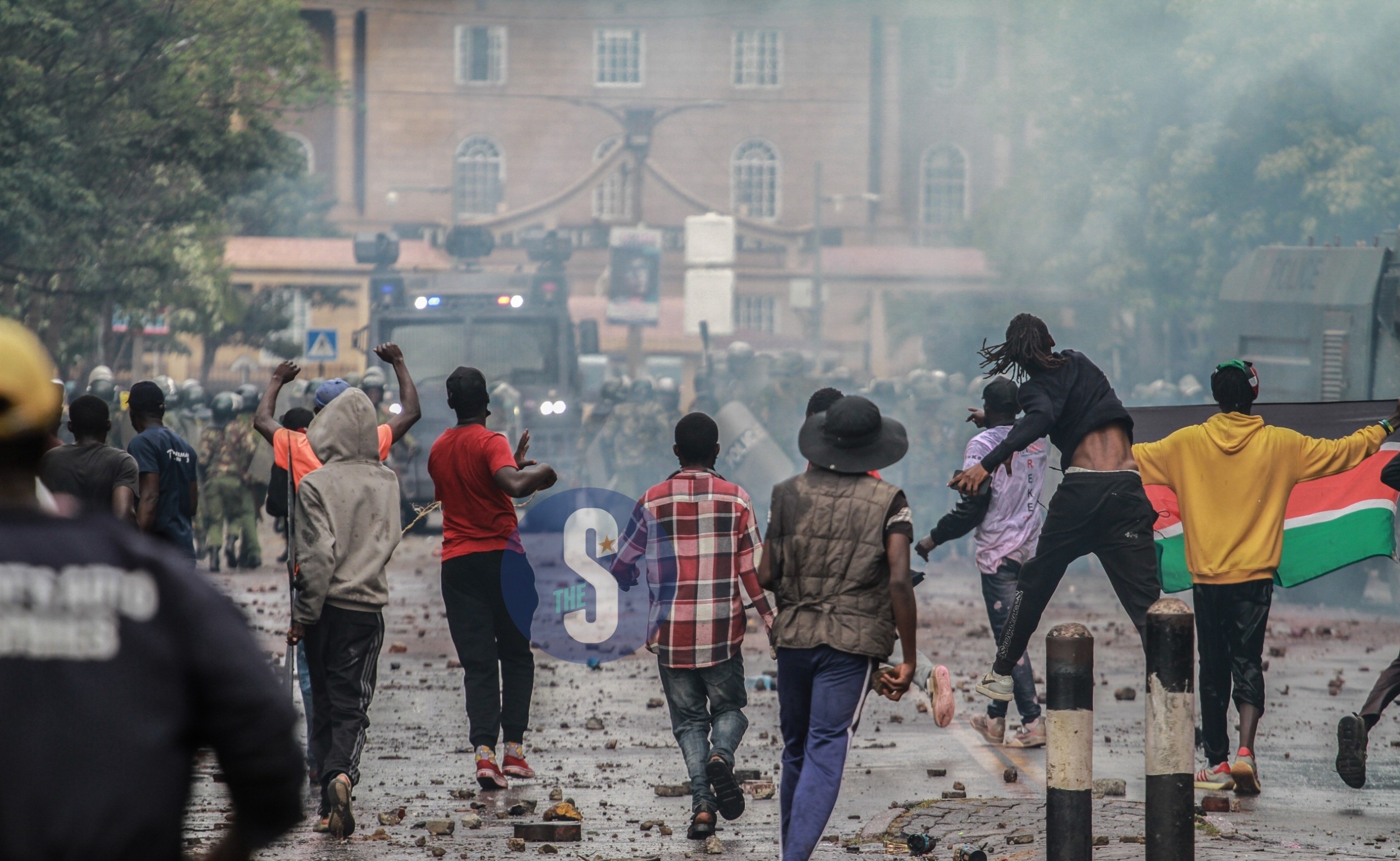
 Nairobi protesters confront a police water canon in a show of defiance during the commemorative Gen Z protests on June 25, 2025. /ENOS TECHE
Only three of the 62 death cases arising from the 2024 anti-Finance Bill protests have reached court nearly two years after the demonstrations that left scores dead and hundreds injured, the Independent Policing Oversight Authority (Ipoa) has said.
The revelation comes just days before the June 25, 2026 Gen Z memorial march, during which families of victims, civil society groups and activists are expected to commemorate those killed during the 2024 protests and renew calls for justice and accountability.
The anniversary has emerged as a litmus test for security agencies on how they will respond to demonstrations this time around after dozens of deaths were linked to police action during the 2024 protests and subsequent protest-related events.
In a statement issued following media enquiries, Ipoa vice chairperson Ann Mwangi said the authority registered 62 deaths linked to the 2024 Anti-Finance Bill demonstrations, but the majority of cases remain under investigation.
According to the authority, three cases are currently pending before court, three have been forwarded to the Office of the Director of Public Prosecutions (ODPP) for review and direction, one is undergoing internal legal review, four were closed after investigations, and five were closed following directions from the ODPP.
The remaining 46 cases are at various stages of investigation.
Explaining why only three cases have progressed to court despite the passage of nearly two years, Mwangi said investigations involving deaths during public protests are often lengthy and complex.
"The completion of investigations is often complex and requires extensive processes involving multiple external agencies. Ipoa frequently relies on institutions such as the National Forensic Laboratory and the Government Chemist for forensic examinations and ballistic analyses, which can affect the timely completion of investigations," she said.
Mwangi added that some investigations are delayed by insufficient evidence.
"Further, the progression of a case to court depends on the sufficiency of evidence and the outcome of prosecutorial review by the Office of the Director of Public Prosecutions (ODPP)," she said, adding that not every completed investigation automatically results in prosecution.
"Some investigations may be closed where evidence does not meet the requisite legal threshold, while others may require further review or additional investigative work."
She said the three cases currently before court are those that met both evidentiary and prosecutorial thresholds required for criminal proceedings.
Beyond the 2024 protests, Ipoia's latest figures show that deaths linked to protest policing have continued to accumulate.
The authority disclosed that it registered 27 deaths arising from the June 2025 Gen Z memorial demonstrations.
Of those, one case is before court while 26 remain under active investigation. A further 38 deaths were linked to the July 2025 Saba Saba demonstrations, with two cases closed internally and 36 still under investigation.
"Collectively, the three major public order management events have generated 127 deaths," Mwangi said.
The figures underscore the challenge facing state agencies as the country prepares for another round of demonstrations centred on demands for accountability over police conduct, extrajudicial killings and corruption.
Organisers of the June 25 memorial march have said the event will honour victims of the 2024 protests and press for justice for those killed and injured during anti-government demonstrations.
The latest Ipoa update is likely to intensify scrutiny over the pace of accountability efforts, with many families of victims still waiting for answers nearly two years after the deadly anti-Finance Bill protests.
The government's initiative to initiate a Sh2 billion reparations framework to compensate victims of violent protests and demonstrations has done little to calm tempers.
Mwangi said details of cases currently before the ODPP could not be disclosed publicly while prosecutorial review remains ongoing.
"This is to safeguard the integrity of the review process, protect witnesses and victims and avoid prejudicing potential criminal proceedings," she said.
To accelerate accountability, Mwangi said Ipoa has adopted several measures, including fast-tracking investigations, implementing a backlog reduction strategy, recruiting additional investigators and strengthening collaboration with stakeholders to ensure policing oversight cases receive priority attention.
As Kenyans prepare to mark the second anniversary of the Occupy Parliament protests, the pace of justice for victims and the conduct of security agencies during upcoming demonstrations are expected to remain under close public scrutiny.