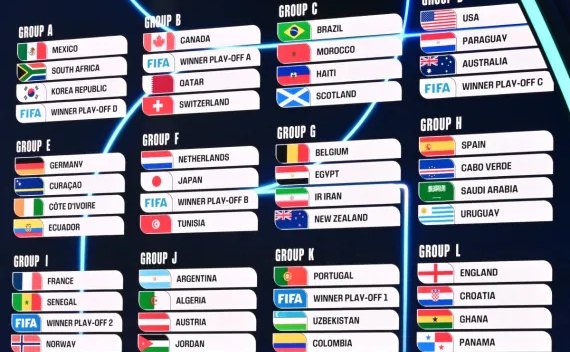
 Nations participating in the 2026 World Cup
As the 2026 FIFA World Cup gets underway across the United States, Canada, and Mexico, the tournament is rewriting records not only on the pitch but in the bank accounts of national federations worldwide.
FIFA has confirmed a staggering $871 million prize pool, nearly double what was distributed at the 2022 Qatar World Cup, turning this summer's competition into a watershed moment for international football finance.
The tournament kicked off on June 11 and runs through to July 19, culminating in the World Cup Final at the New York–New Jersey Stadium in East Rutherford, New Jersey.
For the first time in the competition's 96-year history, 48 nations are taking part, up from the 32-team format used in previous editions.
That expansion alone has transformed the financial landscape of the event. More teams mean more matches, more broadcast slots, more commercial opportunities, and, crucially, more money flowing to football associations across the globe.
FIFA's total distribution of $871 million dwarfs anything
the governing body has previously offered.
The $440 million pool from Qatar 2022 was itself considered historic at the time, yet this year's figure represents a 98 per cent increase.
To put that in further perspective, FIFA is expected to generate a record $11 billion from the 2026 tournament through broadcast rights, sponsorships, ticket sales, and commercial partnerships across 104 matches in 16 North American cities.
The prize pool, while enormous, represents a deliberate reinvestment into the sport's participants.
At the heart of the financial structure is a guaranteed minimum. Every one of the 48 participating nations will receive at least $12.5 million, made up of $10 million in performance-based prize money and $2.5 million in preparation costs paid out before a single ball is kicked.
That baseline was itself revised upward in April 2026, when
FIFA raised the total prize fund by 15 per cent, partly to help federations
absorb the high operational costs of travelling across a three-country host
nation.
The payouts scale upward sharply as teams progress through the rounds. Nations eliminated at the group stage, those finishing between 33rd and 48th place, earn $9 million in performance prize money, bringing their total return to $21.5 million when the preparation and qualification fees are factored in.
Those who survive into the newly introduced Round of 32 collect $11 million, while a place in the Round of 16 is worth U.S$15 million. Quarterfinalists receive $19 million, and from there the sums rise dramatically as teams close in on the title.
The fourth-placed nation walks away with $27 million, while third place earns $29 million. The runners-up will receive $33 million, a figure that would have been considered a winning sum at any tournament held before this decade. And the champions, the nation that lifts the trophy in East Rutherford on July 19, will take home a historic $50 million.
It is important to understand that FIFA's prize money does not go directly into the pockets of players.
The funds are paid to national football federations, each of which then decides how to allocate the windfall.
Some federations distribute a portion as player appearance fees or match bonuses, while others channel the money into operational costs, youth development programmes, or infrastructure investment.
Historically, players in most nations tend to receive somewhere between 20 and 30 percent of FIFA prize money, though the exact figure varies widely depending on agreements negotiated between players' unions and their associations.
Beyond the direct prize money, FIFA has also structured a separate Club Benefits Programme worth $355 million for the 2026 edition.
Clubs whose players represent national teams at the tournament, and who advance further into the competition, receive payments through this channel.
A club such as Real Madrid or Manchester City, with a dozen or more players spread across multiple national squads, could receive tens of millions through this mechanism alone.
For the players themselves, success at the World Cup unlocks rewards that go far beyond any bonus negotiated with their federation.
World Cup winners traditionally attract larger sponsorship deals, elevated global profiles, and significantly enhanced long-term marketability. In an era where football and commercial branding are inseparable, winning the tournament in 2026 will be as transformative off the pitch as it is on it.
The growth in World Cup prize money has been remarkable when traced across history.
When Italy won in 1982, the winners collected around $2.2
million. Argentina's triumph in 1986 was worth approximately $2.8 million,
and West Germany earned roughly $3.5 million for their 1990 victory.
Brazil's back-to-back wins in 1994 and 2002 brought in around $4 million and U.S$8 million respectively, while France received approximately $6 million for their 1998 triumph.
Italy's 2006 victory was worth around $20 million, and Spain earned approximately U.S$30 million in 2010.
Germany collected around U.S$35 million in 2014, France U.S$38 million in 2018, and reigning champions Argentina took home $42 million from Qatar in 2022.
The leap from $42 million to $50 million for the 2026 winners continues a trajectory that shows no sign of slowing , and with FIFA reportedly still in discussions about further adjustments to the prize structure as the tournament progresses, that figure could climb even higher before the final whistle blows in New Jersey.