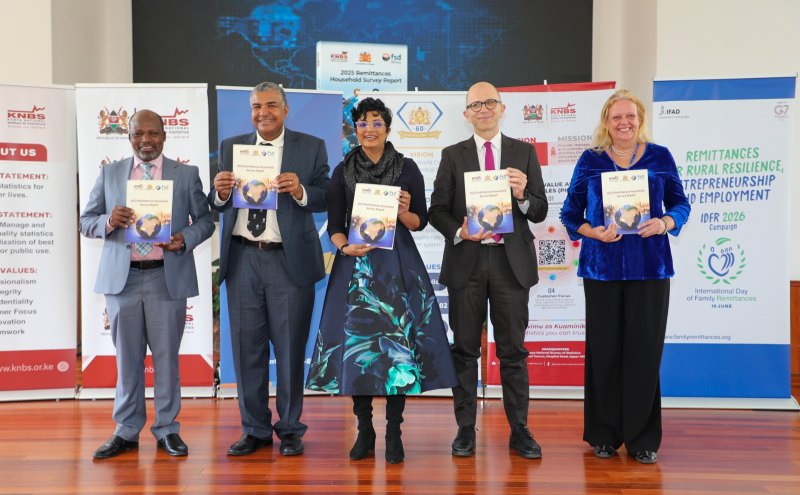

Kenyans living and working locally sent an estimated Sh40.5 billion in remittances abroad to support education, livelihoods and family welfare, according to the 2025 Remittances Household Survey.
The survey, conducted by the Kenya National Bureau of Statistics (KNBS) in collaboration with the Central Bank of Kenya (CBK) and Financial Sector Deepening Trust Kenya (FSD Kenya), paints a detailed picture of how Kenyan households continue to support relatives and dependents living overseas.
Findings show that cash remittances accounted for the bulk of the transfers, amounting to Sh36.3 billion or 89.4 per cent of the total remittance outflows.
In-kind remittances, which include goods and other non-cash support, amounted to Sh4.3 billion, representing 8.6 per cent of the total.
According to the survey, the largest share of remittances was directed towards students and pupils studying abroad.
This group received Sh27.7 billion, equivalent to 68.4 per cent of all remittance outflows, highlighting the importance of financial support from families in Kenya in facilitating access to education overseas.
“This shows the significant role of remittances in supporting education-related expenses for dependents or family members studying abroad,” the survey noted.
The findings indicate that education remains one of the key motivations behind international financial transfers from Kenyan households, with parents and guardians investing heavily in tuition fees, accommodation and other living expenses for students pursuing studies abroad.
The survey also revealed notable differences in remittance
patterns depending on the education level of recipients before they left Kenya.
Individuals who had attained secondary education received Sh20.4 billion, accounting for 50.2 per cent of total remittance outflows. Cash transfers to this category amounted to Sh19.4 billion.
Meanwhile, those who had attained university education before relocating abroad received 22.3 per cent of total remittances and a disproportionately high share of in-kind transfers at 37.5 per cent.
Recipients with primary education or no formal education received comparatively smaller portions of overall remittance outflows but tended to receive a larger share of non-cash support.
The survey further found that individuals engaged in paid employment abroad received 12.5 per cent of total remittance outflows but accounted for 62.5 per cent of all in-kind remittances.
Self-employed individuals abroad also relied significantly on non-cash support, receiving approximately Sh725.5 million in in-kind transfers, representing about 17 per cent of the total in-kind remittance outflows.
According to the report, the trend suggests that employed migrants often receive goods and tangible items from home to support household consumption or business activities rather than relying solely on cash transfers.
“This suggests that employed migrants often receive in-kind goods and tangible items from home, potentially reflecting support for household consumption or business-related inputs rather than cash remittances,” the survey stated.
The survey was conducted across all 47 counties and targeted
individuals who had either sent or received remittances to or from abroad
during the 12 months preceding the study.
It sought to gather comprehensive qualitative and quantitative data on remittance flows, transfer channels, utilization patterns and their socioeconomic impact at the household level.