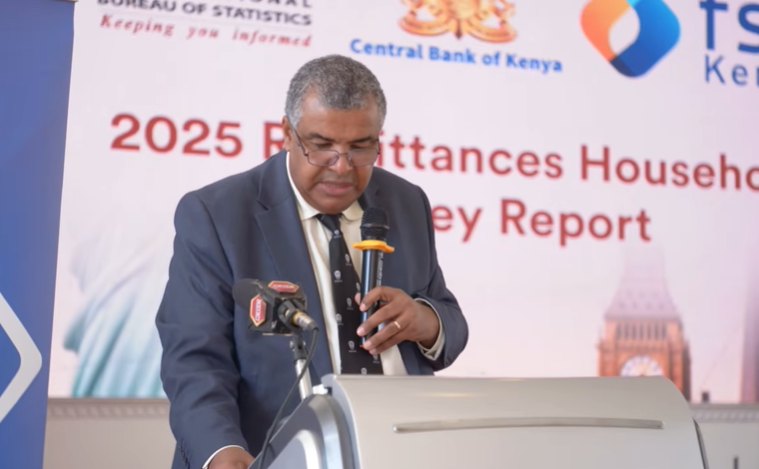

Kenya's rural communities are emerging as the biggest beneficiaries of money sent home by relatives abroad, with nearly two-thirds of households receiving remittances located outside urban centres, according to the 2025 Remittances Household Survey.
The report by the Kenya National Bureau of Statistics (KNBS), Central Bank of Kenya (CBK), and Financial Sector Deepening Kenya (FSD Kenya) shows that diaspora remittances continue to play a critical role in sustaining rural livelihoods, supporting household consumption, housing, education and access to essential services.
According to the survey, 442, 331 households representing 65.1 per cent that received remittances were domiciled in rural areas, compared to 237, 541 households (34.9 per cent) in urban areas.
The findings underscore the growing importance of diaspora earnings in supporting families living outside Kenya's major towns and cities.
"Of the targeted households with either remittance flows or returned emigrants, 60.7 per cent were domiciled in rural areas, while the remaining 39.3 per cent were in urban settings. 65.1 per cent of households reported to have received remittances resided in rural areas, while 34.9 per cent resided in urban areas," the report states.
The survey paints a picture of remittances serving as a vital economic lifeline for rural households, many of which still face infrastructure and service delivery challenges.
Despite receiving financial support from abroad, many rural households continue to rely on basic amenities.
The report found that boreholes and tube wells remain the main source of drinking water for most households receiving remittances, accounting for 31.5 per cent of all households surveyed.
A further 17.2 per cent depended on streams, rivers and springs for water.
The survey also reveals significant disparities in sanitation facilities between rural and urban areas.
"Among households with remittance inflows, the covered pit latrine was the most widely used sanitation facility, accounting for 47.2 per cent. In rural areas, 40.4 per cent of all households with remittance inflows reported covered and uncovered pit latrines as the widely used sanitation facility, while 12.0 per cent of the households reported having no sanitation facilities at all," the report says.
Housing patterns further illustrate the rural character of remittance-receiving households.
"Overall, bungalows constituted the largest share of dwelling units, followed by flats and manyattas, accounting for 48.0, 19.7 and 12.8 per cent, respectively," the report notes. In rural areas, bungalows accounted for 60.5 per cent of homes among households with remittance flows.
The findings also show that remittances have not completely transformed energy use in rural Kenya.
Firewood remains the dominant source of cooking fuel among households receiving remittances.
"Most of the households with remittance inflows reported firewood and products of wood as their main source of cooking energy, constituting 51.6 per cent," the survey states.
However, the report points to positive gains in access to electricity and solar energy.
Electricity was identified as the main source of lighting for 62.4 per cent of households receiving remittances, while solar energy accounted for 24 per cent.
The findings suggest that while diaspora remittances are helping improve household welfare across rural Kenya, significant gaps remain in access to water, sanitation, housing quality and modern energy.