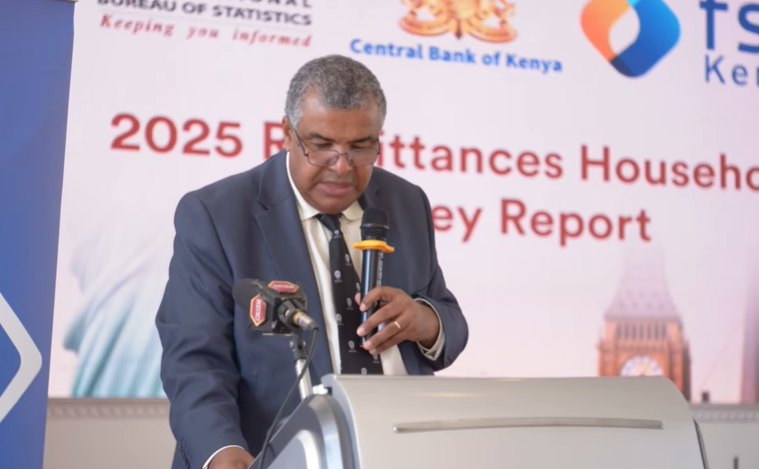
 Prof Robert Mudida, Director, Research at Central Bank of Kenya speaking during the launch of the Remittances Household Survey 2025, June 16, 2026. /SCREENGRAB
More women than men received remittances from relatives during the 12-month period between June 2024 and May 2025, according to new data released by the Central Bank of Kenya (CBK).
Findings from the Remittances Household Survey 2025 show that female beneficiaries accounted for the majority of recipients of money sent from abroad and within the country.
The survey indicates that 6,026,086 women received remittances during the review period compared to 4,679,067 men, translating to a difference of about 1.35 million recipients.
Overall, women accounted for 56.3 per cent of all recipients, while men represented 43.7 per cent.
The survey, the first of its kind in Kenya, was conducted jointly by CBK, the Kenya National Bureau of Statistics (KNBS) and FSD Kenya to address data gaps in household remittance flows.
It covered both inward and outward remittances through formal and informal channels, including cash and in-kind transfers.
The study targeted 4,440 households and examined remittance transactions recorded between June 2024 and May 2025.
Data collection was conducted over 30 days in August 2025, achieving a completion rate of 78 per cent.
Rural households recorded a response rate of 94 per cent compared to 70 per cent in urban areas.
According to the survey, 679,852 households reported receiving remittances, while 140,125 households reported sending remittances during the period under review.
Overall, 730,290 households reported both inflows and outflows.
Recipients aged between 30 and 39 years formed the largest beneficiary group, with 3,507,462 people receiving remittances.
Of these, women accounted for 1,997,839 recipients, equivalent to 33.2 per cent of all female beneficiaries, while men accounted for 1,509,623 recipients or 32.3 per cent of all male beneficiaries.
The 40-49 age group ranked second, with 1,744,244 recipients. Women again outnumbered men, accounting for 915,075 recipients compared to 829,169 men.
Those aged 20-29 were the third-largest recipient group at 1,597,108, comprising 906,286 women and 690,822 men.
The relatively high number of beneficiaries in younger age brackets suggests that remittances may have been used to support education, upkeep and management of family projects.
Among older recipients, 1,344,346 people aged 50-59 received remittances, including 697,141 women and 647,205 men.
Another 1,319,759 recipients were aged 60-69, comprising 789,784 women and 529,975 men.
The number of beneficiaries declined sharply in older age groups. Recipients aged 70-79 numbered 506,798, while those aged 80-89 totalled 281,230.
Women continued to dominate both age brackets. In the 70-79 category, there were 272,064 women compared to 234,734 men.
Among those aged 80-89, women accounted for 223,299 recipients against 57,931 men.
The survey found that 51,812 people aged 90 years and above received remittances, including 41,122 men and 10,690 women.
The trend was reversed among teenagers aged 10-19, where male recipients numbered 160,385 compared to 110,367 females.
A significant gap was also recorded among children aged nine years and below, with households reporting 101,537 female recipients compared to 15,097 male recipients.
Meanwhile, female senders also outnumbered male senders, with 680,207 women reporting remittance outflows compared to 447,475 men.
The 30-39 age bracket accounted for the largest number of remittance senders at 335,094, comprising 188,932 men and 146,162 women.
They were followed by those aged 40-49, who accounted for 235,707, comprising 79,453 males and 156,254 females.
Beyond the number of recipients and senders, the survey also highlights the scale of remittance flows. Kenyan households received a total of Sh931.9 billion in remittances during the period under review while sending out Sh40.5 billion.
Cash transfers accounted for 89.5 per cent of total remittance outflows. On the inflow side, cash transfers made up 91 per cent of all receipts, with in-kind transfers accounting for the remaining 9 per cent.
The report attributes most outward remittances to support for students studying abroad.
"These remittance flows were primarily directed to students abroad, who received more than two-thirds of the total, highlighting education as a major driver of outflows from Kenya. The prominence of education-related remittances underscores the critical role of households in supporting tuition, living expenses, and settlement costs for Kenyans studying overseas," the report notes.