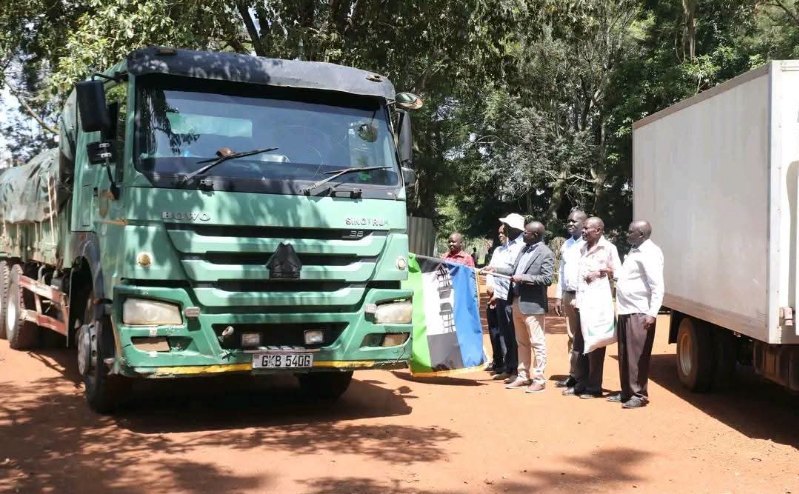
Farmers in Busia county have received a major boost following the delivery of 24 tonnes of cotton seed by the government as part of ongoing efforts to revive the crop's value chain.
The seeds were distributed to farmers affiliated with three cooperatives- Jairos Farmers Cooperative Society, Nambale Farmers Cooperative Society and Luanda Farmers Cooperative Union.
The consignment, which will be issued to growers through the e-voucher system, is the first tranche of a planned 100 tonnes of cotton seed earmarked for the county.
The seed distribution forms part of an ambitious Kenya Kwanza administration programme aimed at revitalising the cotton sector and restoring it to its former status as a key driver of economic growth and a major source of livelihoods in western Kenya.
Among the interventions being implemented is the provision of quality and affordable farm inputs through partnerships with stakeholders such as Vistari Technologies, formerly Rivatex.
The textile firm has signed off-take agreements with cotton farmers in Busia and other cotton-growing counties, guaranteeing a market for their produce.
Under the arrangement, Vistari supports farmers with quality inputs and commits to purchasing all harvested cotton.
The company has so far procured 1,500 tonnes of Open Pollinated Variety (OPV) cotton seed for distribution to farmers across the country's cotton-growing regions.
Vistari is working closely with the Presidential Economic Transformation Secretariat (PETS), which is spearheading the revival of key agricultural value chains nationwide.
"PETS played a key role in logistical support, while the Agriculture and Food Authority and the Busia County Government ensured proper coordination and technical support," said PETS head Augustine Cheruiyot during the seed handover.
The company is also investing heavily in modernising its processing facilities to enhance capacity and support increased cotton production.
The renewed government support has encouraged many farmers in Busia to return to cotton farming after years of abandoning the crop.
Busia County Executive Committee Member for Agriculture, Livestock and Fisheries Simplisius Mukok said more than 200,000 households are now engaged in cotton production following a coordinated revival strategy by the national and county governments.
He attributed the renewed interest in the crop to improved prices and sustained government support.
A kilogramme of seed cotton currently fetches Sh72, more than double the Sh32 paid to farmers three years ago.
Other interventions include the revival of farmer cooperatives and the rehabilitation of the Luanda Ginnery.
"Farmers now aggregate their produce through cooperatives before delivery to the ginnery," Mukok said.
"This ensures proper storage and enables them to benefit from economies of scale."
The revived Luanda Ginnery, upgraded at a cost of Sh150 million, currently produces eight bales of cotton lint and 20 litres of seed cake oil daily.
Although production remains below capacity due to inadequate raw material, Dr Mukok expressed optimism that output will increase as more farmers return to the crop.
"The facility is under new management and operating under improved regulations. The future is promising and we expect significant growth in the coming years," he said.
Busia is among the counties prioritised under the national cotton value chain revival programme launched in 2022 through a partnership between the national and county governments.
To boost productivity, the county has strengthened extension services and introduced an agripreneur model.
Some seven agripreneurs have been deployed in every ward and equipped with motorcycles to improve outreach to farmers.
The agripreneurs are young people trained in modern agronomy and agribusiness management.
While many farmers prefer Bt cotton because of its higher yields, the county is also promoting open-pollinated varieties, which are more affordable for smallholder farmers since the seeds can be recycled for subsequent planting seasons.
Despite existing challenges, significant progress has been recorded in pricing, extension support, cooperative management and adoption of best farming practices.
"This demonstrates that the government's interventions are yielding results," Cheruiyot said, commending the collaboration between the national and county governments.
He said the programme aligns with the Bottom-Up Economic Transformation Agenda (BETA), which forms the foundation of President William Ruto's economic growth strategy.
Cotton was among the priority crops identified by Busia residents during Kenya Kwanza's pre-2022 public engagement forums. The resolutions from those consultations were incorporated into county charters that are now being implemented across the country.
Development partners supporting the sector's revival include the International Fund for Agricultural Development (IFAD) and the World Bank through the National Agricultural Value Chain Development Project (NAVCDP).
Farmers are also benefiting from value-added products such as seed cake used in animal feed manufacturing. Previously considered waste, the by-product now provides an additional source of income alongside cotton fibre.
To sustain the gains, the national and county governments are working on a supportive legal and regulatory framework, including plans to establish a cotton corporation. An industrial park and an export processing zone are also under construction in Nasewa, Matayos constituency.
"The final destination for cotton and other crops is the industrial park, where farmers will be able to add value and earn more from their produce," Mukok said.
The county is also promoting youth participation in agriculture, not only as producers but also in marketing, aggregation and digital agricultural services as part of broader efforts to create jobs and strengthen rural economies.