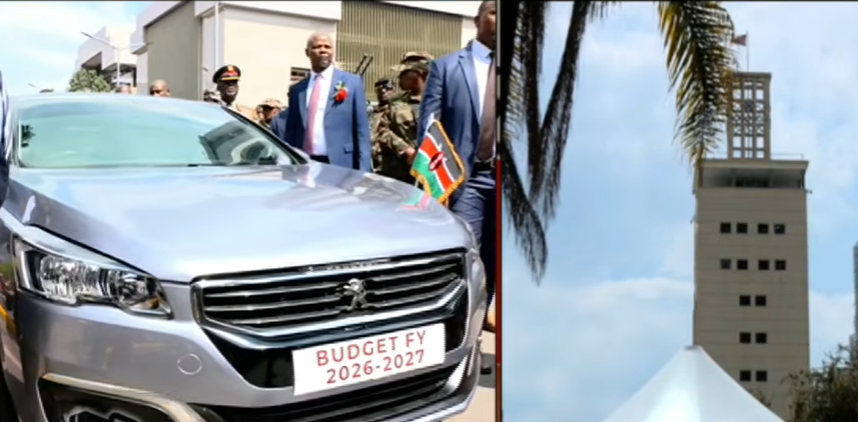
On Thursday, June 11, National Treasury Cabinet Secretary John Mbadi made his way to Parliament to present the 2026/27 national budget, arriving in a carefully presented and highly symbolic scene that marked the occasion.
The Cabinet Secretary rode in a grey Peugeot, its number plate visibly customised and boldly inscribed with the words “BUDGET FY 2026–2027,” immediately identifying the purpose of the journey.
The vehicle also carried the official Kenyan flag, adding a formal national presence to the transport arrangement as it proceeded towards Parliament.
Before departing, Mbadi and other Treasury officials paused for photographs.
During this moment, they were all dressed in coordinated blue suits, presenting a uniform and formal appearance ahead of the budget presentation.
On Mbadi’s left lapel, a red flower was neatly pinned, standing out against the blue suit and contributing to the coordinated ceremonial look.
In his possession, Mbadi carried the iconic black budget briefcase.
The briefcase bore the Kenyan coat of arms alongside the word “Harambee,” reinforcing its association with the national budget process and fiscal planning tradition.
Security presence was visible and significant, with a police motorcade accompanying the movement towards Parliament, underscoring the official and protected nature of the event.
The scene contrasted with the previous financial year’s budget presentation, when Mbadi walked to Parliament for the 2025/2026 budget reading.
Mbadi will present the 2026/2027 national budget, unveiling a record Sh4.84 trillion spending plan aimed at stimulating economic growth, creating jobs and supporting key sectors of the economy.
The budget comes at a time when many Kenyans are grappling with the high cost of living, unemployment and rising prices of basic commodities, making the fiscal blueprint one of the most anticipated policy statements of the year.
According to Treasury projections, the government expects to raise Sh3.67 trillion in revenue, comprising Sh2.9 trillion in ordinary revenue collections, Sh644 billion in Appropriations in Aid and Sh44 billion in grants.
However, the spending plan will leave a budget deficit of approximately Sh1.2 trillion, which the government intends to finance through a combination of domestic and external borrowing.
Treasury officials say domestic borrowing will account for nearly Sh1 trillion of the deficit financing, while external borrowing is projected at Sh148 billion.
The government also plans to address pending bills estimated at Sh83 billion in a move aimed at improving liquidity in the market and boosting business activity.
The budget focuses on critical sectors such as education, infrastructure and economic empowerment programmes, with the government hoping the investments will accelerate economic growth and create employment opportunities, particularly for young people.