


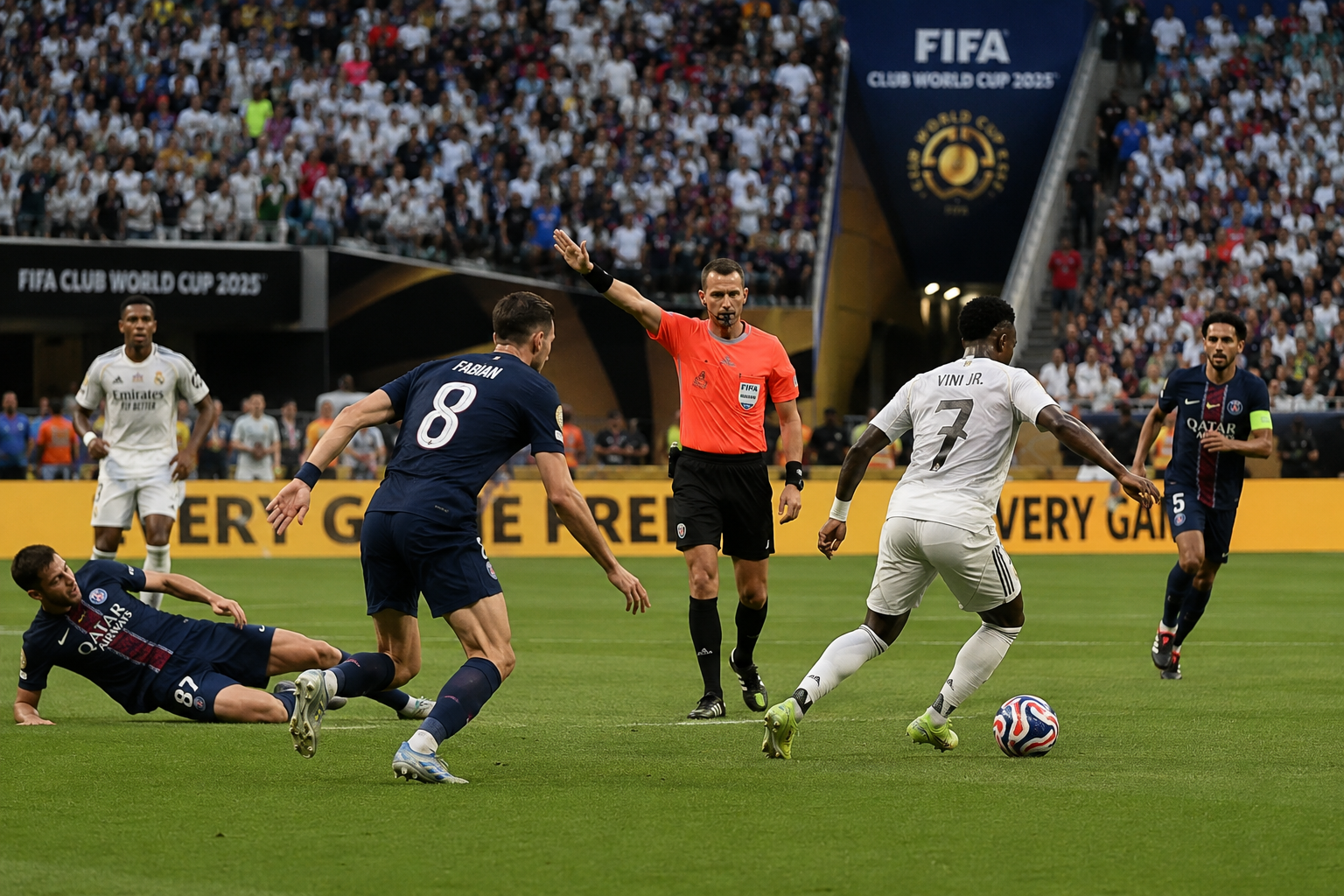
 If an offence is committed by an opposing player during a goal-scoring opportunity, no yellow card will be awarded if advantage is played and a goal is scored./AI ILLUSTRATION
Football fans across the world will be treated to a new set of rules during the 2026 World Cup as FIFA seeks to enhance the quality of the game that enjoys a huge global following.
The new rules, developed by the International Football Association Board (IFAB), are aimed at tackling discrimination, cutting time-wasting, enhancing match tempo and improving both player and fan experience.
Among the landmark amendments is the introduction of a 10-second time limit for players to leave the field of play when being substituted.
If the time limit is exceeded, the substitute cannot enter until the first stoppage after one minute has elapsed.
Players who receive assessment or treatment on the field of play, or who cause play to be stopped due to injury, must leave and remain off the field of play for one minute after play has restarted.
If an offence is committed by an opposing player during a goal-scoring opportunity, no yellow card will be awarded if advantage is played and a goal is scored.
During throw-ins, a five-second visual countdown will apply if a player or team delays taking the throw-in. If the time limit is exceeded, the throw-in is awarded to the opposing team.
Similarly, the referee will initiate a five-second visual countdown when a player or team delays taking a goal kick. If the time limit is exceeded, a corner kick will be awarded to the opposing team.
The referee may also award a corner kick if a goalkeeper holds the ball for too long or if a team delays taking its goal kick.
Amendments have also been made to the video assistant referee (VAR) protocol to rectify two infrequent but potentially match-changing errors.
These include the award of a red card resulting from a clearly incorrect second yellow card and cases of mistaken identity where the referee shows a yellow or red card to the wrong player of either team.
"The offence itself cannot be reviewed except in the context of mistaken identity," the amendments state.
Additionally, the centre referee has the option to review a clearly incorrectly awarded corner kick, including when the ball has gone out of play over the touchline, provided this is done immediately and without delaying the restart.
"If the corner kick is taken quickly, then the decision cannot be changed," the rules state.
Other changes include players being permitted to wear accessories such as jewellery, provided they are not deemed dangerous.
"The banning of jewellery created confrontation and had been inconsistently applied. It also overlooked cultural, religious, medical and personal reasons for wearing certain items. The focus is on non-dangerous items being allowed if safely and securely covered," IFAB said.
To further enhance fair play, IFAB has permitted FIFA the option of providing referees, assistant referees and fourth officials with body cameras as part of the technology to help referees make or change decisions.
On ball dropping, if play is stopped because the ball made contact with a match official or an outside agent, the ball will be dropped where the contact occurred.
Conversely, if the match is stopped for another reason, the ball will be dropped to the team that would have kept or gained possession had play not been stopped.
This means that if a game is halted after a tackle or because an off-ball player is lying injured while the ball is moving towards an opposing player, the ball will be dropped to the team that would have gained possession had the match not been stopped.
This advantage also applies to the team that would have taken the restart if the ball had gone out of play.
During penalties, IFAB clarified that if the taker accidentally kicks the ball with both feet simultaneously, or if the ball touches their non-kicking foot immediately after the kick, the penalty must be retaken if a goal is scored.
However, the automatic yellow card for the kicker has been removed if they commit an offence at the same time as the goalkeeper.
Previously, the penalty taker would be cautioned even if it was determined that the goalkeeper had also stepped off the goal line before the spot kick was taken.
The 2026 FIFA World Cup is jointly hosted across North America by three countries—the United States, Mexico and Canada—with matches taking place at 16 different stadiums.
As football fans around the world count down to the opening match between hosts Mexico and South Africa at the iconic Estadio Azteca in Mexico City on June 11, the tournament will also become the first to be played under new set of rules designed to make the game faster, fairer and more engaging for players, officials and supporters alike.











![[PHOTOS] The Star, Chinese Embassy host Kenya-China media dialogue](https://cdn.radioafrica.digital/image/2026/06/215e29cd-5ca2-4faf-bb4e-d1686b2c3dad.jfif)