
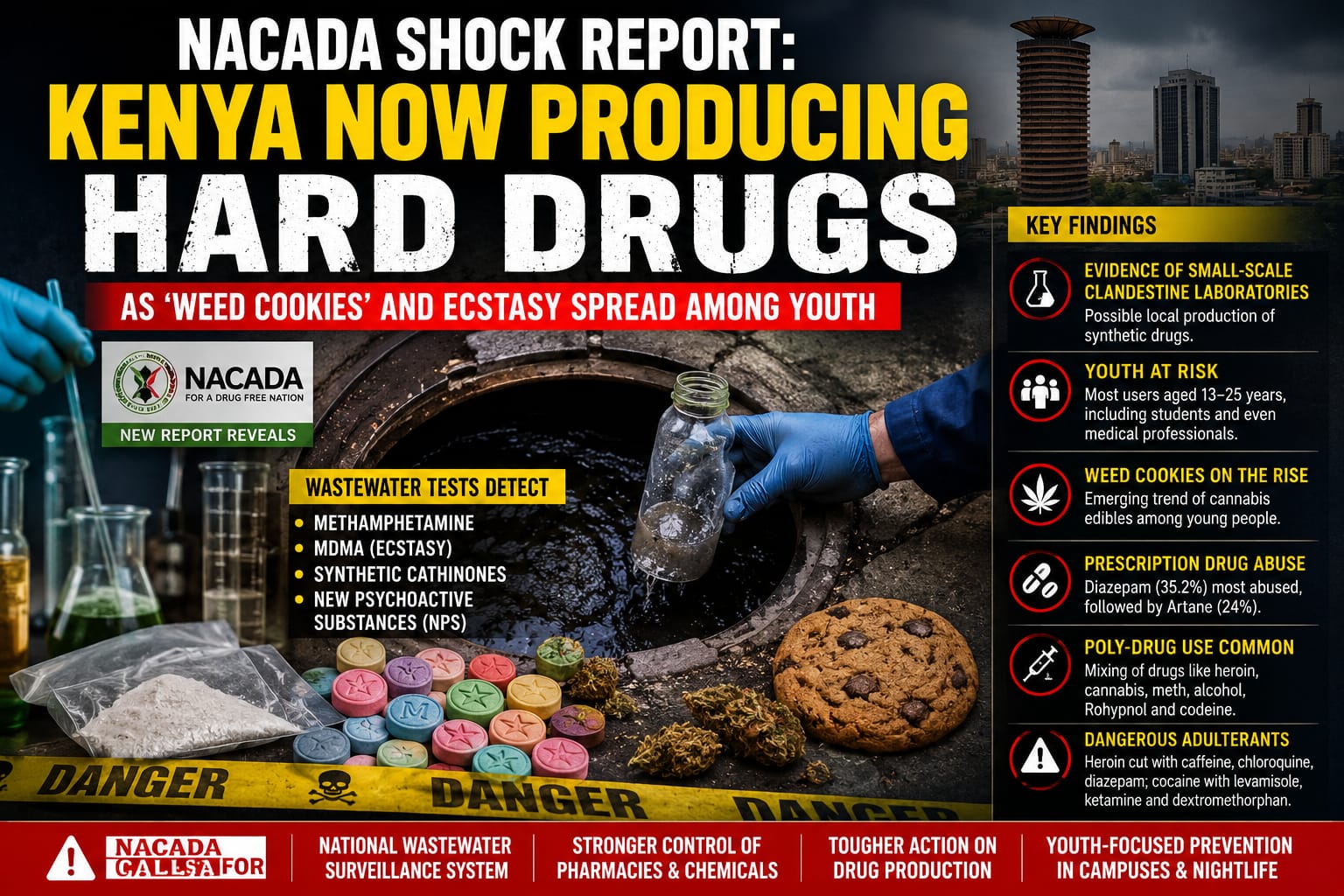
Kenya could be entering a dangerous new phase in the fight against drugs after a groundbreaking NACADA wastewater study revealed evidence of possible local production of synthetic narcotics and changing drug consumption trends among youths.
The study also uncovered rising abuse of prescription medicines and an emerging culture of “weed cookies”, ecstasy and methamphetamine, raising fears over the growing sophistication, accessibility and spread of illicit substances across the country.
The explosive findings, contained in a 75-page report are likely to trigger national debate over whether Kenya is quietly sliding into a sophisticated narcotics crisis previously associated with Latin America, Europe and parts of Asia.
For the first time, government agencies used wastewater collected from sewer systems in Nairobi, Mombasa, Nakuru, Kisumu and Eldoret to trace drug consumption patterns in communities, entertainment joints and urban hotspots.
What investigators found has alarmed anti-drug officials.
The report says laboratory analysis revealed “evidence of small scale clandestine laboratory activity” linked to the production of synthetic stimulants including methamphetamine, MDMA, commonly known as ecstasy, and synthetic cathinones.
In simple terms, the findings suggest that Kenya may no longer be just a transit route for narcotics, but could also be developing into a manufacturing point for synthetic drugs.
“The results indicate possible production of synthetic stimulants specifically methamphetamine, MDMA and synthetic cathinones,” the report states.
The study further detected new psychoactive substances (NPS) including alpha-ethyltryptamine, benzofurans and synthetic cathinones in Kenyan wastewater systems.
Investigators also identified emerging psychoactive substances such as methamphetamine, MDMA/ecstasy and tryptamine-based psychedelics including psilocybin and DMT.
The revelations come at a time when nightlife culture, campus parties and urban recreational drug use are increasingly becoming part of youth conversations on social media and in entertainment circles.
In another finding likely to spark public concern, the report says drug abuse is increasingly affecting teenagers, students and even medical professionals.
Data from focus group discussions showed that “most of the users were aged 13-25 years” and that the problem was “on the increase among students and medical professionals.”
The study covered 12 hotspot counties including Nairobi, Mombasa, Kisumu, Nakuru, Kiambu, Uasin Gishu, Nyeri, Isiolo, Kilifi and Garissa.
Investigators sampled wastewater near entertainment venues, drug dens and areas frequented by vulnerable populations including university students.
Perhaps the most surprising cultural shift captured in the report is the emergence of cannabis edibles.
Researchers found that besides smoking marijuana, users are now increasingly consuming “weed cookies”.
The trend mirrors what has been witnessed in parts of the United States and Europe where cannabis-infused foods have become fashionable among young users seeking discreet ways of getting high.
“Findings showed that the abuse of cannabis was widespread across all the sampled counties,” the report says.
“The study showed that besides the smoked cannabis, there was an emerging trend in the use of cannabis edibles. The identified cannabis edibles were mostly ‘weed cookies’.”
The report also documents an explosion in prescription drug abuse across the country.
Diazepam emerged as the most abused prescription drug at 35.2 per cent, followed by trihexyphenidyl, commonly known as Artane, at 24 per cent.
Amitriptyline and tramadol also featured prominently.
Prescription drug abuse was confirmed in nine of the 12 sampled counties including Nairobi, Mombasa, Kisumu, Garissa, Kiambu and Uasin Gishu.
The report warns that some prescription medicines are increasingly being used as “legal highs.”
Anti-drug experts are also likely to raise concern over the rise of poly-drug use, the mixing of multiple substances to intensify intoxication.
Among the combinations documented were heroin mixed with cannabis and tobacco, cannabis mixed with methamphetamine and hashish, methadone mixed with diazepam, and alcohol mixed with Rohypnol or codeine.
Some users reportedly referred to the heroin-cannabis-tobacco mixture simply as a “cocktail”.
Researchers said some heroin users were combining drugs partly because heroin had become expensive and unaffordable.
The study further found that heroin use, historically concentrated in Nairobi and the Coast, has now spread into non-traditional counties such as Nyeri, Nakuru, Kisumu, Isiolo and Uasin Gishu.
“Emerging trend shows that access to heroin has penetrated to other non-traditional counties,” the report says.
Another disturbing finding was that street drugs are increasingly being mixed with potentially dangerous substances.
The study found heroin samples cut with caffeine, chloroquine and diazepam, while cocaine samples contained levamisole, ketamine and dextromethorphan.
The report warns that such adulterants significantly increase the risk of overdose and toxicity.
In response to the findings, NACADA is now proposing establishment of a national wastewater surveillance and early warning system to monitor emerging drugs in real time.
The authority also wants stronger monitoring of pharmacies, tougher regulation of precursor chemicals used in drug manufacturing and enhanced anti-narcotics operations targeting clandestine laboratories.
The report further recommends targeted prevention campaigns in universities and nightlife settings amid fears that synthetic recreational drugs are gaining popularity among urban youth.
“This study is the first of a kind in Kenya,” the report notes, adding that wastewater analysis offers government agencies a powerful tool for detecting drug trends quickly before they spiral into a national public health crisis