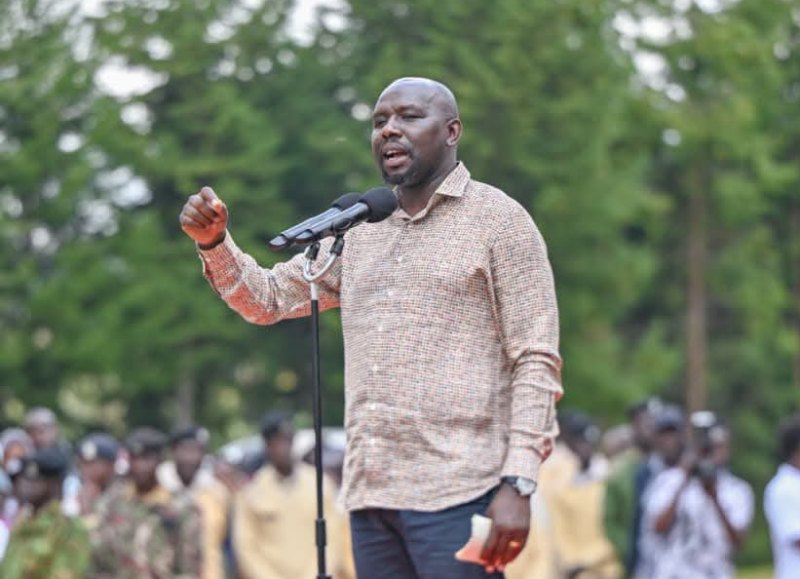
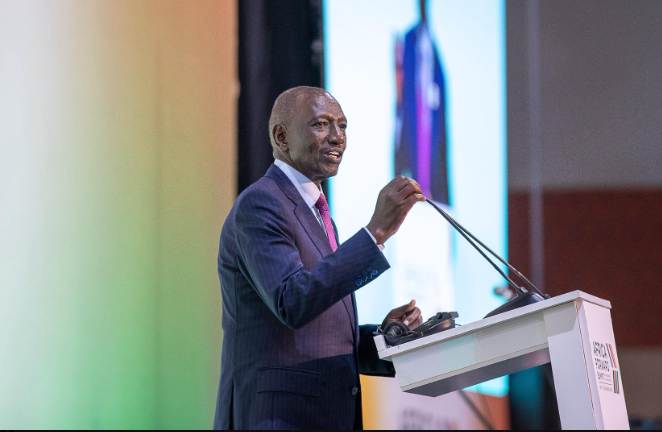
 President William Ruto speaking at Africa Forward Summit/ PCS
African leaders have adopted the “Nairobi Declaration” at the close of the Africa Forward Summit in Nairobi, outlining a new continental agenda anchored on financial independence, technology-driven growth and green industrialisation.
The declaration was unveiled by President William Ruto alongside French President Emmanuel Macron after two days of high-level discussions on Africa’s economic future and global partnerships.
Speaking on behalf of African heads of state, Ruto said the continent was shifting away from dependency on foreign aid and would increasingly mobilise resources through local financial institutions to fund development.
“Africa has immense resources and capacity. We are not
coming to beg for donations,” Ruto said.
“We are looking for mutual partnerships built on respect, investment and shared prosperity.”
Under the Nairobi Declaration, African countries have committed to strengthening regional financial systems and empowering African banks and development institutions to finance infrastructure, industrialisation, and social programmes.
The leaders also placed technology and youth empowerment at the centre of Africa’s transformation agenda, citing the continent’s rapidly growing young population as its greatest economic asset.
Africa currently has the world’s youngest population, with a median age of about 18 years, while projections show that one in every four people globally will be African by 2050.
Leaders say this demographic shift presents enormous opportunities for innovation, digital trade, manufacturing and labour-driven industries if governments invest heavily in education, skills and technology.
According to Ruto, the continent must now focus on creating jobs for millions of young people entering the labour market every year through investments in digital infrastructure, artificial intelligence, innovation hubs and entrepreneurship.
“Africa’s youthful population is not a burden; it is our biggest competitive advantage,” he said.
Energy transition emerged as the third pillar of the Nairobi Declaration, with leaders agreeing to accelerate investment in affordable and sustainable energy to drive industrial growth and food production.
The summit resolved to expand the use of green energy sources, including solar, geothermal, wind and nuclear power, to lower electricity costs and support sectors such as agriculture, manufacturing and transport.
African leaders have argued that access to reliable and affordable power remains critical to unlocking industrialisation and reducing poverty across the continent.
Macron, whose government announced a multi-billion-dollar investment push targeting Africa during the summit, said France was committed to a new relationship with Africa based on equality and mutual respect.
“We want a partnership anchored on respect and shared responsibility,” Macron said.
The French leader also announced that he had invited Ruto to attend the upcoming G7 Summit in June, saying developing economies must be included in global decision-making.
Macron noted that African nations often bear the heaviest economic consequences during global crises, including wars, climate shocks and disruptions in commodity markets, despite contributing the least to many of those challenges.
The Nairobi Declaration is expected to form the foundation
for future cooperation between African nations and global partners as the
continent seeks greater economic self-reliance and influence in global affairs.