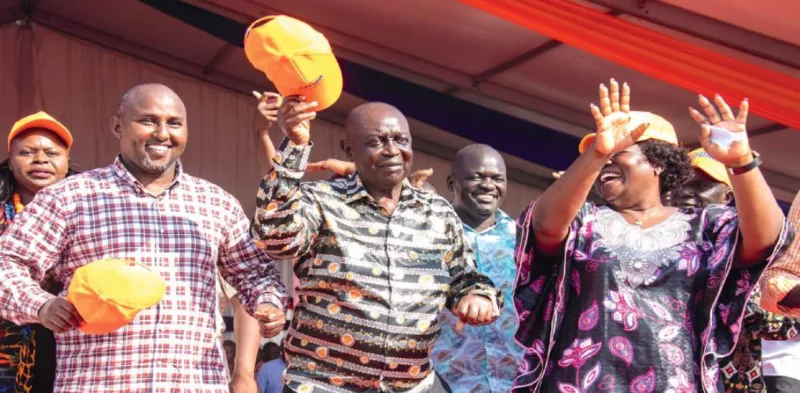
 Kiharu MP Ndindi Nyoro greeting residents of Kahuro shopping centre on March 9, 2026/ ALICE WAITHERA
Kiharu MP Ndindi Nyoro has cautioned the government against
raising fuel prices in the coming weeks, warning that Kenyans should not be
burdened with costs beyond global market trends.
The MP claimed that the government is hatching a plan to
have the Energy and Petroleum Regulatory Authority (EPRA) hike fuel prices
beyond international levels while blaming it on the ongoing war in Iran.
“We have seen what is happening in Iran, and the instability
there, but I want to tell the government and EPRA to work with the statistics,”
Nyoro said.
The war in Iran has rattled global energy markets, with
crude oil prices climbing back to levels last seen in 2022.
At that time, international prices were above $100 (Sh12,930)
per barrel, and they have currently returned to similar highs.
Instability in the Middle East often triggers spikes in oil
prices due to fears of supply disruptions, and the Iran conflict has already
caused volatility in global markets.
Nyoro argued that Kenya’s fuel prices should reflect actual
import costs rather than speculative increases tied to geopolitical events.
The legislator insisted that EPRA must account for the fuel
consignments already imported at lower prices before adjusting local pump
prices.
“EPRA, you know very well that when you increase fuel prices
in Kenya, you must first deplete the consignment that was imported at lower
prices”.
“So we don’t expect you to start deceiving Kenyans by
raising fuel prices because the fuel from the month of March up to April is
fuel that was brought into Kenya before global prices began to rise,” Nyoro
said.
He warned that any attempts to hike prices would be met with
opposition, calling instead for the removal of extra taxes imposed on the
commodity.
Nyoro reminded the government that Kenyans minimally
benefited when global oil prices dropped sharply in the past.
“When global oil prices dropped from $100 per barrel down to
even $54 per barrel, Kenyans barely felt the prices fall. They were only
reduced by one or two shillings. Why? Because in the first two years, the
government increased VAT on fuel from 8 percent to 16 percent,” he said.
He further noted that in 2024, immediately after protests,
the government introduced an additional fuel levy of Sh7 per litre.
“They timed it when global fuel prices were dropping, and
they added seven shillings. That seven-shilling fuel levy you added, together
with VAT—the time has come—you must remove it. Because you cannot transfer the
rising prices entirely to consumers,” Nyoro declared.
Nyoro said this while opening the Kahuro Assistant County Commissioner’s
office, where he faced resistance from local administrators who failed to attend
the event, with some reportedly claiming they had received “orders from above”
not to accept the office.
There were also attempts by police officers to stop the
event, saying they were acting on instructions from senior authorities. The
situation briefly caused tension before members of the local community pushed
back and allowed the event to proceed.
“The one who sent those police officers to start issuing
threats: next time, do not send people here. Next time, come yourself so we can
meet face to face,” Nyoro said defiantly.
Reports indicate that a very senior government official was planning to officially open the same office in the coming weeks, sparking speculation about political rivalry.