In a public notice on Friday, the Commission said it is seeking to fill
positions critical to strengthening the independence, accountability and
efficiency of the Judiciary in line with its mandate under Article 171 of the
Constitution.
The vacancies include Chief Kadhi, Registrar of the Judicial Service
Commission, Assistant Director ICT Security and Assistant Director ICT
Infrastructure.
Each position has one available slot.
Applicants are required to visit the JSC careers portal for full job
descriptions and instructions on how to submit applications.
The Commission emphasised that all applications must be filed through the
official portal at https://jsc.go.ke/jobs-2/
and received no later than 5 pm on February 5, 2026.
JSC reminded the public that its recruitment services are free,
cautioning applicants against fraudsters.
“Only shortlisted and successful candidates will be
contacted. Canvassing in any form will lead to automatic disqualification,” JSC
warned.
The Commission reaffirmed its commitment to fair competition, merit-based
selection and equal opportunity for all eligible applicants.
The Chief Kadhi's role is one of the most senior positions within the Kadhi
Courts, responsible for guiding the administration of Islamic law in matters of
personal status, marriage, divorce and inheritance.
The Registrar of the JSC serves as a key institutional administrator,
supporting the Commission’s operations, coordination and governance
responsibilities.
The two ICT positions focus on strengthening digital systems within the
Judiciary.
The Assistant Director of ICT Security will lead cybersecurity operations
and safeguard judicial digital infrastructure, while the Assistant Director ICT
Infrastructure will oversee the design, maintenance and reliability of the
Judiciary’s technology backbone.
Earlier, the JSC also declared a vacancy in the Office of Judge of
the Supreme Court, inviting qualified legal professionals to apply for the
position.
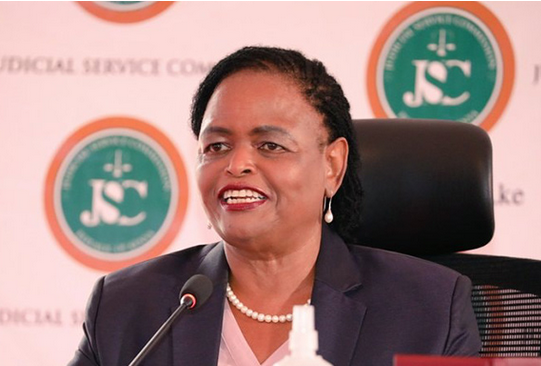
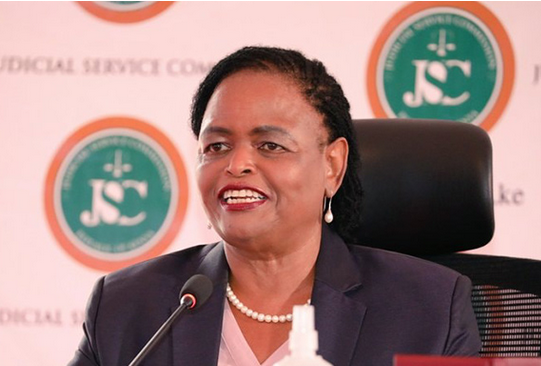
In a special Gazette Notice, Chief Justice Martha Koome said the successful
candidate will serve until the mandatory retirement age of 70, with an option
for early retirement at 65 as provided under the Constitution.
The Gazette outlined the jurisdictional mandate of the
Supreme Court, which includes exclusive authority to hear and determine
disputes relating to presidential elections under Article 140.
The Court also hears appeals from the Court of Appeal
and other tribunals as permitted by law.
Additional functions include issuing advisory opinions
at the request of national and county governments and addressing applications
arising from emergencies.
In the notice, applicants were asked to ensure they meet the constitutional and
statutory requirements.
They are required to hold a law degree from a
recognised university, be advocates of the High Court of Kenya or possess an
equivalent qualification from a common-law jurisdiction.
Candidates must also demonstrate extensive legal
experience.
This includes at least 15 years as a superior court
judge, or 15 years as a distinguished legal practitioner with relevant
experience.
Alternatively, an applicant may combine legal practice
and judicial service, provided the total experience amounts to not less than
fifteen years.
The Gazette further highlighted the need for
applicants to meet the integrity standards set out in Chapter Six of the
Constitution.
They must demonstrate high moral character,
impartiality, good judgment and a commitment to public service.
Chief Justice Koome noted that candidates must also
show strong professional competence, communication skills, fairness, and a wide
breadth of legal and life experience.
The JSC emphasised that the application process would
be open and competitive, with detailed instructions available on its official
portal.








![[PHOTOS] Ruto pushes for stronger Kenya-EU economic ties in Brussels](https://cdn.radioafrica.digital/image/2026/06/3aebc395-285b-441c-8aa4-33cb538f8d44.jpg)