Fire Breaks Out, Disrupts Operations Along Luthuli Avenue
5mon agoadminvideo
Fire crews were forced to contend with toxic fumes from burning batteries as well as highly flammable fabrics.


Audio By Vocalize
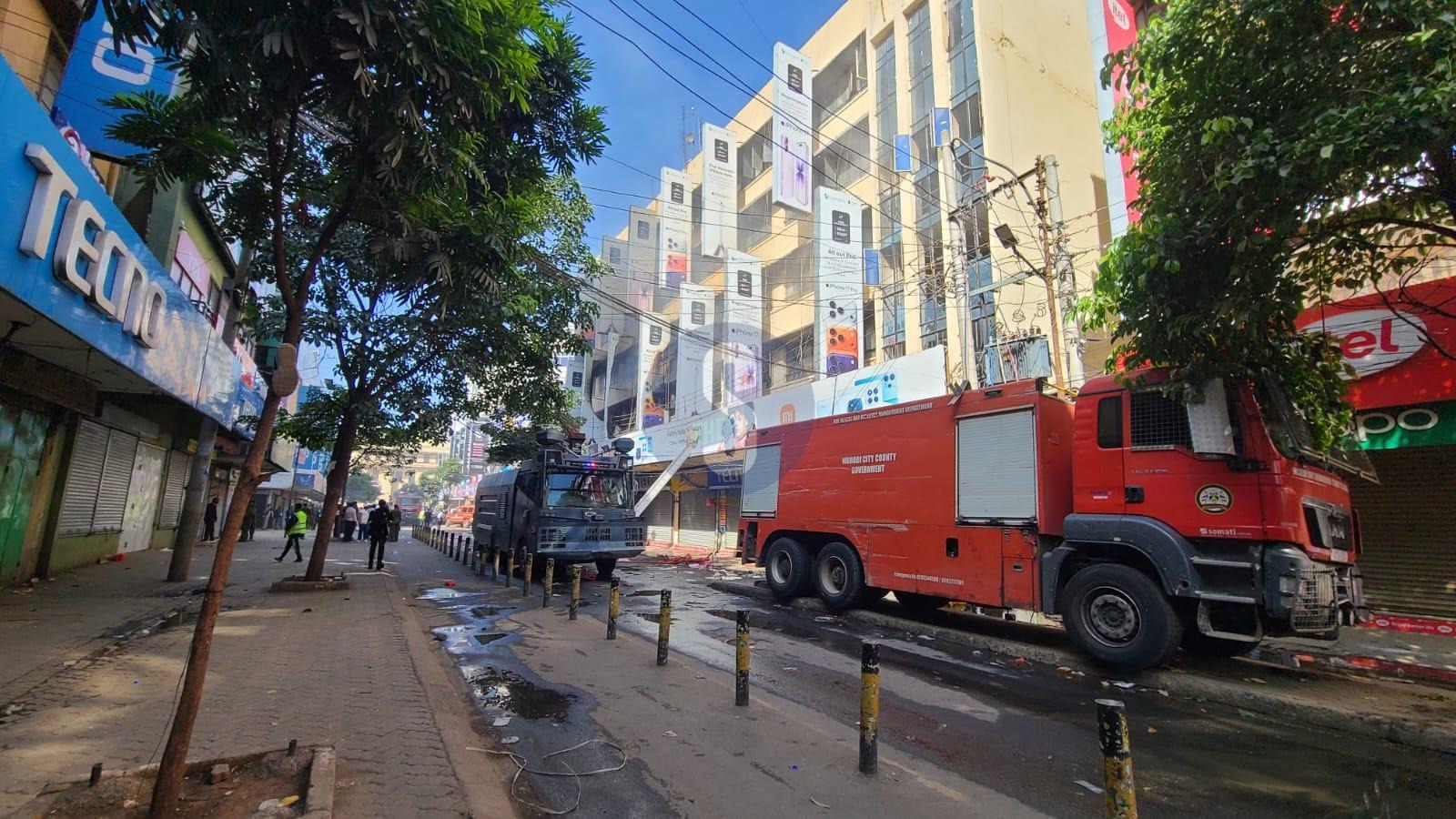
Firefighters have cited structural challenges and welding
activities as key factors behind the fire that broke out at Ramogi House along
Luthuli Avenue in Nairobi’s central business district, with authorities
confirming that the blaze was contained to one floor.
Nairobi County Assistant Director of Fire Services Wilson
Wanjiru said the biggest challenge during the operation was the building’s
design, particularly the presence of only one exit, which complicated access
and evacuation during the firefighting effort.
“The biggest challenge was the building having one exit. If
you have one exit there is humidity and a lot of heat and that is a very big
challenge in firefighting,” Wanjiru said, explaining that limited ventilation
and access significantly hindered operations.
He added that the nature of businesses operating on the
affected floor further escalated the risk. According to Wanjiru, two shops were
located at the epicentre of the fire — one dealing in textiles and another
selling mobile phone accessories and batteries.
“Another challenge is that we had two shops, one with
textiles and another with accessories for mobile phones and batteries,” he
said. “The batteries emit very toxic gases and the fabrics, but we were able to
control that.”
Fire crews were forced to contend with toxic fumes from
burning batteries as well as highly flammable fabrics, conditions that required
careful handling to prevent further spread and protect emergency responders.
Despite these challenges, Wanjiru said firefighters managed to bring the
situation under control.
He disclosed that the ignition point was traced to the
textile shop, which was not immediately accessible to responders at the onset
of the fire.
“All in all, the fabric shop had a very big problem because
they did not allow us to open it first and that’s where the ignition came
from,” Wanjiru said.
According to the fire services department, only one floor of
the building was affected by the blaze, with firefighters successfully
preventing the flames from spreading to other levels.
“Only one floor is affected, the other floors we were able
to contain,” Wanjiru said.
He noted that the swift containment helped minimize losses
to neighbouring businesses, many of which managed to salvage their goods before
the fire intensified.
“Initially, neighbouring shops were able to salvage their
goods except for the two affected,” he said.
Preliminary findings indicate that the fire was caused by
welding work being carried out within the building. Authorities are now warning
business owners and contractors to strictly observe safety protocols when
undertaking such activities in occupied commercial premises.
“The initial fire was caused by someone who was doing
welding,” Wanjiru said.
The incident has renewed concerns about fire safety
compliance in Nairobi’s older commercial buildings, particularly along busy
trading streets such as Luthuli Avenue, which host densely packed shops and
storage spaces.
Fire officials say building designs with limited exits,
combined with hazardous commercial activities, significantly increase fire
risks.