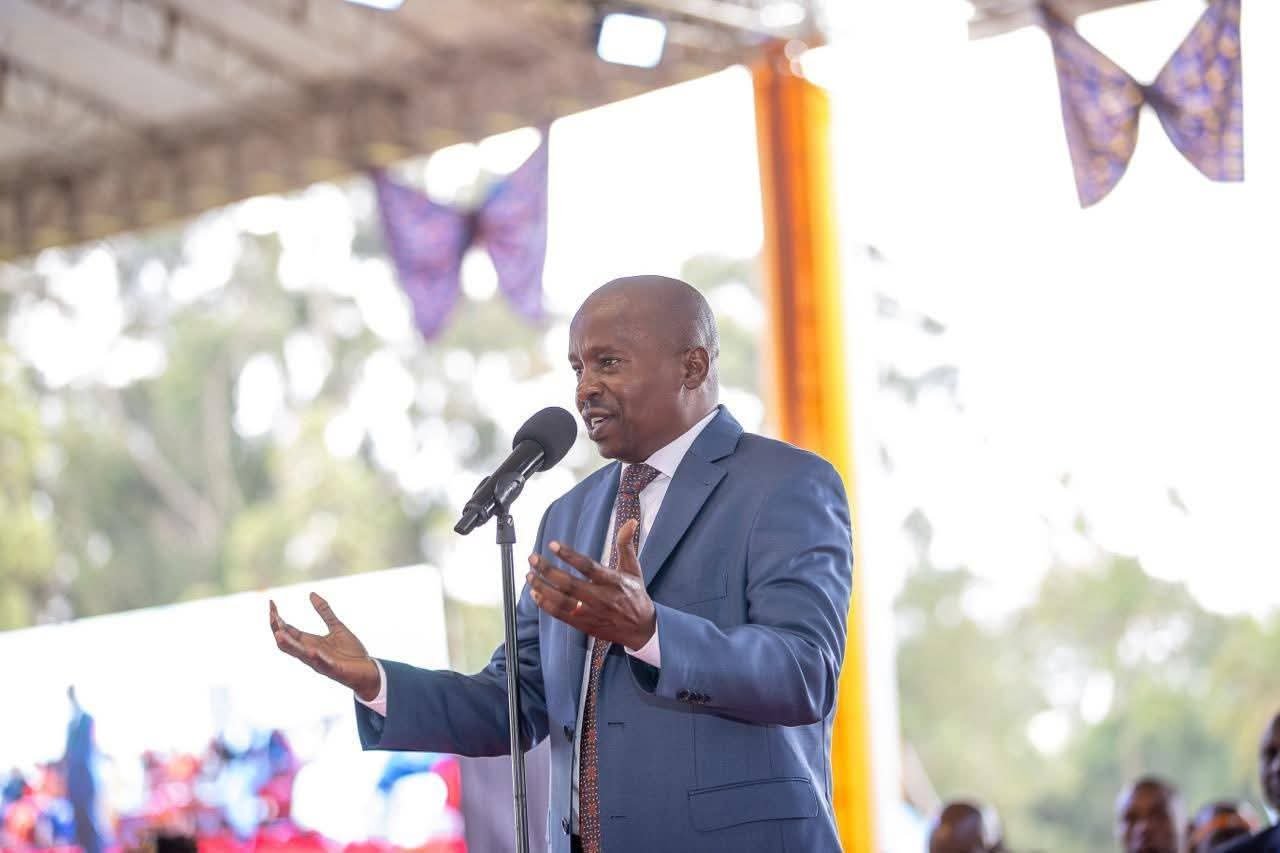
 Deputy President Kithure Kindiki during the International Minorities Rights Day aat the State House on December 19, 2025/ PCS
Deputy President Kithure Kindiki has
responded to recent pessimistic comparisons between Kenya and Singapore,
asserting that dismissing the former’s potential based on Asian city’s small
size is misplaced.
Kindiki’s statement comes at a time
when Singapore, a city-state covering just 735 square kilometers, has been held up as a development model by
the William Ruto - administration.
The DP, however, stressed that Kenya’s
ambitions should not be limited to comparisons with Singapore alone, pointing
out that the country’s first world goals draw inspiration from multiple Asian nations, not just one.
“Pessimistic comments about
Singapore being a tiny 735 square kilometer city-state incomparable to Kenya
should know that Kenya’s first world ambition is modeling on a few more Asian
countries besides Singapore,” he said.
“China, a 9.6 million square
kilometer mega country of 1.5 billion people (compared to Kenya’s 582, 646
square kilometer area and 55 million people) is almost 17 times larger than
Kenya.’
Using China as an example, Kindiki
highlighted how a vast nation of 9.6
million square kilometers and 1.5 billion people transformed itself
within a generation.
“China’s turning point was 1978,” he
said, referring to the start of economic reforms and opening-up policies.
“In just 40 years, it moved from
being poor and isolated to achieving first world status.”
By contrast, Kenya has a land area
of approximately 582,646 square
kilometers and an estimated population of 55 million people.
Kindiki argued that size and
population should not be barriers to development, pointing out that countries
of different scales have successfully pursued transformative economic agendas.
“Kenya will transition to the first
world in our lifetime,” the Deputy President said, reaffirming the government’s
commitment to long-term structural reforms and investment in key sectors of the
economy.
The DP noted that in 40 years, between
1981 and 2020, China lifted 800 million of its citizens from
poverty, accounting for 75 percent of overall global poverty reduction.
“That is roughly 200 million people lifted
from poverty every 10 years. As of 2022, 20 million people in Kenya, 40 percent
of the total population, live in poverty,” he added.
Kindiki expressed confidence that “it is
possible to reduce this number by 10 million every 10 years, making our poverty
eradication journey complete in 20 years”.
His remarks come amid ongoing
national debates about development strategies and the relevance of
international benchmarks.
He emphasised that while Singapore’s
achievements are noteworthy, Kenya’s path to prosperity will be informed by a
broader set of global examples, tailored to the country’s unique context.
The Deputy President’s statement
seeks to reassure citizens and stakeholders that Kenya’s development trajectory
remains ambitious and achievable, despite challenges and scepticism.
On Thursday, former Chief Justice
David Maraga argued that it was “dangerous” to portray Kenya as being on a Singapore-like trajectory,
saying the foundations that enabled the country’s rise are absent in Kenya
today.
He stated that Singapore’s success was not built on
slogans or public relations but on discipline, integrity and leadership that
treated corruption as an existential threat.
“First, ruthless anti-corruption discipline. In Singapore, corruption ended
careers and destroyed reputations, regardless of rank. Ministers were
investigated, prosecuted and removed without hesitation,” he said.
Maraga added that this approach was reinforced by
fiscal restraint, long-term planning, a lean and merit-based government, zero
tolerance for waste, and a focus on domestic wealth creation rather than
exporting labour.
“Second, fiscal restraint and long-term planning.
Singapore treated debt as a tool of last resort, not a governing strategy,”
Maraga added.
“For decades, it ran prudent budgets, accumulated
national reserves, and funded development from productivity and savings rather
than perpetual deficit financing, a stance repeatedly highlighted in IMF and
World Bank assessments of its macroeconomic framework.”