

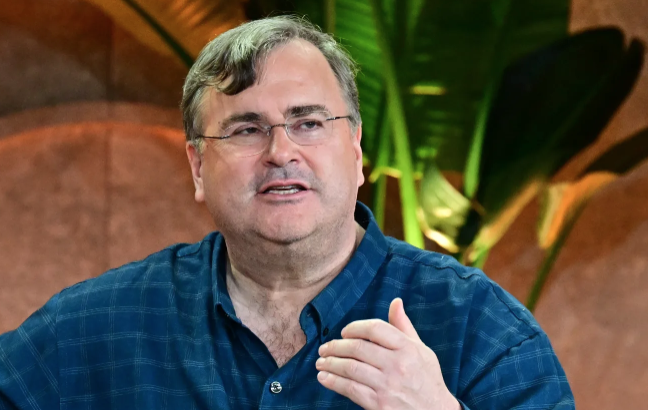
 LinkedIn co-founder and venture capitalist Reid Hoffman/SCREENGRAB
Reid Hoffman is best known as the co-founder of LinkedIn, the professional networking platform that transformed how people connect, hire and build careers across the globe.
But beyond Silicon Valley success and personal wealth, the billionaire entrepreneur is now channeling his influence, capital and technological insight into one of humanity’s most complex challenges; curing cancer using artificial intelligence.
“My current priority is investing in and building with AI to
benefit humanity,” Hoffman said in one of his recent posts, a statement that
captures the arc of his career, from building powerful networks of people to
creating intelligent systems capable of accelerating scientific discovery.
Hoffman became a billionaire after co-founding LinkedIn in 2003, a platform that grew into the world’s largest professional network with more than one billion members.
Microsoft acquired LinkedIn in 2016 for $27 billion, cementing Hoffman’s place among the most successful technology founders of his generation.
But LinkedIn was only one chapter in a career defined by spotting transformative ideas early and helping them scale rapidly.
Before LinkedIn, Hoffman served as executive vice president at PayPal, where he was a founding board member and managed the company’s external relationships.
As an investor and partner at venture capital firm Greylock, which he joined in 2009, he made early and lucrative bets on companies such as Facebook, Airbnb and Zynga, while also backing cutting-edge ventures including nuclear fusion startup Helion Energy and autonomous vehicle firm Aurora.
In recent years, Hoffman’s focus has increasingly shifted toward artificial intelligence.
He was an early investor in OpenAI when it was still a nonprofit research lab and later co-founded Inflection AI in 2022 alongside DeepMind co-founder Mustafa Suleyman.
Inflection aims to create AI systems that make it easier for humans to communicate with computers, reinforcing Hoffman’s long-standing interest in technology that amplifies human agency.
Now, that interest has taken a deeply personal and societal
turn with the launch of Manas AI, a healthcare startup focused on accelerating
drug discovery for cancer.
Hoffman co-founded Manas with Dr. Siddhartha Mukherjee, a renowned oncologist and Pulitzer Prize-winning author of The Emperor of All Maladies, widely regarded as one of the most authoritative chroniclers of cancer’s history.
“Most people have had friends, family members, etc., who’ve died from cancer or had serious cancer problems,” Hoffman told CNBC in a recent interview. “If we can make a huge difference on this, and this is the kind of thing that AI can make a huge difference in, it’s the kind of reason why AI can be great for humanity.”
Hoffman describes healthcare as both “wondrous and terrifying,” reflecting the promise of medical breakthroughs alongside the staggering complexity and cost of developing new treatments.
According to a Deloitte report, bringing a single new drug to market can take more than a decade and cost billions of dollars. Manas AI aims to dramatically compress that timeline.
The company plans to use proprietary chemical libraries and AI-powered filters to identify promising drug candidates faster and more accurately than traditional methods.
Its initial focus is on aggressive and hard-to-treat cancers, including prostate cancer, lymphoma and triple-negative breast cancer.
By applying machine learning to massive datasets, Manas hopes to reduce what has historically taken decades into a process measured in years.
Manas AI has already raised $24.6 million in seed funding, led by General Catalyst and Hoffman himself, with participation from Greylock.
The startup has also entered into a strategic partnership with Microsoft, leveraging the tech giant’s Azure cloud-computing platform.
Hoffman said Manas is deploying several advanced Microsoft tools, including some not yet available to the public.
The partnership reflects Hoffman’s enduring ties to Microsoft following the LinkedIn acquisition, as well as his belief that large-scale AI research requires robust computing infrastructure.
He revealed that he and Mukherjee have been working on Manas for about a year, with momentum accelerating in recent months as the foundational scientific and technical resources fell into place.
Beyond entrepreneurship, Hoffman is widely regarded as one
of the most influential thinkers in technology and business.
He is a frequent public speaker, known for his ability to explain complex ideas with clarity and approachability.
He has authored or co-authored six best-selling books, including Blitzscaling, The Startup of You, The Alliance, Masters of Scale, Impromptu and most recently Superagency: What Could Possibly Go Right with Our AI Future.
He also hosts two popular podcasts, Masters of Scale and Possible, where he explores how bold ideas shape the future.
Born and raised in California, Hoffman earned a bachelor’s degree with distinction in symbolic systems from Stanford University before completing a master’s degree in philosophy at Oxford University as a Marshall Scholar.
His academic background, blending technology, cognition and philosophy, has profoundly shaped his thinking about networks, human behavior and ethical innovation.
His philanthropic work mirrors his business philosophy. Hoffman serves on several non-profit boards, including Endeavor, the Stanford Institute for Human-Centered AI, the Berggruen Institute and the MacArthur Foundation’s Lever for Change.
He has received numerous honours for his contributions, including an honorary Commander of the Order of the British Empire (CBE) and the Salute to Greatness Award from the Martin Luther King Jr. Center.
With Manas AI, Hoffman is betting that artificial intelligence can do more than optimize businesses or automate tasks.
It can, he believes, fundamentally change how humanity confronts disease. If successful, the effort could redefine drug discovery—and mark the most consequential chapter yet in the career of a man who has spent decades building networks to shape the future.