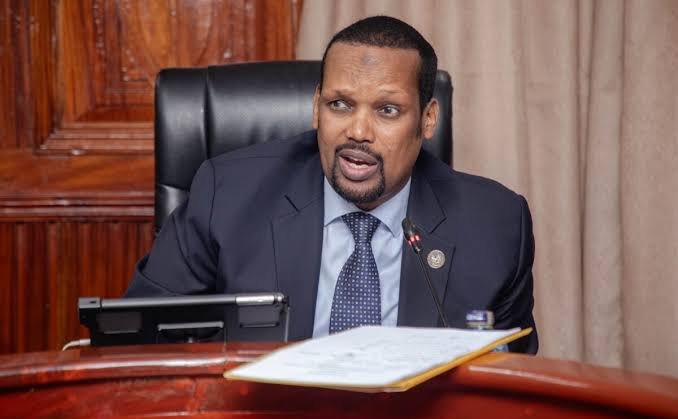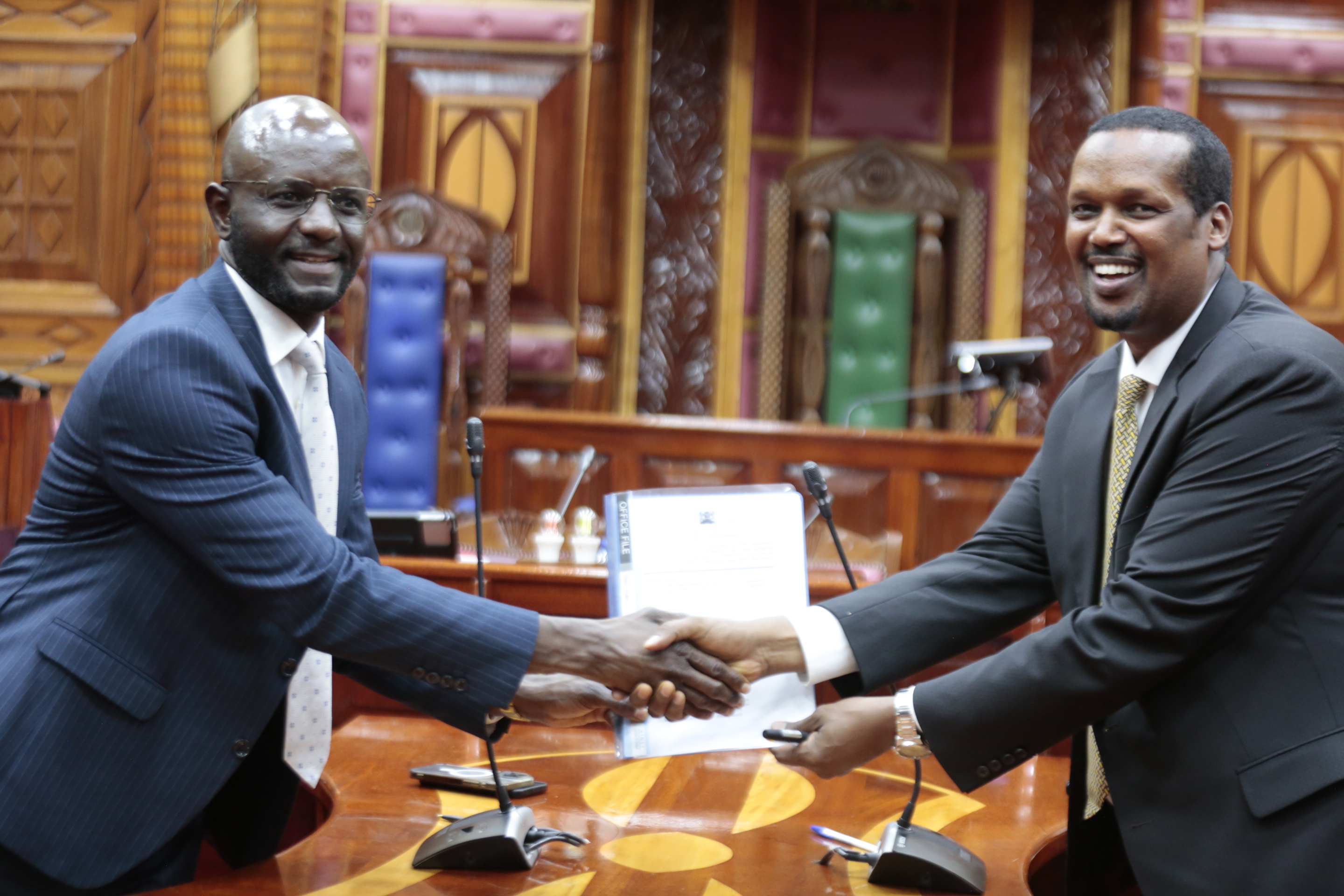
 Education Cabinet Secretary Julius Ogamba announcing the Kenya Junior School Education Assessment (KJSEA) results at Mitihani House in Nairobi, Thursday, December 11, 2025./EDUMIN
When Education Cabinet Secretary Julius Ogamba on Thursday announced the Kenya Junior School Education Assessment (KJSEA) results at Mitihani House in Nairobi, the figures were 151,691 fewer than the expected candidature.
The rollout of the Competency-Based Education (CBE) system in January 2017 produced the first cohort of 1,282,150 pupils who sat the inaugural Kenya Early Years Assessment (KEYA) in 2019.
KEYA, administered in Grade 3, is a national school-based assessment covering English, Mathematics, and Integrated Learning.
KNEC provides assessment tools digitally or in PDF format for teachers, who evaluate learners and upload the scores.
Three years later, the same cohort sat the Kenya Primary School Education Assessment (KPSEA) at Grade 6 in 2022.
In January 2020, the government issued a decree introducing the 100 per cent transition policy, making it mandatory for all primary school graduates to enrol in secondary school to guarantee 12 years of continuous basic education.
Despite this, the number of KPSEA candidates dropped by 2.23 per cent to 1,253,577.
KNEC data shows that while the number of girls increased slightly by 1.11 per cent—from 604,522 in 2019 to 604,964 in 2022—the number of boys declined by a similar percentage margin, from 677,628 to 648,613.
On Thursday, when Ogamba stood on the steps of Mitihani House, he announced the results of 1,130,459 candidates who sat the KJSEA.
This represented an 88.17 per cent transition rate from the initial KEYA cohort of 1,282,150 learners.
The statistics now raise questions about the whereabouts of 151,691 pupils who registered for early primary education but did not transition to senior school for Grades 10, 11, and 12—the final phase of basic education under CBE.
Notably, the number of girls who transitioned from Grade 6 to Grade 9 dropped by 53,135, while the decline among boys was even more pronounced at 69,922 over the four-year period between 2022 and 2025.
The results released by Ogamba also showed that girls outperformed boys in 10 of the 12 learning areas under CBE.
For example, of the 29,219 candidates who exceeded expectations in English (8 points), 17,328 were girls compared to 11,891 boys.
Girls also surpassed boys in Kiswahili, Agriculture, Mathematics, Kenya Sign Language, Integrated Science, Social Studies, Christian Religious Education, Creative Arts and Sports, and Pre-technical Studies.
It is expected that the Grade 10 learners will report to their respective schools starting from January 12, 2025.
Their placement in senior schools will be guided by the learner’s performance and the selected pathway.