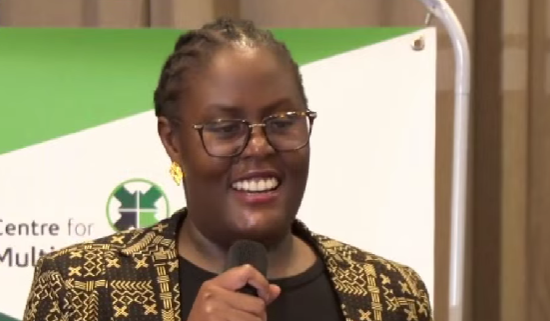
EALA MP Winnie Odinga has paid a politically pointed tribute to her father, the late Former Prime Minister Raila, saying his lifelong example taught her what leadership means.
The EALA MP said that he learned from Baba, leadership is rooted in courage, public service and an unwavering belief in human dignity.
Speaking during International Human Rights Day, Winnie said Raila embodied a rare mix of authority and warmth that shaped her understanding of leadership.
“In honouring Baba, as we fondly call him, we remember that he had a rare quality of being both profound and approachable. He could challenge a dictator and charm a drunken cat, all in the same breath. Sometimes I thought he had a hidden career as an acrobat because he moved effortlessly from an office meeting to dancing on stage within minutes,” she said.
According to Winnie Raila’s political legacy, showed and he believed that change begins where fear ends.
“Baba taught us that passion can shake political history and that democracy is not just a system but a way of life. He always insisted that leadership comes from the will of the people, not the will of its leaders. He said leadership isn’t about a title, it’s about showing up every day, fighting for what is right and lifting others as you climb,” she said.
She defended Raila against critics who labelled him radical, saying she prefers to call him a dreamer.
“He dared to walk where others hesitated because he envisioned a future where no one was left behind. That spirit is what we must carry forward,” she said.
Winnie also shared a light moment involving Raila’s standoff at the DCI headquarters, saying his humour under pressure reflected his philosophy of leadership.
“I watched a video of him being denied entry at the DCI office. He turned the moment into a soap opera, raising his eyebrow, asking ‘why not,’ and then staging a charming protest. Later, he laughed about it and reminded us that you must learn to laugh at yourself. His mantra was always: Procedure first, pressure second, then action,” she said.
She argued that Kenya’s governance challenges need the same blend of seriousness and humour and urged dialogue between generations rather than political factions.
“Our institutions sometimes work like a family during a heated dinner, lots of shouting, some staring, and eventually someone storms off. People fear change like they’re guarding the last piece of cake at a birthday party. But just a sprinkle of Baba’s humour can turn conflict into a friendly game,” she said.
Winnie emphasised that her father’s teachings remain a compass for navigating Kenya’s turbulent political moment.
“What I learned from Baba is that change is possible, but it demands courage, resistance and a sense of humour. That is the leadership we must fight for,” she said.
Winnie used the platform to call out what she described as a widening generational rift in the country, arguing that young people are eager to participate meaningfully but are routinely shut out.
“We joke about our social divisions, but beneath them lie serious tensions. Young people are not being allowed to define their future, while older generations keep shifting the goalposts. We are living through a crisis of generations, a crisis of culture, and even a crisis of tradition versus technology,” she said.
She criticised persistent gender disparities, saying societal reactions to leadership differ sharply depending on who asks the hard questions.
Winnie reflected on the pressures facing Kenyan youth who simultaneously occupy two worlds: physically rooted in Kenya but digitally connected to global ideals. She noted that older generations often underestimate their abilities.
“When you have a problem at home, you ask the young person to fix it in one minute, and they do. But it irritates them because that’s not all they are good for. They can do a lot in one minute. We just need to give them more space,” she remarked.