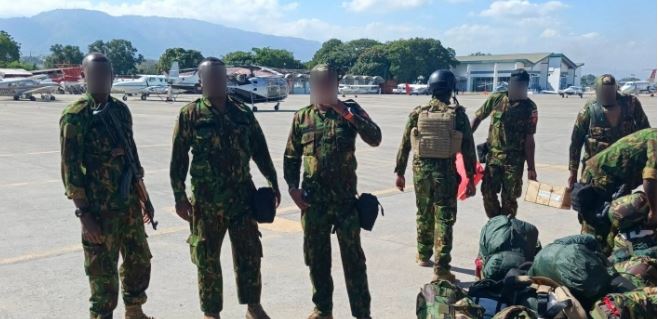
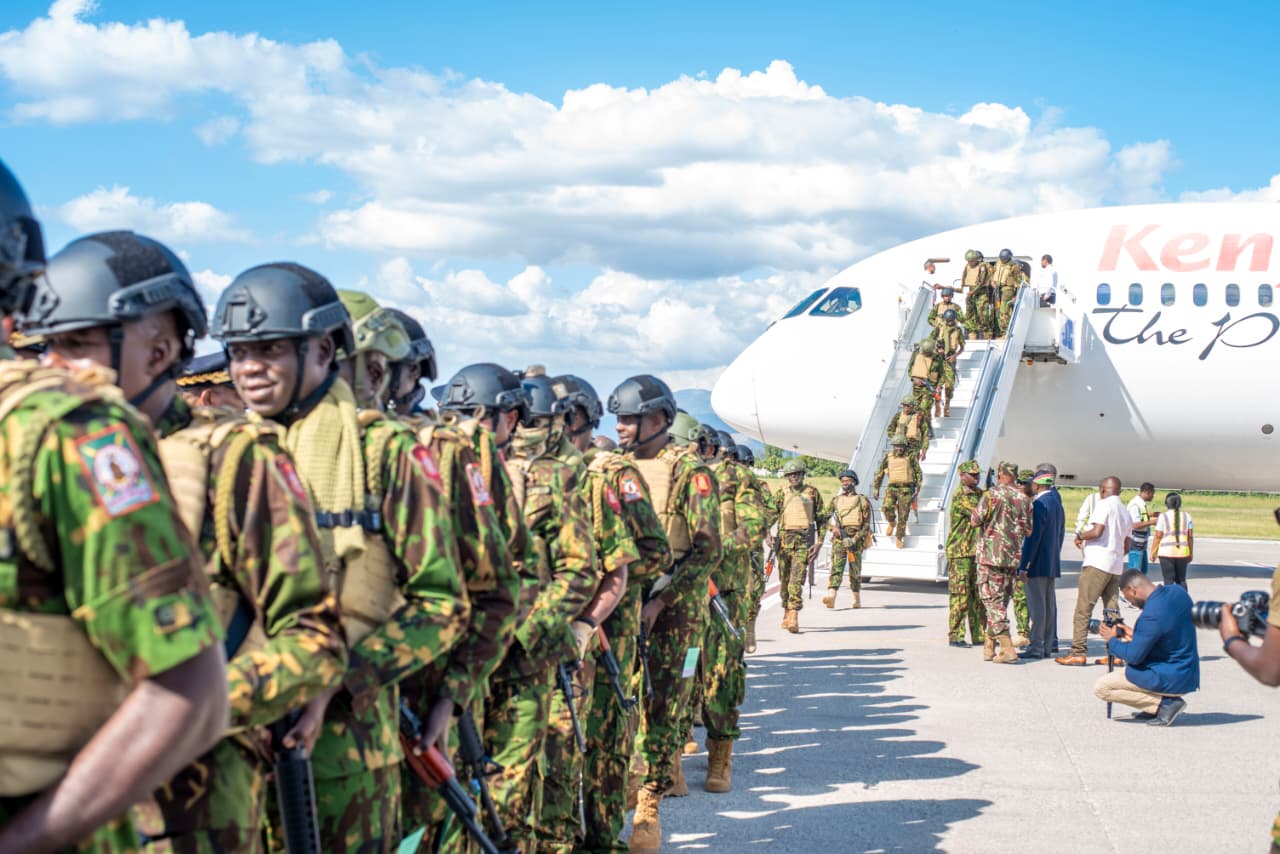
The Kenyan-led Gang Suppression Force (GSF) received a major boost on Monday with the arrival of a fifth contingent of 230 specialised police officers.
The team reinforced international efforts to
restore security in Haiti amid ongoing gang violence, even as more than 100
others departed Port-au-Prince after completing their tour.
More will leave Haiti in the coming days after the new team is properly oriented, officials revealed.
Speaking at Toussaint Louverture International
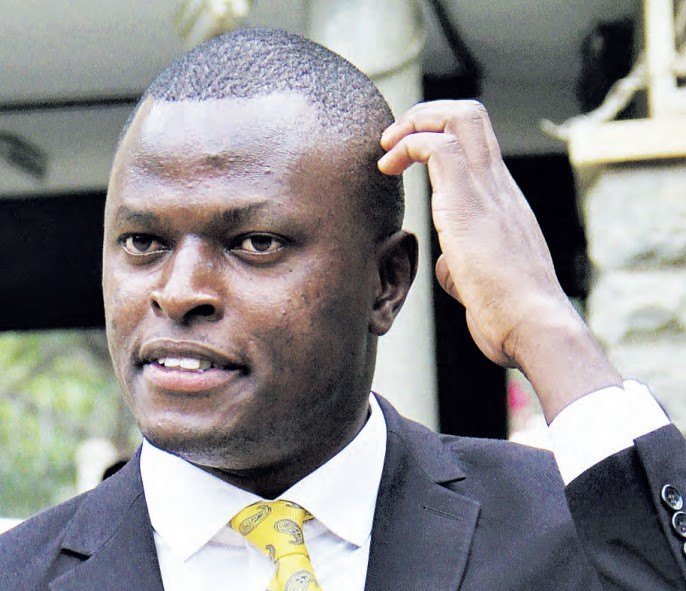
Airport during the official reception ceremony, GSF Force Commander Godfrey
Otunge hailed the deployment as a strong signal of Kenya’s long-term commitment
to stabilising Haiti and supporting the Haitian National Police (PNH).
“Kenya stands with Haiti—for as long as it
takes—until peace prevails,” Otunge said, emphasising that the new contingent
arrives after the expansion of the GSF mandate on October 3, 2025.
The deployment brings the total number of Kenyan
officers serving in Haiti to more than 700, making Kenya the largest
contributor to the multinational security mission.
Kenyan officers first arrived in June 2024, marking the launch of the earlier Multinational Security Support (MSS) mission.
Since then, four additional rotations have
supported joint operations with the PNH, particularly in the West and
Artibonite Departments—areas heavily affected by gang activity.
The new team landed aboard a Kenya Airways flight and was accompanied by Deputy National Security Adviser Joseph Boinnet.
At Monday’s ceremony, Otunge also announced that about 100 Kenyan officers from the pioneer contingent will soon return home after completing their tour of duty.
He praised them for their service, describing
their contribution as “honourable, resilient, and unwavering.”
He noted that the transition from MSS to the newly
established GSF had initially raised concerns among observers and gang
networks, who expected a leadership vacuum.
“Instead,” he said, “the GSF has emerged more
focused, better coordinated, and better resourced.”
The ceremony also highlighted the role of other
contributing countries, including
The Bahamas, Jamaica, El Salvador, and Guatemala which have pledged continued support to strengthen the GSF.
Otunge expressed gratitude to the Haitian
Government, the PNH leadership, and international partners whose logistical,
financial, and operational support he said had enabled “well-synchronised
operations that have dealt significant blows to the gangs tormenting this
nation.”
He also paid tribute to PNH and GSF officers who
have died in the line of duty. “Their courage reminds us that the price of
peace is high—but it is a price we are prepared to bear so Haiti may reclaim
its rightful place as a strong, safe, and thriving nation,” he said.
Addressing the Haitian public directly, Otunge
urged citizens to remain hopeful and assured them that the mission would
continue until security is fully restored and conditions allow for “free, fair,
and credible national elections.”
“We will win this fight. We will defeat those who
have held communities hostage for far too long,” he said, calling on gang
members to surrender and submit to state authority.
The arrival of the fifth Kenyan contingent marks
the latest phase in the international effort to strengthen Haiti’s security
institutions as the country continues to battle entrenched gang networks,
chronic instability, and a longstanding humanitarian crisis.
The first contingent, comprising 400 officers, and
the second, made up of 200 personnel, were drawn from a cross-section of elite
Kenyan police units, including the General Service Unit (GSU), the Anti-Stock
Theft Unit (ASTU), and the Rapid Deployment Unit (RDU) of the Administration
Police.
Their professionalism and discipline have been
widely recognised by both Haitian authorities and international partners.
The officers’ return follows a new UNSC resolution
transitioning the UN mission into a specialised Gang Suppression Force (GSF).
On Thursday December 4, US Secretary of State
Marco Rubio praised the role the Kenyan team has played in stabilizing the
country. This was after he met president Ruto in Washington DC to
discuss the team’s operations among other issues.


![[PHOTOS] Uhuru graces commissioning mass of Catholic Women](https://cdn.radioafrica.digital/image/2026/06/0bbd7e96-f180-4e02-966f-97c3fb201478.jpg)