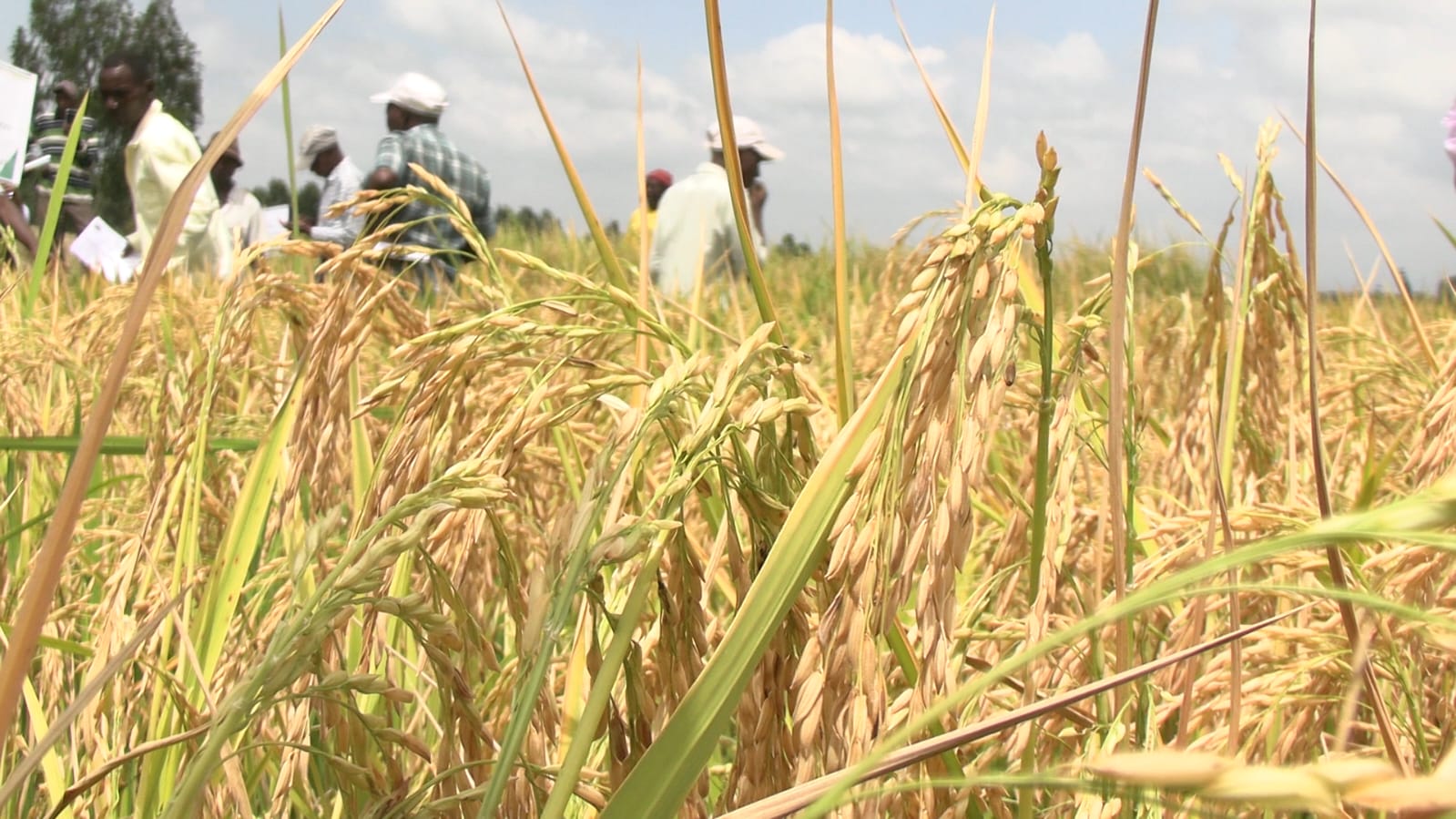
 The new varieties of rice at Kalro, Mwea /ALICE WAITHERA
The Kenya Agricultural and Livestock Research Organisation has introduced four new high-yielding rice varieties to enhance rice production and cut imports.
In partnership with other stakeholders, the research agency has rolled out Kalgold, Kalpaa, Kalfine and Kal-Imara, which are known for high harvests, to bridge the gap in rice production.
Local rice farmers produce 23 per cent with the state forced to import the rest to stem shortages and stabilise rice prices.
Speaking during farmer's field day in Mwea irrigation scheme, Kalro’s Mwea centre manager Ruth Musila confirmed the country currently produces 304,000 tonnes of rice against a national demand of 1.3 million tonnes.
She said Kalgold variety can produce 5.5 tonnes per hectare in warm temperatures and about 3.5 tonnes in moderately cold temperatures.
The variety is equivalent to pishori variety with more than 60 per cent head rice recovery, which is considered high yielding as most of the original weight of the rough rice is recovered as whole kennels after milling.
The variety can fit the ecological zones of Mwea, Ahero, Taita
Taveta, Bura and Tana regions.
The Kalpaa variety, also known as 'Mkombozi', Musila said, does well with weekly irrigation or rainfall, especially lowland ecological zones in central, Western and coastal rice growing zones.
It matures within 95 to 100 days and farmers can achieve yields of up to eight tonnes per hectare.
Farmers have lauded the government for continuously working to help them boost their production, but underscored the need to ensure sufficient seeds are availed.
Josephat Kimwea said the new varieties have the potential to drastically boost their production and returns compared to the indigenous ones.
Kirinyaga agriculture executive John Gachara expressed concerns over the proliferation of substandard agrochemicals in the scheme that he said are posing great health risk to farmers.
In partnership with the Pests Control Products Board, the county has started sensitising farmers on the harmful chemicals and their impacts on the environment and their health in a bid to discourage them from using them.
Rice farmers have been resorting to harmful chemicals, especially to control golden apple snails that have been wreaking havoc on their farms.
A study conducted by the Centre for Agriculture and Bioscience International in partnership with the Ministry of Agriculture, the county government and Mwea Irrigation and Agricultural Development in 2023 revealed that more than 70 per cent of daily pest-related complaints were due to the snails.
Further, farms with a moderate infestation of about 20 per cent reported a 14 per cent decline in yields and a 60 per cent drop in their returns compared to non-infested farms.
When they were first spotted, farmers were advised to conduct mass snails and eggs collection campaigns, and drain their farms during the vulnerable stages of the rice plant to kill the eggs.
Following the report, a multi-institutional technical team was formed to coordinate interventions such as research and extension efforts, including spraying farms with a biodegradable chemical that was reported to be largely ineffective.
Many households have reported grappling with skin, respiratory and surging chronic illnesses attributed to the harmful chemicals.