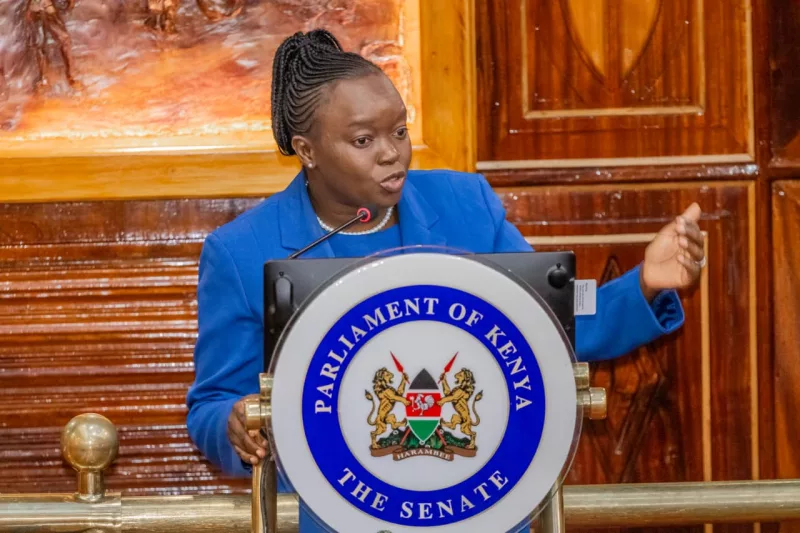
All state sugar mills that are currently leased out will automatically revert to the government after the 30-year lease period, Agriculture Cabinet Secretary Mutahi Kagwe has said.
The CS who was before Parliament to respond to members’ questions said the government is reviving the sugar industry through the private capital with the lease rental amounting to Sh40,000 per hectare annually for Chemelil, Muhoroni and Sony Sugar companies.
Nzoia Sugar Company has rental amount of Sh45,000 per hectare per year.
This is in addition to a concession fee of Sh4,000 per tonne of sugar produced and Sh3,000 per tonne of molasses, a one-off goodwill payment equivalent to one year’s lease rent is also payable in the first year.
The package covers land, buildings, plant and machinery and the entire factory ecosystem excluding motor vehicles and livestock.
The move to lease, Kagwe said, is meant to restore efficiency, protect farmers and unlock new investments in cane development and processing.
“The lessee shall not assign, transfer, pledge or make other disposition of the lease or any part thereof. The nucleus land shall only be used for cane development and not be used as collateral by the lessee,” Kagwe told MPs.
“The lessee to invest in diversification into cogeneration of power, production of bioethanol and allied products and the expiry of the term lease, all the initial and additional investments shall revert to the lessor.”
Kagwe also moved to settle the question on whether the lease rent took into account the value of the nucleus estate farming land.
According to the CS, the agreement includes all the land, buildings, plant and machinery.
He also clarified the nucleus estate and standing sugarcane was not valued since these were considered in the leased asset portfolio.
MPs were also concerned with possible monopoly in the sector given that the only established millers were considered in the takeover.
But Kagwe said the operations of leased state-owned sugar firms are regulated by the Kenya Sugar Board (KSB), which was established by the Sugar Act, 2024 (Act No. 11 of 2024).
“The Act has several provisions that give the Kenya Sugar Board regulatory powers for market monitoring, regulation and control of unfair trade practices which are used to restrain monopolistic behaviour. The existing framework include regulatory oversight by KSB on compliance, cane harvesting, and milling operations and farmer protection and sugarcane pricing frameworks under the Sugar Act, 2024,” he told Parliament.
According to Kagwe, the agreements go beyond ordinary leasing and impose strict performance obligations on the private millers and the lessees are required to invest in massive cane development programmes, rehabilitate and modernise factory equipment, and adopt new technologies to improve milling efficiency and recovery rates.
They are also required to diversify into cogeneration of power, production of bioethanol and allied products, while ensuring the management and maintenance of nucleus estates and out-grower systems to secure sustainable cane supply for the factories.
Kagwe further said the millers must also comply with the Competition Act that restricts any firm from controlling more than 50 per cent of the national market.
“Following the leasing of the four state-owned sugar mills, none of the sugar companies controls more than 50 per cent of the market. The KSB and the Competition Authority will retain strict oversight of the sector,” he said.
The leasing proceeds, he noted, will directly benefit local farming communities through payment of farmers’ bonuses, cane development, infrastructure and support to out-grower systems.


![[PHOTOS] Elderly brave cold to vote in Ol Kalou](https://cdn.radioafrica.digital/image/2026/07/d2345b9e-578f-45ff-9bb0-d7819671c165.webp)

![[PHOTOS] Ol Kalou residents turn out in large numbers to vote](https://cdn.radioafrica.digital/image/2026/07/fe42d51c-7f79-466e-94e8-59561f77bbe7.webp)