

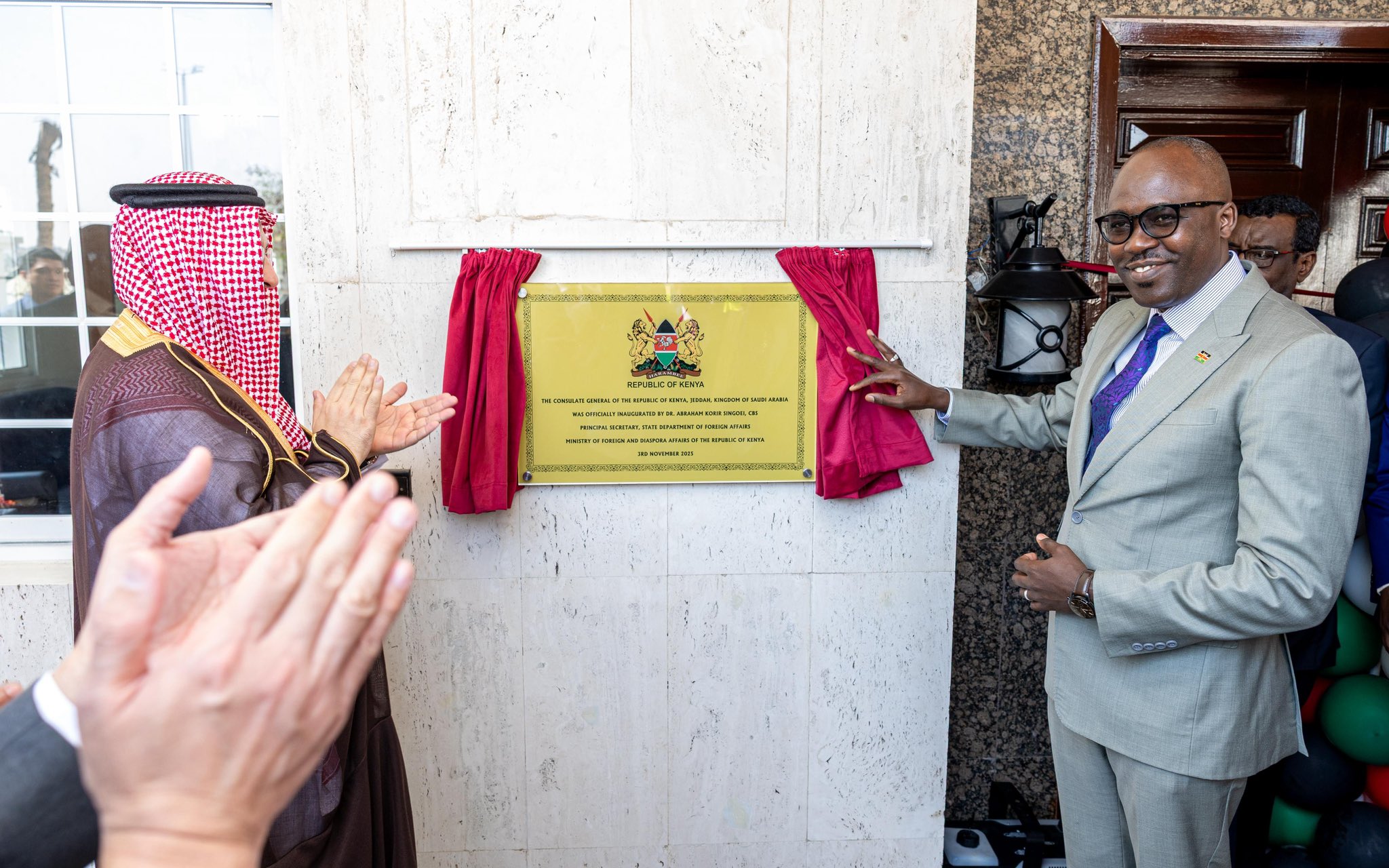
 Foreign Affairs PS Korir Sing'oei inaugurates the Consulate General in Jeddah, Saudi Arabia, on November 3, 2025./HANDOUT
The Embassy of Kenya in Riyadh has commenced a mass registration exercise for Kenyan nationals under Huroob.
The move provides an opportunity for those in distress to obtain Emergency Travel Certificates (ETCs) and return safely to Kenya.
Huroob refers to a classification in Saudi Arabia applied to migrant workers who are reported as having left their employers or breached residency rules.
Conflicts involving pay, working hours, or contract disputes often push workers to leave their jobs, after which employers file Huroob reports.
In some cases, workers quit after going for long periods without being paid, leading employers to register them as having absconded.
Switching to another employer without receiving official approval for a transfer also violates residency regulations and results in a Huroob status. Additionally, workers who fail to renew their residency permits on schedule can be marked under Huroob.
The Embassy has also advised all eligible Kenyans to come forward for ETC processing, with or without a passport, as long as they present any valid Kenyan identification document.
Acceptable forms of identification include National Identification Cards, birth certificates, copies of passports (if available), driving licenses, and Huduma Cards.
This initiative aims to assist Kenyans facing difficult circumstances, particularly those whose legal or employment status in Saudi Arabia may be irregular, and to facilitate their safe repatriation to Kenya.
The embassy urged citizens to follow its official channels for updates on venue locations, registration schedules, and required documentation.
“The Embassy remains committed to protecting the rights and welfare of Kenyan nationals in Saudi Arabia. We encourage all eligible citizens to participate in this exercise and ensure a smooth return home,” the Embassy said in a statement.
Kenyans in need of assistance are encouraged to act promptly, as the registration exercise is time-sensitive and part of ongoing efforts to support nationals abroad.
On November 19, the Embassy of Kenya in Riyadh issued a reminder to all Kenyan domestic workers and their employers regarding the rules and terms governing employment in the Kingdom of Saudi Arabia.
The guidelines aimed to ensure transparency, safety, and compliance with
Saudi labour laws.
According to the Embassy, every domestic worker must have a valid, written
contract approved by the Ministry of Human Resources and Social Development
(MHRSD). The contract should clearly outline the worker’s salary, job duties,
working hours, and benefits.
Employers are required to pay salaries on time and through official channels,
providing a salary slip or proof of payment.
According to the embassy, unlawful deductions are strictly prohibited, and domestic
workers are entitled to at least nine hours of daily rest, weekly rest days,
paid annual leave, and safe accommodation with adequate food.
The Embassy also stressed that medical care must be ensured, and workers
should have access to hospitals or clinics when necessary.
Employers are not permitted to confiscate passports or personal documents,
and workers must be allowed reasonable communication with their families.
Procedures for the transfer of sponsorship or final exit must comply with
official regulations through the MHRSD and Jawazat platforms. The statement also noted
that workers should never be forced to work against their will.
In cases of abuse, unpaid salary, overwork, or mistreatment, domestic
workers are urged to report immediately to the Kenyan Embassy in Riyadh.
The Embassy emphasised that awareness of these rights is critical for protecting the welfare of Kenyan nationals in Saudi Arabia and encouraged both employers and employees to strictly adhere to the regulations.