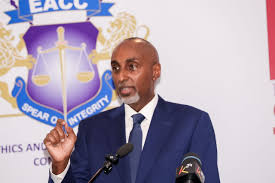
EACC Chief Executive Abdi Mohamud says
officers undertaking recruitment exercise have a responsibility to conduct due
diligence before hiring an employee.
Failure to conduct background checks can
only mean the bosses are complacent or negligent of their duties and thus
liable for prosecution according to the anti-graft agency.
Mohamud said a recent probe of mass hirings
by two agencies established a trend where several individuals were hired, yet
they had fake papers. In one agency, seven senior employees have already been arraigned.
Accounting officers who include PSs and CEOs,
heads of parastatals and heads of human resource departments will not be spared
in the probe on fake papers, EACC says.
“By the time we are done with these
investigations, if we find that those who were conducting the recruitment were
negligible, we will take them to court or submit them to the Ombudsman to institute
administrative actions,” Mohamud said.
Mohamud was speaking on Wednesday morning,
during a Virtual session that brought together Principal Secretaries (PSs),
chairpersons, members of boards, CEOs and corporation secretaries of
parastatals following a directive of Head of Public Service Felix Koskei.
The anti-graft boss said the enactment of
the Conflicts of Interest law now gives the agency more powers to enforce integrity
values and fight corruption.
Among the new powers are the seizure of
assets acquired irregularly by public officers, who fail to declare their
interest in a business, investments or property. This includes assets owned by
close family and associates of any public officer.
“The EACC has powers to seek forfeiture
of any undeclared assets or unexplained assets by public servants, including
those owned by family members,” he said.
Mohamud said EACC and the Attorney General’s
office are currently developing regulations to give effect to the new law and
will be presented in parliament soon to replace those under the Public Officers
Ethics Act, which are currently being used.
The anti-graft body also warned that actions
of some public officers are endangering public assets owned by institutions due
to contracts that expose them.
“Our attention has been drawn to various
cases where officers disregard state corporations’ assets, or sign contracts
that are detrimental to those institutions,” the EACC boss warned.
He cited a case of a TIVET from Western Kenya
that was being auctioned, with EACC stepping in to stop the move that could have
seen the institution lose its bus, among other assets.
“Yet that institution has a board and
management and entered into a contract that exposed its assets. We have since moved
to court to institute recovery of the assets that were being auctioned,” he
said.
The commission says it is intensifying
operations to crack down on bribery incidents, which are contributing to Kenya’s
poor rating internationally in the bribery index.
“As a commission, we do understand that
bribery is a major problem in the public service, including parastatals. Young people
who want to seek IDs are asked for a bribe, and employers are asking for bribes.”
The session was part of a three-week
directive by Koskei to all public servants to attend mandatory online
sensitisation and training on addressing inefficiency, impunity and corruption.
The trainings and sensitisation are being
used as a forum to reiterate the roles of various officers in addressing
impunity, indiscipline, inefficiency and corruption in the civil service.
The exercise that commenced on October 29,
2025, is slated to end today, November 12, 2025, according to a circular from
Koskei’s office.