Kenya’s growing public wage bill is emerging as one of the biggest threats
to economic stability, consuming a large share of national revenue and
squeezing out funds for key development projects.
New figures from the National Treasury show the government’s salary
obligations to civil servants have risen sharply in recent months, piling
pressure on a strained budget already burdened by heavy debt repayments and
sluggish revenue growth.
According to Treasury data, the country was spending Sh75 billion monthly on salaries in January this year—a figure that
climbed to Sh80 billion by October.
This represents a Sh5 billion increase in just 10 months.
The Salaries and Remuneration Commission (SRC)
adds that over the past three years, the total wage bill has ballooned by
Sh135.9 billion, rising from Sh1.035 trillion to Sh1.171 trillion.
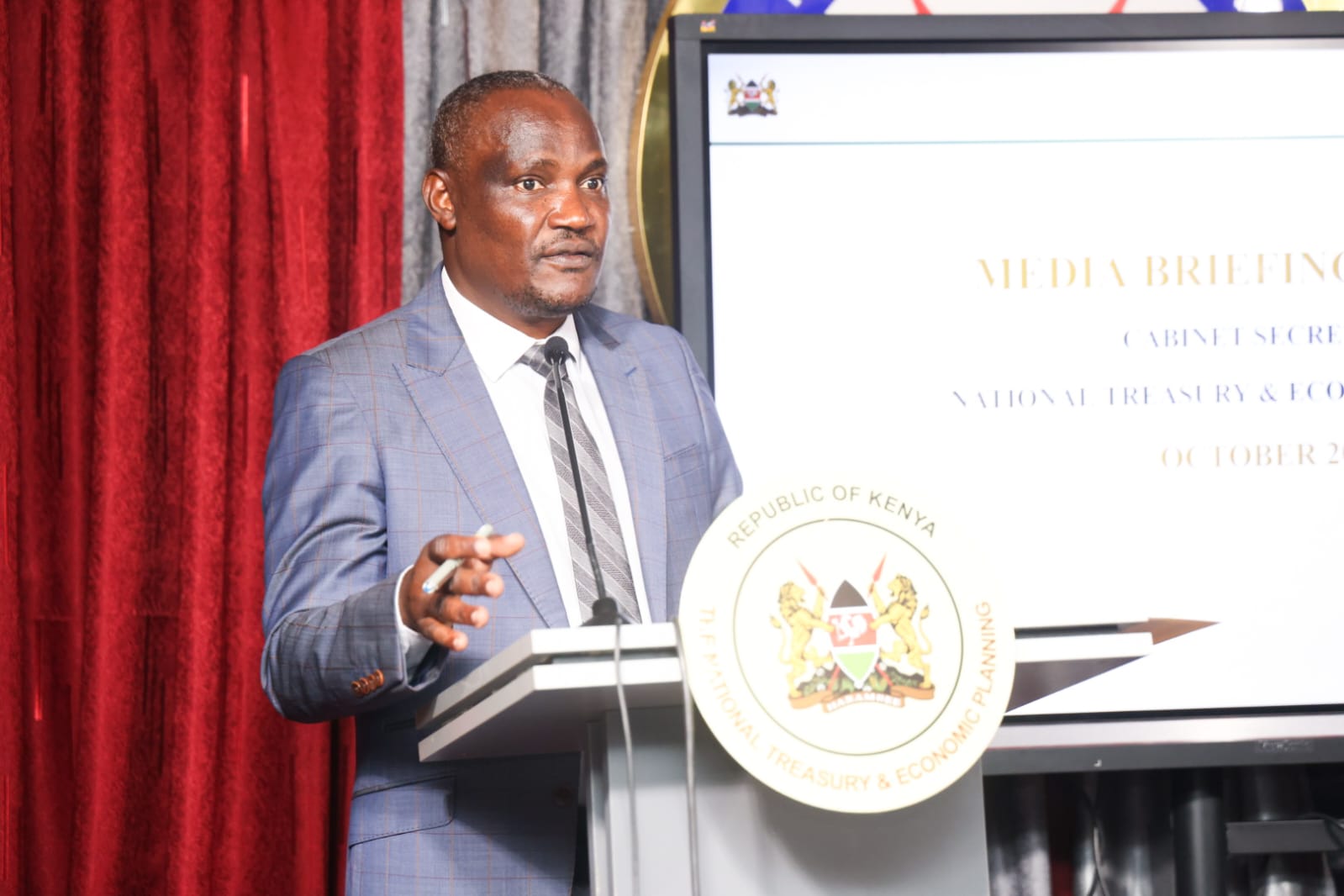
National Treasury CS John Mbadi told Parliament on Tuesday that the surging recurrent expenditure is choking
funds meant for development.
“If not checked, the trend may
not be sustainable,” he warned.
He said that, coupled with rising loan
repayments, the growing wage bill has left the government with almost nothing
to spend on critical infrastructure, health, and education projects.
In the 2023-24 financial year, Kenya’s total
revenue stood at Sh2.7 trillion, of which Sh1.38 trillion was spent on debt
repayment.
With an additional Sh960 billion
going to salaries, the government was left with barely Sh200 billion for all
other obligations—forcing it to borrow to keep basic services running.
“Up to January this year, we were paying our
wage bill per month at Sh75 billion, translating to Sh900 billion per year.
Today, it has gone up by Sh5 billion per month and is now Sh80 billion,” Mbadi
told MPs.
“That is Sh960 billion per year, and that is not a very good position
to be in. It is not sustainable.”
Appearing before the National Assembly’s
Education Committee to discuss the funding of collective agreements for
university and college staff, Mbadi cautioned against overstraining the fiscal
space.
He said up to 2013, the government was
spending about 16 per cent of ordinary revenue on wages.
That figure has now surged beyond 40 per cent in less than 12 years, breaching legal limits.
The Public Finance Management (PFM) Act, 2012,
and accompanying regulations cap the wage bill-to-revenue ratio for both
national and county governments at 35 per cent.
The warning came as the government grapples
with limited fiscal space, rising debt repayments and sluggish revenue
performance.
Treasury has instructed ministries, departments and counties to freeze new
recruitment and adopt performance-based pay structures to control the growth.
Mbadi also revealed that Kenya almost
defaulted on its debt obligations last year due to the shrinking financial
space.
“The country almost defaulted in paying their
loan last year,” he told the committee.
“We would actually be talking about
whether we can sustain our workforce employment. I agree that our lecturers and
staff in public universities are not adequately remunerated—they need better
salaries—but we must also be alive to the challenges that we are facing.”
Mbadi's remarks came amid renewed pressure from
lawmakers and unions pushing for higher pay and expanded staffing, moves that
could further strain public finances ahead of the 2025-26 budget cycle.
The CS, however, struck an optimistic tone,
saying the economy is showing signs of recovery, but warned that reckless
spending could undo recent gains.
“It would interest this committee and the
Kenyan public to note that our economic stability is improving,” Mbadi said.
“If you look at our macroeconomic fundamentals, they are better than they were
two or even one year ago. But if we do not maintain this trajectory, we will
slide again to where we were—and the effect may be disaster.”
In the last financial year, 2024-25, the Salaries and Remuneration Commission data indicates that wage bill in counties had assumed an upward trend
rising from Sh38.6 billion in the first quarter to Sh55.68 billion in the second
quarter.
In the third quarter, a slight drop was recorded to Sh52.6 billion before it
climbed again to Sh68.8 billion in the fourth quarter of the financial year.
According to SRC records, the total revenue increased from Sh87.91 billion
in the first quarter, to Sh146.8 billion in the second quarter, but dropped to Sh96.12
billion in the third quarter.
In the fourth quarter, the revenue was projected to rise to Sh143.49 billion.
In the national government, SRC’s data for the last financial year indicates
the wage bill rose from Sh151 billion in the first quarter, to Sh165.26 billion
in the third quarter.
The same was projected to rise to Sh184.4 billion in the fourth quarter of the
2024-25 financial year.
“On the other hand, in the 2024-25 financial years, total ordinary revenue exhibited an
upward trend increasing from Sh348.6 billion in the first quarter to Sh378.2
billion in the third quarter, and projected to rise to Sh440.9 billion in the
fourth quarter,” SRC states in a report.
The data is captured in the recent SRC’s Fourth Quarter Wage Bill Bulletin (April–June 2025).
While recruitment drive is necessary to address service delivery gaps,
fiscal experts warn that the pace of hiring is unsustainable given the current
revenue performance.
“Generally, the number of public service employees has been on a consistent upward
trend over the years, crossing the one million mark in 2024 to reach 1.023
million employees,” SRC said in the report.
An analysis of the Economic Survey 2025 shows that wage employment in the
modern sector increased by 2.4 per cent from 3.1 million in 2023 to 3.2 million
persons in 2024.
Out of the number, about 2.2 million are in the private sector while
one million are in the public space.
From the SRC records,
the number of public sector employees rose from 937,900 in financial year
2021-22 to 1,023,200 in financial year 2023-24.
The average monthly
gross salary per employee also increased from Sh70,229 to Sh71,784 over the
same period.
According to the 2025 survey, the surge in employment in the public service was
particularly witnessed in five categories. They are ministries and other
extra-budgetary institutions, the Teachers Service Commission (TSC), parastatals, corporations controlled by the government and county governments.
From the records, TSC has consistently remained the largest public service
employer, registering the highest growth in employment at 5.2 per cent.
Its employees increased from 390,400 in 2023, to 410,700 employees in 2024.
Ministries and other extra-budgetary institutions emerged as the second largest
public service employer, followed by the county governments with 236,700 and
226,500 employees in 2024, respectively.
INSTANT ANALYSIS
Kenya’s wage bill currently accounts for more than 45 per cent of total revenue,
far above the 35 per cent threshold recommended by the Public Finance Management
regulations. Economists warn that unless urgent measures are taken, the
government may be forced to borrow more to fund development—worsening the
country’s fiscal deficit.

 National Treasury CS John Mbadi/ FILE