24 counties that could make or break Kalonzo, Gachagua in 2027 battle with Ruto
The opposition must rely on calculated tactics and grassroots manoeuvring to secure the numbers.
by JULIUS OTIENO
Audio By Vocalize
United Opposition leaders Fred Matiang’i, Kalonzo Musyoka and Mukhisa Kituyi at a past event/DENISH OCHIENG
At least 24 counties are weak links in the opposition’s ‘united
front’ for the presidency, posing a major difficulty in toppling President
William Ruto in 2027.
The
United Opposition, fronted by DCP leader Rigathi Gachagua, Wiper boss Kalonzo
Musyoka and former Interior CS Fred Matiang’i, faces an uphill task in these
counties.
Apart
from weak grassroots networks, the yet-to-be-formalised alliance lacks dominant
regional heavyweights who can secure bloc votes in their areas.
This
means the coalition must lean on calculated strategies and grassroots mobilisation
to boost its numbers.
The
opposition has yet to mount serious campaigns in these regions, although its
leaders and supporters repeatedly visit Gachagua’s home turf of Mt Kenya
and Kalonzo’s Lower Eastern stronghold.
“There
are areas where the opposition will not need to waste their time and money.
Places like Luo Nyanza and Kalenjin-dominated counties of the Rift Valley,”
political analyst Martin Andati told the Star.
For
other regions, he said, opposition leaders must appeal directly to the people
and leverage President Ruto’s perceived
unpopularity.
Kenya’s
electoral law requires a presidential candidate to secure at least 25 per cent
of votes in 24 counties and an overall national tally of 50 per cent plus one
vote.
An
analysis by the Star reveals glaring gaps in the opposition’s reach,
particularly at the Coast.
The
six counties—Mombasa, Kilifi, Kwale, Taita Taveta, Lamu and Tana River
— lack an opposition-aligned kingpin to rally voters.
Unlike
the opposition, Ruto has won the backing of ODM leader Raila Odinga, who
has long dominated regional politics and influential figures from his party
have joined the Ruto administration.
Among
them is flamboyant Mining CS Hassan Joho, the immediate former Mombasa
governor and former ODM deputy leader. A youthful crowd-puller, Joho
entrenched ODM’s dominance in Mombasa before crossing over to Ruto’s Cabinet with
Raila’s blessing.
“We
have decided to remain in government, and we will not leave. In 2027, we are
with our President, but in 2032, we will go for that seat,” Joho said on July
2.
In
the Rift Valley, Ruto remains unchallenged.
The
opposition lacks a principal to galvanise that vote-rich region, where the President
secured more than 70 per cent of votes in Uasin Gishu, Nandi, Kericho, Bomet
and Baringo in 2022.
Raila
also dominated Turkana.
In
Nyanza, Raila still has a strong grip over Kisumu, Migori,
Siaya and Homa Bay.
The
opposition has not mounted campaigns there, a dynamic that could favour Ruto
if Raila sustains his support for the incumbent and a second term.
In
Northeastern, nearly all elected leaders back Ruto, leaving Gachagua and Kalonzo
without a foothold.
Health
CS Aden Duale, Mandera Senator Ali Roba, Eldas MP Adan Keynan, and Dadaab
MP Farah Maalim are among the region’s influential figures supporting the
government.
Some
analyst say, however, the opposition has a fighting chance in the region.
“Northeastern
is a swing region. No one can claim to control it fully. They have not had an
outright kingpin for a long time, and they also make their decision [on who to
back] late, depending on where they think power would go,” Andati said.
Western
Kenya remains contested.
The
opposition has allies such as Trans Nzoia Governor George Natembeya and DAP-K
leader Eugene Wamalwa.
Yet,
National Assembly Speaker Moses Wetang’ula is in Ruto’s corner and still wields
considerable clout.
In
Busia and Vihiga, the alliance lacks a commanding voice.
DCP’s
Cleophas Malala has also been overshadowed by Raila and former Kakamega
Governor Wycliffe Oparanya.
Andati
said the opposition could ride on Natembeya’s rising star to wrest the
region from Raila’s grip.
Currently,
the opposition has a stronghold in Mt Kenya, where Gachagua has consolidated
support.
This
has weakened Ruto’s grip on the region, which he relied on greatly to win in
2022.
Other
opposition principals, including Martha Karua (PLP), Justin Muturi (DP) and
Peter Munya (PNU), also hail from the region.
Ruto,
however, is counting on Deputy President Kithure Kindiki from Tharaka Nithi and loyalists
to reclaim that vote bloc.
In
Eastern, Kalonzo commands a massive following in Makueni, Kitui, Machakos and
parts of Taita Taveta.
Nairobi,
the country’s most cosmopolitan county and the richest in votes, is expected to remain
a fiercely contested battleground, as will the Maa counties of Narok, Kajiado
and Samburu.
Since
2013, coalitions among major ethnic blocs have shaped presidential outcomes.
The
Uhuru Kenyatta-Ruto alliance delivered two straight wins by merging Mt Kenya
and Rift Valley.
In
2007, the Pentagon coalition nearly toppled Mwai Kibaki, while in 2002, a broad
opposition front ended Daniel arap Moi’s 24-year rule.
Yet
the opposition’s troubles go beyond weak county bases. It is also grappling with
poor finances, internal divisions and alleged state infiltration.
Data
from the Office of the Registrar of Political Parties show Ruto’s UDA and Raila’s
ODM this year dominate the Sh1.94 billion political parties fund, together
controlling more than Sh1.2 billion.
UDA
will receive Sh789.7 million—more than 40 per cent of the fund—while ODM takes
Sh421.8 million. Jubilee is allocated Sh184.8 million, Wiper Sh98.8 million, and
DAP-K Sh43.2 million. Gachagua’s DCP is not eligible for funding, as it does
not yet have elected leaders.
Beyond
financing, Ruto enjoys the many benefits of incumbency, with access to state
machinery to advance his political agenda.
The
United Opposition is also battling a unity test, with its principals sticking
to personal bids for the top job. Kalonzo has declared it is “now
or never”, Gachagua insists he will be on the
ballot ¾ a
possible negotiating tactic ¾ while Karua has made
similar pronouncements.
“If
you fail to unite, then the person who will benefit is the incumbent. That is a reality
that they all know,” political observer Charles Munyui warned.
Instant
analysis
Forces
ganging up to unseat President Ruto face many hurdles that could favour the
incumbent in 2027. The President faces a growing list of opponents and waning
popularity due to a battered economy and unpopular policies. Difficulty in
picking a single opposition candidate could be a huge
advantage for Ruto. Multiple opposition candidates would split the vote,
which the President would exploit. Reports are emerging of clashing egos,
ultimatums, government infiltration and divisions within the opposition,
with a little more than two years to the polls.
This is premium content
Subscribe to Continue Reading
Help us continue bringing you unbiased news, in-depth investigations, and diverse perspectives. Your subscription keeps our mission alive and empowers us to provide high-quality, trustworthy journalism. Join us today to make a difference!

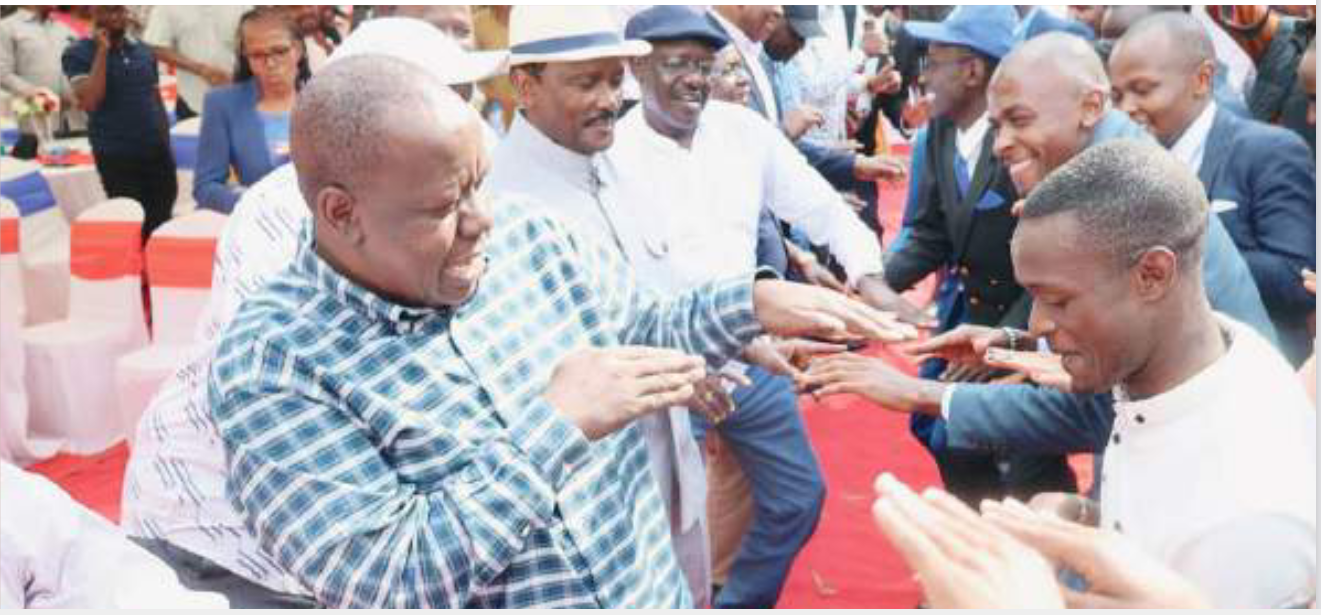 United Opposition leaders Fred Matiang’i, Kalonzo Musyoka and Mukhisa Kituyi at a past event/DENISH OCHIENG