The government has insisted that it will go
on with the World Bank-backed controversial electronic procurement despite opposition from Parliament and the Council of Governors.The e-Government Procurement (e-GP) system
was officially launched on April 7, 2025, and is set to become the sole
platform for all public procurement processes across Ministries, Departments,
and Government Agencies (MDAs) starting from the 2025/26 financial year.
CURBING PROCUREMENT-RELATED FRAUD
According to the National Treasury, the
system is expected to save the country up to Sh50 billion annually by curbing
procurement-related fraud and inefficiencies.
Section 7(c) of the Public Procurement and
Asset Disposal Act (PPADA), 2015 has mandated the National Treasury to design and
prescribe an efficient procurement management system for the National and
County Governments to ensure transparent procurement and asset disposal as
contemplated by Article 227 of the Constitution.
The e-GP system digitises the entire
procurement process—from planning and bidding to contract management and
payment. Suppliers are required to register on the platform, submit bids
online, and track the status of tenders and contracts.
To enhance transparency and reduce fraud,
the system is integrated with key government databases, including the Kenya
Revenue Authority’s iTax system, the Integrated Financial Management
Information System (IFMIS), the Business Registration Service, and the
Integrated Population Registration System.
The Treasury states that e-procurement is an
initiative aimed at enhancing transparency and accountability, establishing an open
marketplace for procurement needs, and supporting the introduction of
procurement reforms to better manage and monitor public procurement activities.
“Beneficiaries include not only governments
and suppliers but also the public at large in having access to transparent
information on the public expenditure of taxpayers’ money,” Treasury states on
its website.
The government insists that among the
benefits of the system are enhanced transparency and accountability achieved
from online publication of tender notices, contract award notices, online bid
submission, and procurement audit trails.
STERN WARNING
On Sunday, President William Ruto issued a
stern warning to government officials resisting the adoption of e-procurement system
declaring that there is no turning back in the fight against corruption and
wastage of public resources.
The President said some individuals within the government are adamant about clinging to outdated procurement methods that have
long enabled corruption and inflated public spending.
“There are people who want to stick to the
old ways where the government buys a product worth Sh2 at Sh10,” the President
said in Siaya after attending a church service, adding that the system is
designed to open up government spending to public scrutiny, ensuring that every
coin of taxpayers’ money is accounted for.
“Any officials who are not ready to
continue with e-procurement can leave as well. They will not stop us from fully
adopting this system and ensuring our resources are used as expected.”
Treasury CS John Mbadi accuses heads of
procurement of misadvising accounting officers (PSs and CEOs) to oppose the
changes while telling off critics of the new system.
“I am not getting distracted in implementing
the e-procurement. EGP is the way to cut down on wastages in government. My plea to accounting officers is, don’t listen to your procurement officers because they don’t want to
let go of where they have been stealing public funds,” Mbadi spoke in the same
event attended by the President.
The Treasury CS accuses critics of e-procurement
of being ignorant, saying although the system, just like any other new system,
will have challenges, it will eventually work.
He insists the system was procured in 2022 at
US$2.9 million, or about Sh370 million, and not Sh5 billion as claimed in some
sections of the media.
THREATS TO SUE
The Council of Governors (CoG) through Chairman
Ahmed Abdulllahi, has warned the National Treasury that the council will be compelled
to instate a court action should they not reconfigure the Integrated Financial
Management System (IFMIS) to enable county governments to upload their
procurement plans as per the previous regime.
Governors insist the transition has been
hasty, incomplete and marred with inconsistencies, causing confusion and
paralysis across procuring entities
"In this regard, the Council asks the
National Treasury to lift any administrative blocks related to the
implementation of e-GP, failure to which we shall be constrained to seek legal
redress on the underlying issues as this borders on provision of services
across all Counties," CoG boss said.
National Assembly has since voted to
nullify a circular by Treasury while Senators led by Narok’s Ledama Ole Kina raised
concerns over the national government’s directive requiring county governments
to adopt an e-procurement system.
"With the utmost respect, Mr.
President, county governments are constitutionally semi-autonomous. Article 219
clearly mandates that counties receive their equitable share of revenue without
undue delay and without deduction," Ledama states.
On Tuesday, 19th August 2025, the National Assembly
unanimously endorsed a report of the Delegated Legislation Committee that
recommended the annulment of the circular 04/2025 issued by the Public
Procurement Regulatory Authority (PPRA) on August 12 on grounds that there was
no public participation.
“The circular seeks to amend the law
without involving parliament and without public participation. The circular
outlaws the manual submission of tender documents and purports to impose
punishment. They should have initiated the amendment of the law to allow the
electronic system,” committee chairman Samuel Chepkonga said.
PPRA Director General Patrick Wanjuki says that
all government agencies were required to comply with e-procurement starting
July 1 failure to which “any manual transaction shall be surcharged on the
officer who authorized the transaction.”

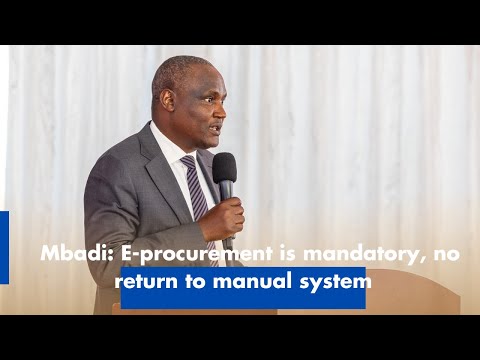


 Treasury CS John Mbadi./FILE