Wash–wash gangs on spot as Kenya fights grey listing tag
Most illicit financial transactions aided through real estate sector
by VICTOR AMADALA
Audio By Vocalize
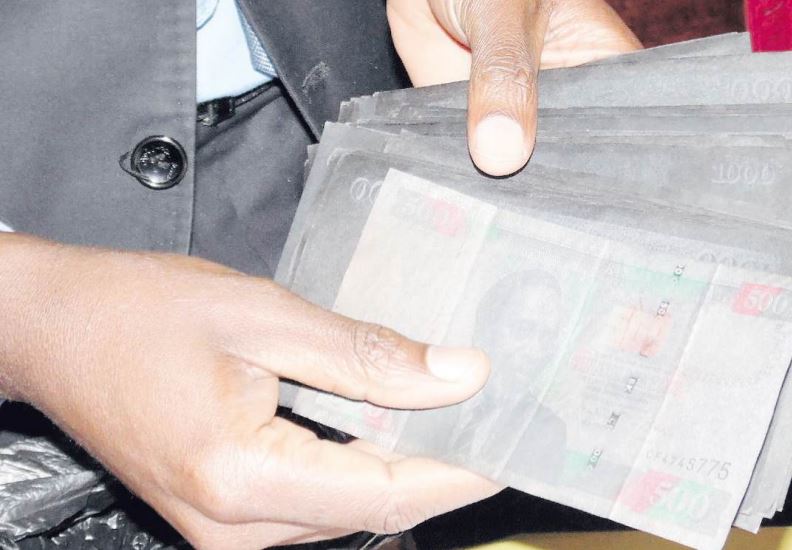
A Makadara law
courts officer
counts fake
money
recovered by
police from
a money
laundering suspect
/FILE
The government has intensified the crackdown on perpetrators of illicit
financial flows and money laundering through real estate and shell companies,
as the country faces increased scrutiny from the international community.
Various global institutions, including the
International Monetary Fund, European Union, and the United States government,
have pointed fingers at Nairobi, accusing President William Ruto’s
administration of aiding the vice that poses threats to global security.
A senior government official privy to the
ongoing efforts by the country to cleanse its financial system told the Star in
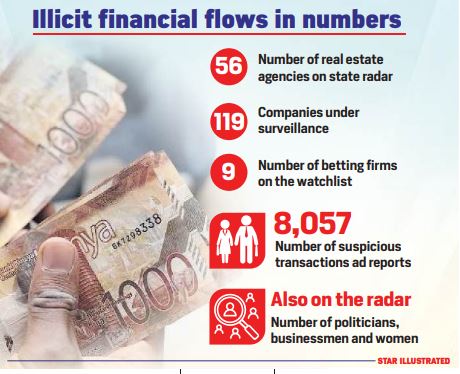
confidence that at least 56 real estate agencies, 119 companies, nine betting
firms and several politicians and businesspersons are on the state radar over
the vice.
Already, the Financial Reporting Centre has
flagged and frozen bank accounts belonging to several companies and
individuals, even as it highlights increasing cases of suspicious financial
transactions.
The latest annual report by the centre
shows it received 8,057 reports consisting of 5,454 STRs, 2,482 Suspicious
Activity Reports (SARs) and 114 Suspicious Transaction Activity Reports (STARs)
from reporting institutions and seven reports from walk-ins/whistle blowers.
"This represents a 22 per cent
increase compared to the previous year, where the centre received 6,631
reports, with the banking sector maintaining its consistency as the primary
source of STR/SAR/STARs reporting," the annual report adds.
The Money Laundering and Terrorism
Financing Trends and Typologies Report 2025 by FRC flagged suspicious
transactions valued at Sh6.97 trillion, almost half of the country’s Gross
Domestic Product, with banks handling 91 per cent of the transactions.
The report highlights one case involving
a foreign construction firm with two local subsidiaries involved in major
infrastructure projects.
Directors of the three related companies
hatched a scheme of evading taxes through making fictitious payments.
They used company employees to register
shell companies that were used to raise invoices claiming to be suppliers of
construction materials. Those shell companies recruited businesses dealing in
hardware and construction materials.
“They subcontracted them to make the
supplies. Part of the funds that were paid to the shell companies were
withdrawn in cash, converted into foreign currencies, while a smaller portion
was paid to the suppliers," FRC annual report says.
Regulation 34 of the 2023 Anti-Money
Laundering law requires all reporting institutions to report any cash
transaction of $15,000 or more (or its equivalent in other currencies), even if
it doesn’t seem suspicious. These cash transaction reports must be
submitted to the centre by the end of each week.
The chilling report of rampant cases of
illicit financial flows comes at the time Nairobi and its environs are
witnessing a significant construction boom, fueled by high-value transactions
and minimal regulatory oversight—conditions that, in some cases, have
previously been linked to money laundering and terror financing.
Early this year, the FRC directed all real estate agencies to register
with the centre in compliance with Section 47A of the Proceeds of Crime and
Anti-Money Laundering Act, 2009 (POCAMLA).
The Estate Agents Registration Board is
established under the Estate Agents Act Cap 533 and recognised as a supervisory
body for real estate agents under the First Schedule of the POCAMLA.
“Registration is done online through the
goAML platform. Take note that failure to register with the FRC constitutes an
offence pursuant to Section 47A (5) of POCAMLA and the centre will proceed to take
necessary action,’’ FRC director general Saitoti Maika said in notice dated
February 14.
Two months ago, President Ruto signed into law an amendment to the
Anti-Money Laundering and Combating of Terrorism Financing Laws (Amendment)
Bill, 2025, which largely targets real estate and shell companies aiding
illicit financial flows.
The bill amended 10 Acts of Parliament to
address the technical compliance deficiencies identified by the Eastern and
Southern Africa Anti-Money Laundering Group and the Financial Action Task Force
on anti-money laundering, combating terrorism financing and combating
proliferation financing.
FATF tasked Kenya with ensuring that the
financial intelligence information gathered is used more effectively and inspecting
the work of non-governmental organizations (NGOs) and not-for-profit organisations
to ensure they do legitimate work and are not used as conduits to transfer
proceeds of crime.
This was after the European Union included Kenya among the money
laundering high-risk states, months after the Financial Action Task Force at
its plenary meeting in February 2024 added the country and Namibia to its Grey List.
The
US Department of State is worried that Kenya’s
efforts to curb money laundering face a tough challenge from designated
non-financial businesses and professions — lawyers, real estate agents, and
notaries — who operate in a regulatory grey zone.
According to the report by the department’s
Bureau for International Narcotics and Law Enforcement Affairs, despite these
professions being covered under the Proceeds of Crime and Anti-Money Laundering
Act, many of these professionals remain largely unchecked.
“Kenyan financial institutions likely serve
as conduits for money laundering associated with the trafficking of illegal
narcotics, humans, weapons, wildlife, timber, charcoal, and minerals,’’ the report released in March reads.
President Donald Trump’s administration
observes that informal Somali financial
networks thrive in the country, operating beyond the reach of regulators.
“These
systems, built on trust and cultural ties, facilitate swift, anonymous
cross-border transactions.”
It adds that those networks
link Kenya to Somalia, where weak
governance and minimal oversight make it nearly impossible to track illicit
financial flows.
Financial crime experts are asking
President Ruto not to relent in the fight against illicit financial flows,
warning that the vice poses a huge
threat to the country’s social-economy.
According to John Kamau, partner, Financial Crime Advisory, Eastern Africa Region, PwC
Kenya, while the EU listing is not
a sanction per se, it is far from symbolic.
“In
regulatory terms, it is a binding designation with immediate legal and
financial consequences across the entire EU market. For a country like Kenya,
East Africa’s financial, innovation and trade hub, the cost is both
reputational and operational,” he said.
He explains that the listing triggers mandatory enhanced due diligence
for any financial or business relationship between EU-based institutions and
Kenyan clients, placing banks, fintechs, exporters, and professional service
firms under a much harsher compliance spotlight, potentially complicating even
the most routine transactions.
For Kenyan financial institutions,
especially those serving as remittance corridors or processing cross-border
payments, Kamau says that the risk of de-banking or de-risking is real.
“The
longer Kenya stays on the list, the harder it becomes to unwind the market’s
perception of elevated risk. In a global financial system increasingly
intolerant of opacity, even a short-term label can leave long-term scars.”
He, however, says that all is not lost as
the country has made tremendous effort to comply, having improved its technical compliance with 28 out of 40
Financial Action Task Force recommendations now marked as “Compliant” and
“Largely Compliant.”
Even so, effectiveness remains low in nine out of 11 key outcomes, a major
hurdle to exiting the Grey List.
“The focus must now shift from policy to
practical enforcement to ensure that we exit from the FATF Grey List and EU
high-risk jurisdiction lists in the shortest time possible.”
The Tax Justice Network Africa, a non-state
agency fighting illicit financial flows, views
money laundering as a significant threat to Kenya's economic stability and
development, advocating for stronger regulations and cross-border cooperation,
especially in the context of digital finance and cryptocurrencies.
This is premium content
Subscribe to Continue Reading
Help us continue bringing you unbiased news, in-depth investigations, and diverse perspectives. Your subscription keeps our mission alive and empowers us to provide high-quality, trustworthy journalism. Join us today to make a difference!

 A Makadara law
courts officer
counts fake
money
recovered by
police from
a money
laundering suspect
/FILE
A Makadara law
courts officer
counts fake
money
recovered by
police from
a money
laundering suspect
/FILE