Visualise a train so long that walking from its front to its
back would take you nearly half an hour!
This is not science fiction but the reality of Mauritania’s
iron ore train, Africa’s longest and one of the world’s heaviest, stretching
close to three kilometres.
Since 1963, the train has thundered daily across the Sahara,
hauling millions of tonnes of iron ore from the mines of Zouérat to the
Atlantic port city of Nouadhibou, a 704-kilometre journey.
Operated by the state-owned Société Nationale Industrielle
et Minière (SNIM), it stands as both an engineering marvel and a stark reminder
of Africa’s colonial legacy.
The railway was laid in the 1950s by European companies, serving
as a crucial part of Mauritania's economy and one of the world's longest
trains.
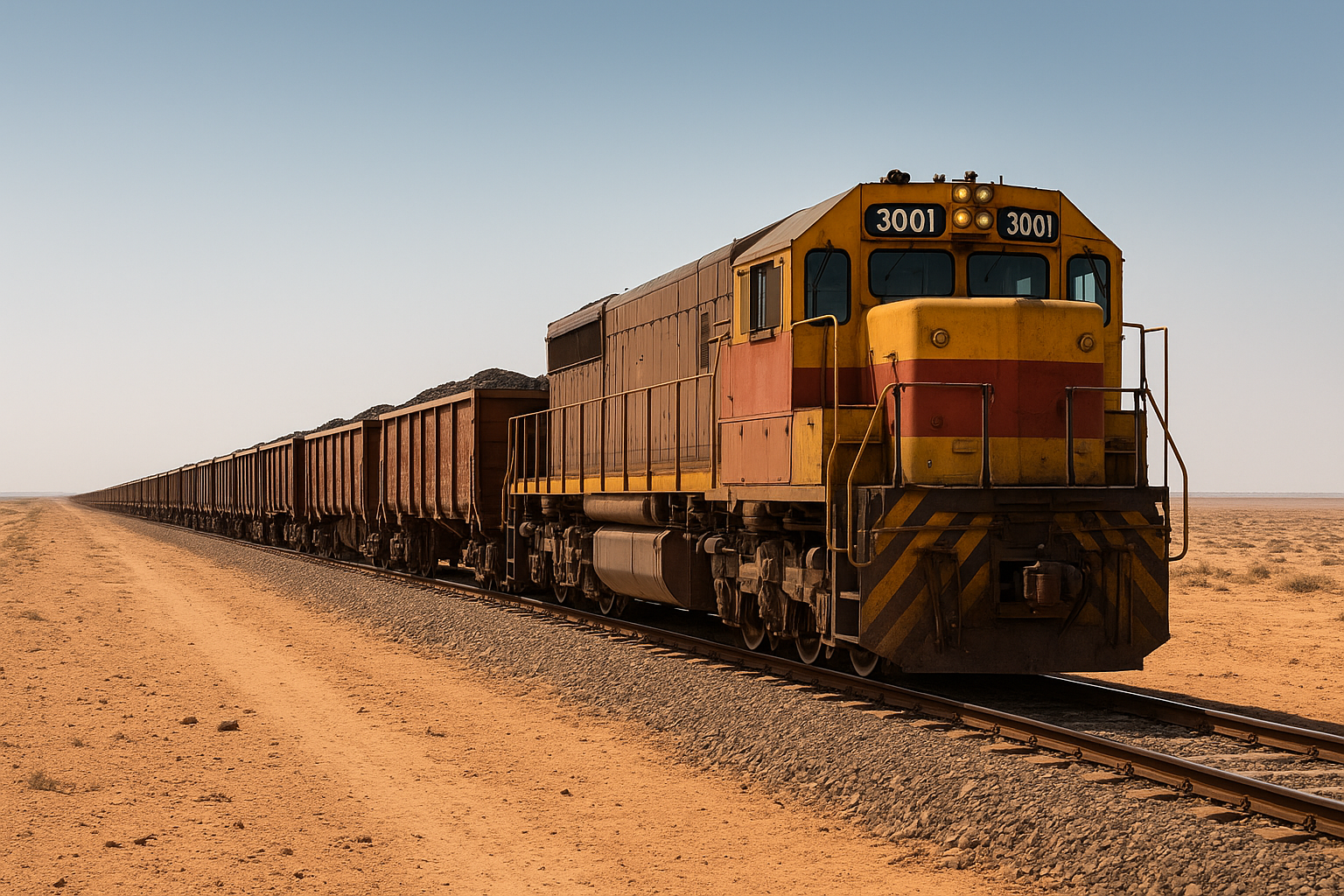
A typical train consists of about 200 to 210 ore cars, each capable
of carrying up to 84 tonnes of iron ore, powered by two diesel-electric
locomotives and supported by 2–3 service cars.
On an annual basis, the railway handles around 16 million
tonnes of freight, underscoring its critical role in Mauritania’s
mineral-driven economy
In the 1960s, the railway used French-made locomotives built
to withstand the desert; later switched to stronger American engines in the
1980s, and by 2010, upgraded again with modern trains designed to handle extreme
heat and sand.
Yet,
despite being built purely for freight, the train has become a lifeline for
ordinary Mauritanians.
With limited alternatives to cross the vast desert,
people ride atop the ore-filled wagons, enduring blistering Saharan heat, suffocating
sandstorms, and freezing desert nights.
While there is a passenger coach attached to some trips,
tickets are costly to the average citizen, leaving many with little choice but to cling to the open
wagons.
Travellers and reporters from outlets such as Al Jazeera have previously documented how locals shield themselves by burrowing into the iron ore for
cover, a practice that highlights both human resilience and the stark
conditions of survival.
Yet, SNIM’s broader impact on the Mauritanian economy is substantial.
In 2023, the state-owned company generated a turnover of $1.37 billion
(Sh175 billion), contributing 14 percent of state budget revenues, around 9 percent
of GDP, and 37 percent of Mauritania’s export volumes.
According to the 2024 SNIM financial year reports, the company has created 6,794 direct jobs.
Despite its mineral wealth, Mauritania captures only a fraction of the value generated by its iron ore.
Much of the ore is exported in raw form, with processing and value addition taking place abroad, mainly in Europe and other global markets.
As a result, while the train powers international industries, Mauritania itself continues to face economic constraints and limited industrial diversification.
Over time, the train has also attracted global attention,
with tourists and adventure seekers seeking what is arguably one of the world's toughest train rides.
For foreigners, it is an
adrenaline-filled journey across the desert.
For Mauritanians, it is a
necessity—a colonial relic turned lifeline.
The iron snake of the Sahara
embodies endurance: a railway built to extract, yet one
that today carries not just ore but the hopes and struggles of those who rely
on it.

 Ai generated