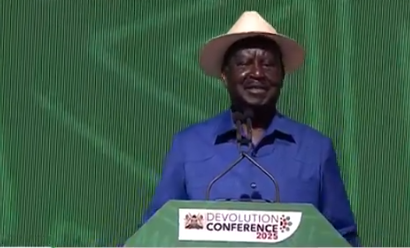
ODM leader Raila Odinga has triggered a political storm after
calling for enhanced mandate and perks to governors.
The proposal that would see even the multi-billion National
Government Constituency Development Fund handed to county chiefs has split
opinion across the political divide.
Speaking during this year’s devolution conference in Homa Bay county,
the former Prime Minister insisted that MPs must be left to perform their
oversight, lawmaking and representation functions and should not engage in any
implementation work.
The continued control of the lucrative NG-CDF kitty by the
lawmakers, Raila said, offends the principles of devolution.
He also went further to demand that even the running of
education be handed to the governors, a proposal that was immediately rejected
by a section of leaders.
But speaking on Friday, National Assembly Speaker Moses
Wetang'ula dismissed CDF critics, saying the fund had changed the face of Kenya.
"Prudent use of CDF funds is best demonstrated through
NG-CDF projects. Across the country if you walk into any village, the most
visible projects be they classrooms, laboratories, or health facilities have
been funded through NG-CDF," he said.
Lugari MP Nabii Nabwera also termed the proposal to give
counties more powers a disaster, arguing that most of the devolved units have
failed to run the Early Childhood Development Education component.
“If you cannot manage ECDE and county vocational centres and
their structures how can you manage primary and secondary education with its
complexity?” Nabii said.
“Only one county, Kiambu, seems to have a clear development plan
for ECDE.”
Raila also continued his push to have governors run Kenya Rural
Roads Authority, Kenya Urban Roads Authority and Kenya National Highways
Authority insisting the national government should not manage roads in the
counties.
“It does not make sense that some roads in Kisumu town cannot be
managed by the governor of Kisumu. There’s no better way to power this economy
than to have major road construction works going on across all the 47 counties
at the same time,” he said.
The opposition chief also advocated for governors who have
served two-terms to enjoy retirement perks just like MPs.
“In Parliament, we did an amendment so that any MP who serves
two terms is automatically entitled to a pension. Why can we not do the same
thing to the governors? A governor who has served two terms needs to be
entitled automatically to a pension,” he said.
But his remarks have rattled lawmakers, with a section of MPs
warning that unchecked powers and lavish perks for governors would only
entrench wastage, corruption and impunity.
Critics also accused Raila of pandering to the powerful Council
of Governors as part of his 2027 political calculus.
Mukurweini MP John Kaguchia while dismissing the ODM leader’s
proposal said any attempt to give governors additional billions will only
result into more hiring and nothing development.
“Under the existing circumstances, it would be wasteful. If for
sure governors would run all these in devolution then we should have serious
capping of how recurrent and development budgets are implemented at the county
level,” Kaguchia told the Star on phone.
“As it stands now, every little additional money in the county
is subjected to new recruitments. County governments have become recruitment
agencies and employment bureaus, every little money they employ their cronies.
“As a result, the development at the counties has reduced to 20
per cent and employment has jumped to 80 per cent, the whole thing is not
working.”
According to veteran human rights defender Suba Churchill, Raila
was playing to the gallery noting that some of the proposal, especially on education,
could compromise quality of education.
“We should avoid a situation where we make proposals because
they are appealing to those who were in the audience. Of course, it must have
been music to the current crop of governors that were there,” Suba said.
“Some of the thinking that went into those things when were at
the national constitution conference in Bomas, the reason why we decided county
governments handle ECDE is because it was also meant to harness the cultural
values of the respective communities that they have been born to.
“We deliberately took primary education to be a function of
national government for the obvious reasons that there are standards that were
to be set and because products of that level of education are invited to
national or county schools so that those standards would apply across.”
Suba also argued that the devolved unit’s lack capacity to
handle education at both primary and secondary level, citing the teething
problems that have persisted with the healthcare management.
“I would not suggest that primary level of education be handled
by the county governments, we have seen the challenges they are facing with the
health sector and the sporadic strikes that we have seen in almost every
county,” he said.
“If you were to add them education with the largest number of
manpower then the issue of capacity will arise.”
Raila supporters, especially, governors, however, defended him,
saying he has consistently stood for devolution and that his call reflects the
frustrations of county governments starved of resources and bogged down by
bureaucracy.
The debate now threatens to pit MPs against governors, with
Parliament promising not to cede ground even as governors rally behind Raila’s
proposal.
Already, the National Assembly is processing a constitutional
amendment that will see NG-CDF anchored in the law.
The former premier also appeared to shield governors from
frequent summons by senators, saying that the county assemblies should be the
ones playing such oversight roles.
“County governments are supposed to be oversighted by county assemblies.
It is unnecessary for Senate to be summoning governors to go to appear in
Nairobi,” Raila said.
“Only the Public Accounts Committee and the Public Investment
Committee should summon – not even governors – chief executives of the
county government.
“It is a waste of time, all the time summoning the Governors to
appear before Parliamentary committees.”