A new audit report has exposed deep financial mismanagement
at the Judiciary, revealing unsupported expenditures, ghost workers, and
multi-million-shilling projects that have either collapsed or failed to deliver
value to taxpayers.
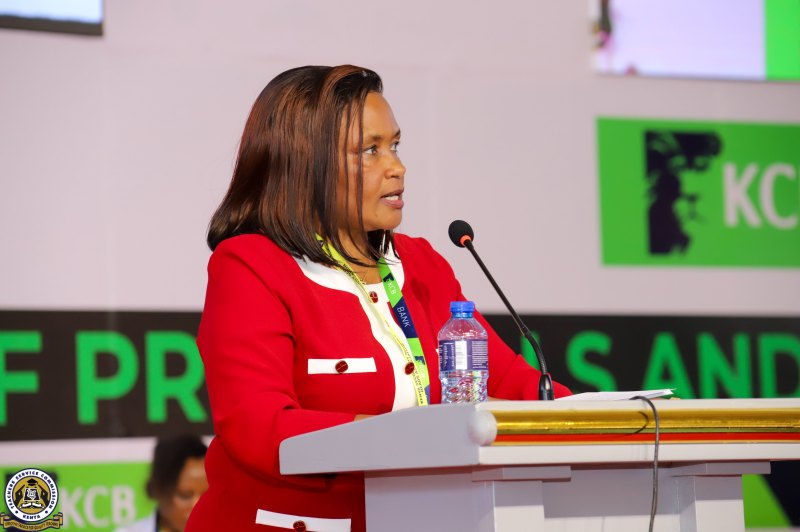
Auditor
General Nancy Gathungu’s review for the financial year ending June 2024 has
uncovered how taxpayers may have lost billions of shillings as a result of
missteps by the Judiciary’s management.
The
report highlights a disturbing pattern of public funds disappearing into ghost
worker payrolls, collapsing multimillion-shilling infrastructure projects, and
questionable expenditures with no paper trail.
At
the centre of the financial haemorrhage are questionable personal allowances of
Sh182 million and leave allowances of Sh131 million that were not supported by
ledger and payroll analysis.
A
review of payroll data revealed the possibility of 2,180 ghost workers, casting
doubt on the validity of Sh4.9 billion that the Judiciary spent on personal
allowances during the year under review.
The
recruitment details and records for the additional staff, whose existence could
not be verified through recruitment records, were not provided for audit
review, hence unsupported.
“In
the circumstances, the regularity, accuracy and completeness of the
compensation for employees of Sh14 billion couldn’t be confirmed,” Gathungu
said.
Taxpayers
may have also effectively thrown away Sh445 million on the Mombasa law courts building,
which was completed in 2021 but is now recommended for demolition due to
structural defects.
A
final structural assessment report by the Housing ministry in May last year
recommended the demolition of the building due to high costs associated with
repair works.
Gathungu
said the public did not obtain value for the Sh445 million spent on the court
building.
The
auditor has further questioned a payment of Sh100 million, which was part of an
arbitral award to a contractor who was involved in the construction of the
Lodwar court.
The
Judiciary was sued by the contractor for breaching contractual obligations,
which resulted in delayed payments and eventual termination of the contract.
The
auditor says the payment could have been avoided if the Judiciary had adhered
to the contract terms.
“Regularity
and value for money could not be confirmed,” the report concludes.
Further
losses appear in unexplained expenditures, including Sh37 million paid for air
tickets without invoices and Sh55 million spent on training programmes that
never had proper approvals or participant lists.
The
expenditure was not supported by an approved training plan, training needs
assessment, approval and list of employees nominated for the training.
“The
regularity, accuracy and completeness of foreign travel, subsistence and
training expenses totalling Sh93 million couldn’t be confirmed,” the Auditor General
said.
Compounding
the queries is a revelation that the Judiciary did not prepare and submit
monthly bank reconciliation statements to the Auditor General for review, hence
breached the law.
Gathungu
further suggested misuse of confidential expenditure, saying there was a need
to enhance accountability of the vote. The expenditures, though certified, lack
robust oversight mechanisms.
Gathungu
has called for clearer regulations to define eligible entities and operations,
along with detailed budgets and post-operation summaries to enhance
accountability.
She
says the regulations should specify what constitutes security-related
operations.
The
Auditor General wants internal oversight mechanisms revamped, budgets made
detailed and post-operation financial summaries issued.
She
argues that the steps would address the risks and ensure responsible use of and
accountability for the funds, beyond the certificate that accounting officers
prepare for audit review.
“The
measures will strengthen governance, foster trust, and ensure funds are
utilised responsibly without compromising state security,” Gathungu said.
The
Judiciary also failed to settle pending bills of Sh872 million during the year
and carried the same forward to the current spending period.
The
amount includes Sh82 million relating to the 2022-23 financial year, while 91
per cent was incurred in the audit year.
This
was in violation of the presidential directive for pending bills to be settled
by the end of each financial year, so as not to distort financial statements of
the year.
Also
cited are internal capacity challenges, which are believed to hamper budget
utilisation, hence the failure to absorb Sh520 million development budget.
Contractors,
as a result, failed to resume work due to rising costs associated with
inflation, delayed procurement processes and delays in certification of works.
“There
was no evidence of plans to build capacity to address these challenges,”
Gathungu said, adding that the situation could compromise the Judiciary’s transformation
plan.
Compounding
these issues is the Judiciary’s failure to operationalise 34 gazetted courts,
leaving 141 out of 175 functional.
Among
the non-operational facilities are 11 courts established in 2020 in Zombe,
Borabu, and Usigu.
No
plans were provided to bring these courts online, undermining access to justice
in underserved regions.
“The
effectiveness of service delivery to the public couldn’t be confirmed,”
Gathungu remarked.
The
report also flags systemic governance failures, including the Judiciary’s
breach of law for not submitting monthly bank reconciliation statements.
Besides
the employee compensation question, the Judiciary was found to be non-compliant
with staff establishment, as the numbers were riddled with discrepancies.
In-post
records showed there were 6,682 staff, a shortage of 721 judges, and
overstaffing of 730 in seven job groups.
“The
non-compliance with the staff establishment may affect service delivery to the
public,” Gathungu said.
“The
effectiveness of the internal controls and the regularity of human resources
management processes could not be confirmed.”
With
Sh520 million in development funds underutilised due to procurement delays and
contractor withdrawals, the Judiciary’s transformation agenda is at risk.
The
findings suggest not just financial mismanagement but a fundamental breakdown
in governance at one of the country’s most crucial institutions.
INSTANT
ANALYSIS
As
the details emerge, hard questions must be asked about how billions in taxpayers’
money could vanish without proper accounting, and what mechanisms exist to
recover these losses and hold responsible officials accountable. The scale of
irregularities suggests these are not mere administrative lapses but
potentially criminal mismanagement of public resources that demand urgent
intervention.