This
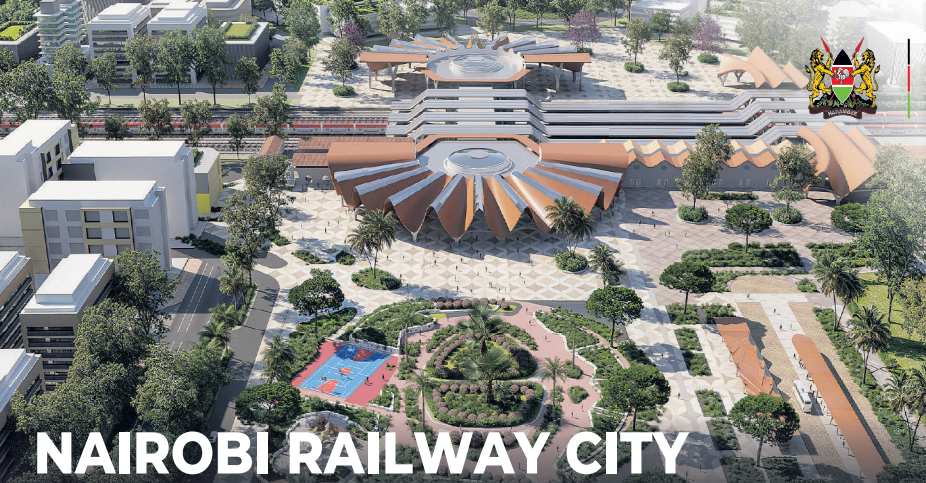
is not a futuristic fantasy. It’s the vision behind the Nairobi Railway City.
Set
to transform how people live, work and move in the capital, the project is one
of the most ambitious urban redevelopment plans ever undertaken in the country.
The Nairobi Railway City is a
transformative urban redevelopment project spearheaded by the government
through Kenya Railways.
Envisioned as a multi-modal,
transit-oriented and modern urban development, the initiative seeks to revamp
the Nairobi Central Railway Station and its surrounding areas.
This flagship project spans 438
acres of prime land within Nairobi and aims to create a new urban heartbeat for
the capital city.
“It's divided into six precincts, each with
a specific location character, specific urban function and unique identity,” Kenya Railways said.
According to Kenya Railways, the
Nairobi Railway City project is part of the core strategy for regenerating the City, balancing social benefits with economic returns.
It is also positioned as a vital
part of the national infrastructure development plan, combining transport,
housing, commerce and green public spaces into a cohesive urban design.
Strategic
location and urban design
The Nairobi Railway City will be
divided into six distinctive precincts.
Each of these precincts is tailored
to serve a specific urban function and possesses a unique identity.
These include Meetings,
Incentives, Conferences and Exhibitions (MICE) Core. The project is designed
as a vibrant hub for culture, innovation, research and employment.
This area will feature a mix of
retail, office, student housing, and educational and cultural
heritage facilities.
The other character is West Core, which is planned as a sustainable commercial centre that
promotes land value capture, job creation and both economic and social
development.
The precinct will feature commercial spaces, transportation facilities, entertainment zones, and high-end offices.
The central station is positioned
as a multi-modal transport and employment hub.
It will also accommodate cultural
and leisure functions, conservation and heritage centres, offices, retail
outlets and a modern railway station surrounded by public open spaces.
Additionally, the central station front is a residential precinct offering a range of inclusive housing
choices.
It will feature new housing
developments, community centres, a fire station, recreational areas and
mixed-use commercial properties.
Within the affordable housing area, a socially focused precinct is being developed to deliver sustainable housing that integrates infrastructure, inclusivity, and economic
opportunities, while preserving heritage and expanding green spaces.
The Railways will also serve as a
market core.
This will serve as a sustainable
market district, intended to create economic opportunities through
infrastructure investments while maintaining a socially inclusive environment.
Transport
and connectivity
The Nairobi Central Railway Station is
poised to become the focal point of the city’s multi-modal urban transport
network.
The redevelopment will significantly
boost commuter capacity. While the current station serves approximately 16,000
passengers per day, the new facility will be able to handle up to 30,000
passengers during peak hours.
Kenya Railways highlights that this
transport hub will provide seamless interconnectivity across the city.
It will integrate with Non-Motorised Transport (NMT) corridors and the Bus Rapid Transit (BRT) system, enabling safe
and efficient movement for pedestrians, cyclists and commuters.
The station will be served by a
modern fleet including Diesel-Electric Multiple Units (DEMUs), locomotives, and
coaches, which form the backbone of the Nairobi Commuter Rail network.
Socio-economic
impact
Kenya Railways emphasises that the
Nairobi Railway City is not just a transport project, but a socio-economic
transformation initiative.
“The NRC project will foster a great
socio-economic transformation for the city of Nairobi through strategic
infrastructure investment and urban planning,” KR noted.
One of the project's significant contributions is to housing.
The development is expected to
address the acute housing shortage in Nairobi by delivering approximately 10,000
residential units.
These will be spread across
single-use and mixed-use residential developments.
Single-use developments will
dedicate 97 per cent of their built area to housing, while mixed-use developments will allocate between 10 and 80 per cent for residential purposes.
It will also provide housing for
studentsto address the inadequate investment in student accommodation and to match the rising
enrollment rates.
Kenya
Railways intends to develop Purpose-Built student accommodation (PBSAs) for at
least 2,500 students on 1.57 acres within the Nairobi Railway City.
“The
site is strategically located in close proximity to Technical University of
Kenya (TUK),” KR said.
This is expected to provide diverse
housing options for Nairobi’s growing population.
Urban
amenities and public realm
In addition to transportation and
housing, the Nairobi Railway City project will prioritise public amenities and
green spaces.
These include new markets such as
the New Wakulima Market, student hostels, walkways for non-motorised movement,
and facilities for meetings and exhibitions.
The "Public Realm" aspect
of the development is intended to create open spaces that enhance quality of
life.
These areas will support public
gatherings, leisure and recreation, contributing to the livability and
inclusivity of the new urban centre.
International
partnership
The Nairobi Railway City is a flagship
initiative under the UK–Kenya Strategic Partnership, with the UK government
supporting its design and planning through technical expertise.
Once complete, it is expected to
redefine the cityscape of Nairobi, creating a well-planned urban environment
that meets the needs of current and future generations.