It is important that a shared
understanding of government
should be used in this article.
Government is that part of the
state that gives it life.
It is the government that enables
the state to deliver its mandate to
citizens.
At the broad level, the state
comprises the government
and citizens, including the
territorial span that constitutes
the geographical country.
The
country is defined by its recognised
boundaries while the citizens give
it life as a nation.
In many cases, there would many
sub-nations that come together.
Therefore, in modern times, what
exists is the nation state. The
government as understood in
political science studies comprises
of three arms.
These are the executive, the
legislature and judiciary. There
also exists the ancillary but
superintending defense forces.
These arms of government are
meant to be independent but
complementary to each other.
In
their respective roles they oversight
and countercheck each other. This
brings forth accountability that
promotes the public good.
The defence forces protect the
citizens from external aggression,
the legislature makes laws
and oversights, the executive
implements the development
agenda while the judiciary arbitrates
in case of disputes.
The disputes may be between
individual citizens or institutions
including the various arms of
government.
Each of the government arms is
headed by a respective institutional
office, some of whom are elected
while others are appointed.
President or prime minister heads
the executive as the jurisdiction
may determine.
The chief justice in
almost all countries generally leads
the judiciary just as the speaker
universally heads the legislature.
The defence forces as an
institution is usually commanded
by the highest-ranking military
general.
Of all these, the executive
is normally the largest and deepest
in terms of organisational structure
and human resource endowment respectively.
In Kenya, the first prime minister
and later President was Mzee Jomo
Kenyatta who was succeeded by
Daniel Moi, Mwai Kibaki, Uhuru
Kenyatta and currently William
Ruto.
The speakers have been Sir
Humphrey Slade, Fred Mati,
Moses Keino, Jonathan Ng’eno,
Francis Kaparo, Kenneth Marende,
Justine Muturi and currently Moses
Wetangula.
On the other hand, the judiciary
has been in the hands of Sir
John Ainley, Arthur Farrell, Kitili
Mwendwa, Sir James Wicks, Sir
Alfred Simpson, Chunilal Madan,
Cecil Miller, Robin Hancox, Fred
Apallo, Majid Cocker, Zacchaeus
Chesoni, Bernard Chunga, Evans
Gicheru, Willy Mutunga, David
Maraga and currently Martha
Koome.
In the history of the country,
the heads of the executive have
largely assumed a quiet life after
retirement.
The second President Daniel
Moi maintained an out of politics
lifestyle after handing over power
to his former vice, Mwai Kibaki.
In the same vein Kibaki retreated
to his Muthaiga residence after
moving from State House until his
death in April 2022.
Uhuru Kenyatta
had brief run-ins with the Ruto
administration regarding being
party leader of Jubilee and Azimio
coalition.
But he soon relinquished these
roles and mended up with his
former deputy. In fact, it turns out
that the discomfort with Uhuru was
more from Rigathi Gachagua than
Ruto.
Until Justine Muturi came into
the scene, most if not all former
speakers of Parliament enjoyed
their retirement in the peace and
tranquility of their residences.
Muturi broke ranks with his
erstwhile boss, Uhuru and joined forces with the Ruto-led Kenya
Kwanza coalition against Raila’s
Azimio coalition.
He would later join Ruto’s
government as its pioneer attorney
general. He therefore moved from
the head of the legislature to the
second tier executive position.
This meant that he had to shift
from the exalted position of the
head of the peoples’ representative
institution to undertaking toxic
partisan politics.
This was very unprecedented
and presented a dicey situation
for the government.
The Kenya
Kwanza coalition sought to revise
many policies of the Uhuru and
handshake government.
As the
speaker, Muturi had presided over
the legislation of these policies. Yet,
now he found himself as the chief
legal advisor on their revision.
He
had moved from being a head of a
very critical arm of government to
being a servant of the head of the
other arm.
This to some extent led to the
apparent dysfunction of the state
law office during his tenure. As fate
would have it, he was later moved
to the lackluster ministry of public
service from where he was fired
to join forces with the impeached
Deputy President Rigathi Gachagua.
Perhaps the most confounding
leadership contradictions of the
country are the recent political
activism of the immediate former
chief justices.
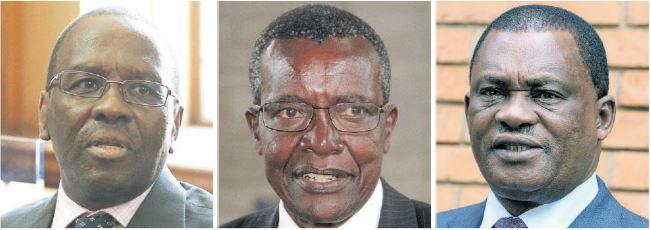
Mutunga rose to become the
pioneer chief justice under the
new constitution.
He had been a
consistent defender of human rights
and crusader for good governance.
As a young and liberal university
lecturer, he was one of the detainees
of the infamous Nyayo era.
He was thus one of the key
architects of the Constitution of
Kenya 2010.
His tenure at the helm of the
judiciary has been hailed and truly remains as the most transformative
since independence.
As an activist
he inspired the establishment
of many legal institutions and
mentored many practitioners.
David
Maraga was also exemplary in his
discharge of jurisprudence even
if he appeared as the antithesis of
Mutunga.
He rose from relative obscurity in
Nakuru as private practice lawyer.
He later joined the administration
of the judiciary as a magistrate and
rose through the ranks. He beat
many prominent names to the
coveted seat of the chief justice in
the rigorous recruitment process.
However, the hallmark of his
tenure was the historic nullification
of the 2017 presidential elections.
It was the first of its kind in the
region and celebrated globally as a
masterstroke.
The two former chief justices
therefore by dint of their
performances in office acquired
unequivocal respect across board.
They became paragons of good
governance and occupied high
moral grounds.
Having delivered their respective
mandates successfully and to the
satisfaction of the citizens, it was
generally expected that the duo
would retreat to a quiet life in their
retirement.
The expectation was they would
join Uhuru and other former chief
justices and speakers of Parliament
as statesmen of the nation.
From this exalted perch they
would regularly offer nonpartisan
and visionary counsel to the nation
in times of crisis.
When the country
is at crossroads as now with the Gen
Z protests, they would be there to
provide unbiased guidance to the
nation.
As respected elders, the country
would also rely upon them to
foster good international relations
and promote regional integration.
However, it is baffling to many that
the duo would be involved in legal
activism in neighboring countries
of Tanzania and Uganda.
These acts contributed to
strained relations between the
government of Kenya and its East
African Community members.
From their vast networks and high
profiles, they might have better used
diplomacy and soft power to achieve
their intended noble objectives.
Maraga has gone ahead to declare
interest in the presidency.
This has pushed him to engage
in partisan politics of the country.
Kenya’s voting patterns are tribally
inclined and mobilisation is
ethnically driven.
Maraga’s greatest challenge will
be how to mount a successful
presidential campaign devoid
of ethnic vitriol. In the ensuing
polarisation of the nation through
tribal jingoism, the duo cannot be
relied upon to provide unbiased way
forward.
Worse still is the fact that they
have inadvertently lowered the
standing of the judiciary as an equal
arm of the government.
On the same breath, Muturi
has also demonstrated that the
legislature is subservient to the
executive.
This unbridled ambition of the
trio clothed in political activism
does not promote good governance
and nurture institutions.