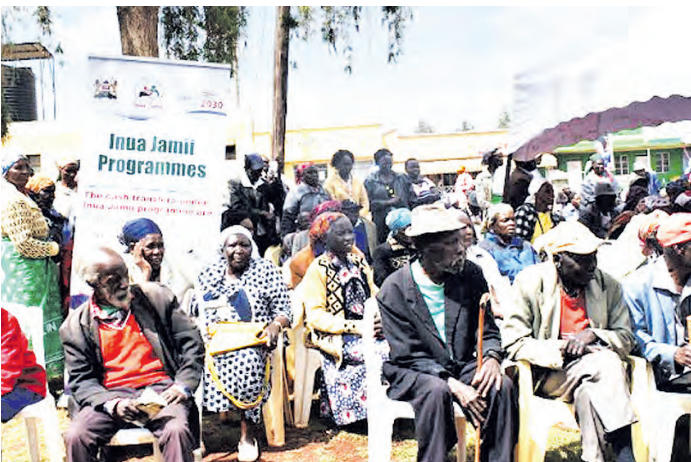
President William Ruto’s administration is straightening out the disorder in the Inua Jamii cash transfer
programme plagued by irregularities
and illegalities.
Audit reports reveal the programme is riddled with ghost beneficiaries, who still receive payments.
To curb fraud, the government has
proposed a new law allowing the seizure of assets from those who unfairly
benefit from the scheme.
The Bill also spells out tough measures aimed at weeding out ghost
beneficiaries reaping benefits from
taxpayers.
The Social Protection Bill, 2025,
sponsored by Majority leader Kimani Ichung’wah requires beneficiaries
to refund the full amount of excess
funds irregularly received.
“Where the board erroneously pays
money to a person who is not entitled
to social protection or the payment
exceeds the amount permitted by
the board, the person shall refund
the money so paid,” it reads.
Deductions can also be made from future
payments.
If the beneficiary is dead, their estate will repay the money.
“Their estate shall refund the money, or the excess amount of money
paid shall be deducted from the
subsequent payment made to the
beneficiary,” the Bill reads.
The proposed law would replace the current
National Social Assistance Authority with a board whose chairperson
would be appointed by the President.
That post previously was filled by a
Cabinet Secretary.
“The board may institute recovery proceedings against any person
who receives money from the board
erroneously,” the proposed law reads.
In February last year alone, 919
Inua Jamii beneficiaries were over paid by Sh896,500, according to the
audit of the state department manning the kitty.
Some 15,243 caregivers represented more than one household, violating programme rules.
Auditor General Nancy Gathungu
in a review of the fund’s accounts
for the year ending June 30, 2024,
flagged the breaches as illegal.
Through the Bill, President Ruto’s
team will also clean the social protection database – to be maintained
by the board.
“The board shall establish a social
protection registry, which shall be
a singular database for social protection interventions,” the Bill reads.
Should MPs pass the Bill, the registry shall maintain an inventory of vulnerable individuals and households.
It would also provide a platform to
select and register beneficiaries of
social protection interventions.
According to the Bill, the registry
would help coordinate social protection interventions better at the
national and county levels.
It would provide data on vulnerable households in the event of shocks
or emergencies.
The system also would facilitate
linkage and referral mechanisms for
social protection interventions.
“The board shall facilitate real-time
updating of changes in household
data through interoperability with
the other national registries,” the
proposed law reads.
It sets the stage for stricter oversight and penalties.





![[PHOTOS] Ruto pushes for stronger Kenya-EU economic ties in Brussels](https://cdn.radioafrica.digital/image/2026/06/3aebc395-285b-441c-8aa4-33cb538f8d44.jpg)