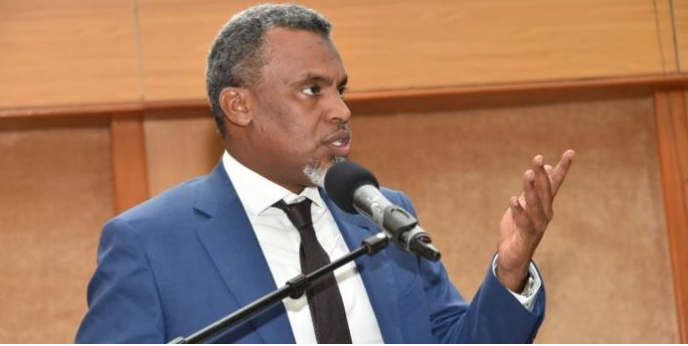
THE director general of the National Intelligence Service Noordin Haji
has defended the institution, asserting that it operates within the law.
“Most of these matters are in
court, and it would not be prudent
for me to comment on them,” Haji
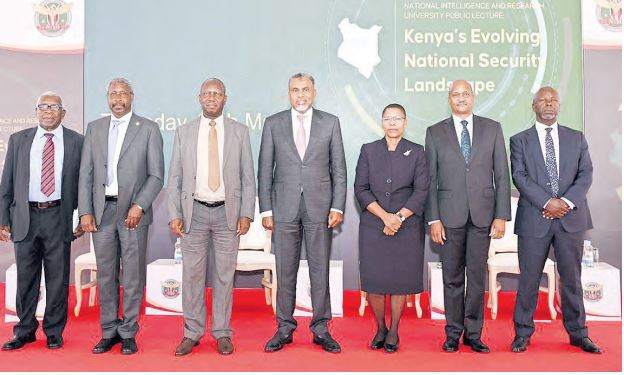
stated during his first-ever public
lecture held at the National Intelligence and Research University
(NIRU).
He reassured Kenyans NIS will
always fulfill its constitutional mandate in accordance with the law.
Haji was responding to claims by
Macharia Gaitho, the Daily Nation
columnist, that a unit under the Directorate of Criminal Investigations
was responsible for abductions kidnappings and killings.
He also
highlighted the challenges NIS faces in combating cybercrime, noting
that the owners of some of the most
popular apps are foreigners.
The
DG criticised existing cybercrime
laws as inadequate for the Kenyan
context, stating, “In the US, all you
have to do is cross the road to get
evidence. We have applied that
same high threshold, but when we
contact Facebook or other applications, what attention do they give
us? We are stuck.”
General Charles Kahariri, Chief
of General Staff, emphasised the
importance of professional intelligence services for state stability,
particularly in combating emerging
threats.
He noted, “Multi-agency
intelligence operations have enabled
us to combat various crimes, especially terrorism.”
The role of citizens in enhancing
security was also underscored, with
calls for vigilance and cooperation
with authorities.
“Kenya is a functional state within the international
system, contributing to global security,” Kahariri said, stressing the
need for collaborative efforts to
achieve peace and stability, particularly concerning regional allies like
Ethiopia.
Haji raised concern over the insecurity and instability in Sudan,
South Sudan, Ethiopia and the eastern DRC
In Sudan, the armed forces are
battling the rebel rapid Support
Forces, while in the neighbouring
South Sudan, political and security
tensions are escalating, with the UN
warning that the country risks sliding into a civil war.
“Our great republic is surrounded
by states grappling with conflicts
and tense inter-state relations resulting in disrupted trade, an influx
of migrants and cross-border crimes. These developments are severely
straining our resources and hindering our efforts to promote regional
integration and advance peace diplomacy,” Haji said.
Among the developments he listed are the conflicts in the Ethiopian
regions of Oromia, Amhara and
Tigray, which he noted have heightened the risk of fragmentation of the
country.
He warned that the protracted
Oromo Liberation Army conflict
in Oromia Region, which borders
Marsabit county, risks an influx of
refugees to Kenya.
Haji said this is likely to result
in resource competition with host
communities, further worsening the
security complexities in upper eastern region.
“Noteworthy, the OLA elements
and Al-Shabaab are symbiotically
leveraging their networks in areas
along the Kenya-Ethiopia border in
smuggling of arms, narcotics and facilitation of recruits,” he said.
The looming resurgence of conflicts in Tigray region, the Intelligence chief noted, risks igniting inter-state war between Ethiopia and
Eritrea, which could compound the
already dire situation in the Horn of
Africa.











![[PHOTOS] Ruto pushes for stronger Kenya-EU economic ties in Brussels](https://cdn.radioafrica.digital/image/2026/06/3aebc395-285b-441c-8aa4-33cb538f8d44.jpg)