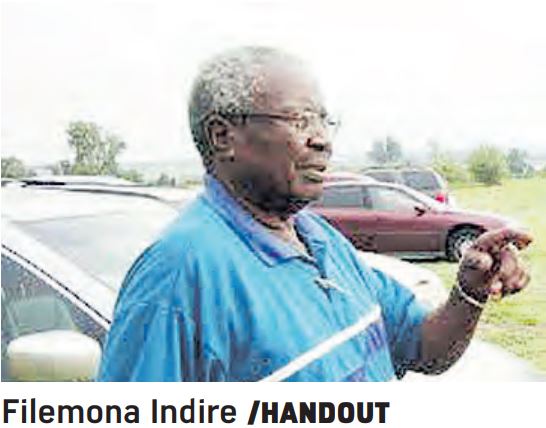
PROF Filemona Indire often told
his contemporaries Africa is a rich
continent that can solve its problems and should not rely on any
help from outside.
He lived most
of his 95 years trying to prove that.
“This country is very rich and
we should not even be thinking of
getting alms from abroad,” he said
in Parliament when he served as a
nominated MP from 1983 to 1988.
The life-long educationist and
church leader died on Tuesday in
Nairobi.
His family describes him
as a foresighted leader and loving
patriarch who was the glue that
held his sprawling family together.
Growing up in a Vihiga village
during the colonial days, he rejected tradition and pursued education.
He was admitted to Nairobi School, known at the time as
the Prince of Wales School, before
proceeding to Makerere University
and later Ball State Teachers College.
He became the first African deputy head teacher of Friends School
Kamusinga in 1957 before proceeding for further studies in the
US between 1959 to 1962.
He was
appointed the first African provincial director of education in Nyanza province.
When the country got independence in 1963, President Jomo
Kenyatta appointed him deputy
ambassador to the defunct Soviet
Union, serving for a year.
After his brief diplomatic stint,
Kenyatta appointed Indire the first
Kenyan professor of education.
Most of his studies focused on how to improve the education curriculum and shoring up the number of
teachers.
This is how he found his
way to the Davy Koech commission on education reforms established in May 1998 by President
Daniel Moi.
Prime Cabinet Secretary Musalia
Mudavadi and National Assembly
Speaker Moses Wetang’ula eulogised him as a ground-breaking
leader




![[PHOTOS] Ruto pushes for stronger Kenya-EU economic ties in Brussels](https://cdn.radioafrica.digital/image/2026/06/3aebc395-285b-441c-8aa4-33cb538f8d44.jpg)