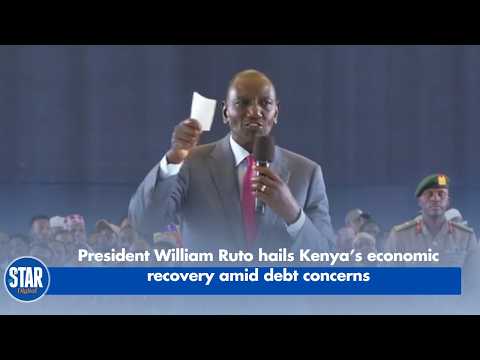
We expect all politicians to bend the truth but some abuse the privilege. Donald Trump and William Ruto are in this category. The similarities between these two leaders, one the former president of the United States and the other the current president of Kenya, are striking. They share a disregard for facts, an obsession with power and an uncanny ability to captivate a fanatical Christian base.
What is perhaps most troubling for the practice of journalism in the US and Kenya is how the media in both countries often falls into a trap of "sanewashing" Trump and Ruto by reporting on their frequent missteps and as if they are merely part of normal political discourse.
“Sanewashing” is the tendency of media outlets to cover blatantly untruthful politicians as if they are still playing by the rules to make them more palatable to the public. The media’s bias towards coherence, honesty and competence often treats politicians like Trump and Ruto as if they are engaging in a rational and well-meaning political debate even when it’s clear they’re not. This normalises their behaviour and downplays the danger they pose to democracy.
I don’t invoke the word “danger” lightly. As a Kenyan, reflect for a moment on the lawless behaviour of acting Inspector General of Police Gilbert Masengeli that's occurring under the watch of a President who repeatedly, in speeches at home and abroad, vows to uphold the rule of law.
Masengeli’s belligerent and illegal actions raise serious questions about the true character of the leadership steering the nation. As Ralph Waldo Emerson once said, “Every institution is the lengthened shadow of a single man. His character determines the character of the organisation.”
Character, as they say, is destiny and this applies to institutions too. For example, both Trump and Ruto excel at transactional politics. For them, political alliances are fleeting and are determined not by shared values but by what’s immediately expedient. This is why the Republican Party and Ruto's UDA have devolved into mere personality cults where ideological consistency means little compared to the raw accumulation of power and money.
A glaring parallel between these two figures lies in how they’ve merged their political roles with personal business interests, chiefly through their hotel ventures. Ruto's ownership of the Weston Hotel which regularly wins government contracts is an obvious conflict of interest that is eerily similar to how Trump’s properties profited from his presidency.
Then there's the near-fanatical devotion both leaders command from their base. Trump has repeatedly lied, misrepresented facts and been implicated in corruption scandals, yet a significant portion of his mostly Christian base remains loyal to him. The same is true for Ruto, whose supporters back him with religious zeal.
This is no coincidence. Both men cleverly exploit religious messaging to rally their supporters. Trump has positioned himself as a defender of Christianity by pandering to evangelical voters while Ruto has employed a similar tactic in Kenya.
A devout Christian, Ruto often peppers his speeches with biblical references and publicly aligns himself with religious leaders. This helps him maintain a veneer of piety even as his administration is mired in accusations of corruption.
Despite their charismatic appeal, Trump and Ruto have demonstrated an astonishing lack of interest in actual governance. For both leaders, everything boils down to political loyalty. They value those who support them unwaveringly regardless of their competence or integrity. This is evident in their staffing decisions, which prioritise sycophants over experts.
Both leaders are heavy on political theatre but light on policy substance. Trump’s presidency was defined by bombastic speeches, erratic tweets and a near-total focus on staying in the headlines. Ruto too seems to care more about being seen and heard than about making meaningful policy changes.
His administration, staffed almost exclusively by a rogue’s gallery of individuals with corruption cases hanging over their heads, has been marred by almost comical levels of mismanagement.
In the end, neither Trump nor Ruto can escape the fact that they often get in their own way. Trump's inability to control his impulses cost him re-election, a fate that is now also hanging over Ruto's head.