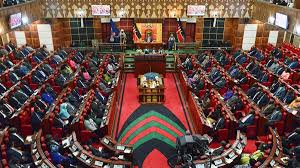
A showdown is looming in the National Assembly today as MPs vote on the controversial tax law clause by clause.
Kenya Kwanza and Azimio sides are gearing up to defend the various amendments they have proposed on the Finance Bill, 2024.
Stakes are high, both in their respective political formations and also on the ground with voters keenly monitoring.
The lawmakers face a tough balancing act in handling the politically charged legislation.
“Members have now deviated from arguing from a point of facts to dealing with political issues,” Chepalungu MP Victor Koech said.
Treasury dangled a carrot for the lawmakers to either support the taxes as proposed or face stringent budget cuts.
Among budgets affected in the hard-hitting cuts proposed by Treasury boss Njuguna Ndung’u, is CDF managed by MPs.
President William Ruto’s side pulled a fast one on the opposition during the vote at the second reading with more than 200 MPs supporting the Bill.
Raila Odinga-led Azimio la Umoja [backed by a few independents and pro-government MPs] managed about 115 votes.
With the show at the first round, the opposition is enthusiastic it will put a strong fight today.
At this stage, the whole membership of the House moves amendments to a bill and the session is chaired by Deputy Speaker Gladys Boss.
This is where amendments to the text of the bill are proposed and independent clauses are voted on and new additions made.
“This is a crucial stage as MPs can vote down clauses of the Bill, or vote for or amend them,” lobby group Mzalendo Trust said.
After the committee stage, the Bill undergoes Third Reading – where MPs vote on its passage and subsequently assented to by the President.
To signal an imminent showdown, Minority Leader Opiyo Wandayi said they insist on deleting every clause of the bill.
“We have a strategy of countering the so called tyranny of numbers. We will employ all means possible to fight these punitive clauses. We are vigilant,” he said.
Wandayi said where it will be impossible to overturn a vote, they will ensure the amendments favour the common mwananchi.
“There are various ways of countering some of the excesses in the bill. We assure our teams that we are ready,” the Ugunja MP said.
He said they have also positioned a number of members to move piecemeal amendments.
“There are still so many dangerous clauses in the proposed bill that we seek to counter one after the other. We will ensure our voice is heard,” Wandayi said.
Fuel levy, eco-levy, export promotion levy and the planned increase in import declaration fee are among the heavily contested clauses.
Majority Leader Kimani Ichung’wa said the changes that will be considered in today’s session is part of a normal processes of considering a bill.
“The Finance Act will eventually capture the adopted amendments and that is what will constitute the Act of Parliament that becomes the operative law,” he said.
Speaker Moses Wetang’ula’s office has been receiving the amendments from members, for tabling before the House Business Committee.
As of Friday evening, a number of MPs [largely from the opposition side] had forwarded their proposals to the speaker for consideration.
The Order Paper detailing the specific proposals was yet to be published by press time.
Several MPs said they want fuel levy dropped, saying it will occasion a price increase in nearly all sectors.
A number of lawmakers also want the proposed eco levy dropped until proper structures are in place to administer the resultant revenue.
Voting on the proposed amendments is usually a heated affair, just as was in the security laws vote and on the taxation of fuel.
During the historic vote on the security laws, Parliament was turned into a battlefield as MPs engaged in physical scuffles.
The same played out when the President Uhuru Kenyatta administration sought to introduce taxes on fuel.
It took a middle-ground of eight per cent for the opposing sides to accept the tax, which Kenya Kwanza finally instigated in the current tax law.
Already, the Finance Committee chaired by Molo MP Kuria Kimani has accepted to add the clause on fuel levy to the Bill.
“The committee noted the need for financing the budget and therefore accepted the amendment by the Roads Ministry on increasing fuel levy charge [from Sh18 to Sh25 per litre],” the committee said.
On the eco-levy, MPs said it will be applicable to imported finished products – to protect local manufacturers.
The levy is among those that the opposition is gearing up to fight, saying it will be cross-cutting, given that Kenya is a net importer.
The government further appears to be keen on retaining the export investment promotion levy as well.
“The objective of the levy is to protect local manufacturing sector from unfair trade practices and increase competitiveness of manufacturing sector,” Kimani said.
MPs will be taking the vote amid uproar from members of the public, with action groups watching.
“Whatever the outcome of the vote, we are sending the message that budgeted corruption cannot be the norm in Kenya,” said Lilian Lingai, national coordinator, United Green Movement.
The lobby says in the event the Bill passes, they will write to EACC to investigate lawmakers who support it.
The probe will start with the 204 MPs who voted to pass the bill at the second reading stage.
She said EACC will have until July 9 to publish the information as spelt in the EACC Act or equally face removal.
“The protest will continue until we occupy Parliament. We the people are sovereign,” Lingai said.
In the U-turn by President Ruto, VAT on bread was dropped, so was transportation of sugar, financial services, duty on vegetable oil, and money transfers.
The government also abandoned the motor vehicle tax, but critics say it was a ‘ruse to sneak in the fuel levy’.
VAT registration threshold was also increased to Sh8 million and excise duty introduced on imported eggs, onions, and potatoes.