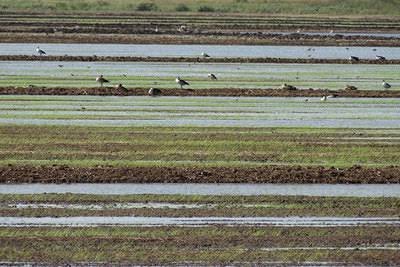
Tana Irrigation Scheme is the home of crop diversification, though rice is the main crop being grown in the more than 12,000 acres’ land.
Farmers from all walks of life who are hungry for money and not afraid to make their hands dirty, have moved there and are making a fortune from farming in one of the oldest irrigation schemes in the country.
The scheme's manager Kirimi Kirigia said currently, 5,000 acres are in use and are benefiting around 1,450 farming families (households).
He added that about 6,000 people depend on the scheme for their livelihood.
“We have seen farmers from across the country coming to farm in Tana. We have relatives calling their relatives to join, neighbours calling their neighbours and even acquaintances have not been left behind. The chain has brought in an additional 300 farmers in the scheme to date,” Kirigia said.
Edwin Mjaka is one of the farmers who has moved to the scheme and is growing green grams under 28 acres.
He said he heard from a relative that there was enough land with reliable irrigation water in Tana and decided to leave his family and make some money from the muddy water.
“I discovered Tana through my brother who works in Hola town. I visited the office here sometime in November last year, they showed me the land, I made the required payments including the operation and maintenance fees and I have not looked back since,” Mjaka said.
He will be harvesting his first crop of green grams in two weeks’ time.
“I am expecting to harvest at least 250 bags of 90kgs. A kilo is currently selling at Sh150. You see from dirty soil, there is a lot of gold coming out of it,” he said.
Paulina Mututa from Lamu county came to the Tana Irrigation Scheme in April 2022.
“I came here in April 2022, to try irrigated agriculture. I had done rain-fed agriculture in Lamu for five years and we had not seen any rains in about three years. I can now do three seasons in a year. I am in my second crop now, preparing land to crop maize in 35 acres because irrigated agriculture, unlike rain-fed farming, is a sure bet,” Mututa said.
Elijah Nderitu is part of the first group to come to the Tana Irrigation Scheme to start Komboka rice farming.
He said they started this journey with five other rice farmers from Mwea. Nderitu said they were redirected from Bura Irrigation scheme to Tana with the message that the scheme was eyeing famers to commence rice farming.
“So, we came straight here, met very helpful staff members who guided us and showed us the land. They cleared the Mathenge bushes for us and the journey continued,” he said.
The rice farmer said he started cropping six acres of land under rice in June last year from which he harvested 23 (100 kg) bags per acre and sold at Sh43 per kg.
“Surprisingly, the rice had gained a lot of popularity in Kenya hence they did not struggle with accessing the market. In the ratoon crop, the yields went up to 33 (100 kg) bags per acre and sold at Sh65 per kg.
Nderitu attributed the increase in yields to addressing soil salinity and also because the Mathenge thorns were no longer a threat.
He is now doing his second crop on 20 acres made possible through the proceeds from previous harvests.
“The six farmers multiplied in tens. The numbers have grown. Even livestock farmers have joined rice farming. In Mwea, you could only do two to three acres but here, there is plenty of land to do more,” the farmer said.
Mohammed Jare, is a livestock farmer who has diversified to maize farming. He is currently growing maize on two acres and is planning to do rice farming on three acres.
“I have seen my friends doing well in rice farming. We are not used to growing rice but we are learning to do it, of which I am grateful,” Jare said.
Catherine Kagwiria a farmer from Meru moved to Tana Irrigation Scheme in September 2021. She is currently growing rice under 15 acres.
She said in the first harvest, she got 200 (100kg) bags of rice and she was able to sell at Sh43 per kilo. From the ratoon, Kagwiria got about half yields selling at Sh65 per kilo.
She said rice farming in Tana is incomparable with Mwea.
“In Mwea, we used to lease an acre per season, including operation and maintenance fees, at Sh53,000. Here, it is Sh5,900. The yields in Mwea, especially Pishori rice variety is about 25 bags per acre while in Tana, the Komboka rice variety which is a preferred variety in the area, produces about 33 bags. The market is ready too,” she said.
“The community has welcomed us and we are living with them well,” she added.
Kirigia said in 2020/2021, 45 acres were put under rice seed and 95 acres under commercial rice.
“The production cost per acre was Sh70,000 and Sh60,000 for seeds and commercial rice respectively while the yields, were 80 tonnes and 275.75 tonnes in that order. The seeds and commercial rice were selling averagely at Sh800 and Sh45 per kg with gross returns of Sh64 million and 12 million respectively,” he said.
Kirigia further noted that in 2021/2022, both the main crop and ratoon on 1,957 acres gave 7,045 tonnes, selling at average Sh65 per kilo with gross returns of Sh458 million.
“Half-way through the financial year 2022/2023, 2,000 acres have yielded 4,800 tonnes, selling at an average Sh60 which is equivalent to Sh288 million,” the scheme manager said.
-Edited by SKanyara