It feels like this time, the campaigns have been going on forever. Even though the official campaign period lasts only weeks, the children who were born when Deputy President William Ruto started campaigning for the presidency have probably joined Grade 1 in the CBC school system.
The campaigns in this election cycle have sounded, felt and tasted different.
Since the restoration of multiparty democracy and the subsequent elections under pluralism in 1992, no electoral cycle has sounded more vicious, more vindictive and more profane than the 2022 season. Which is quite interesting, because in our younger days, when we watched from the ringside as the brave liberation heroes battled President Daniel Moi for control of state power in 1992, we thought we had seen it all.
Yet in those battles and the epic ones later between Mwai Kibaki and Raila Odinga in 2007, as well as Uhuru Kenyatta and Raila in 2013 and 2017, there was an unwritten rule within the political system that certain topics were no-go zones.
Two such hallowed grounds were the founding fathers of the nation, especially Jomo Kenyatta and Jaramogi Odinga alongside the immediate families of top politicians, mainly those of the president and his opponents.
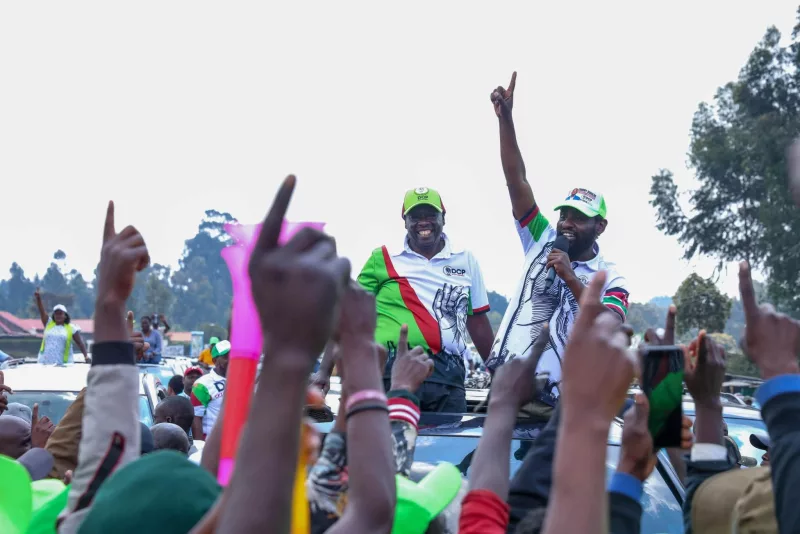
This year, however, that entire delicate balancing act has been thrown out of the windows. Politicians from the UDA formation, whose acidic tongues make the devil frown, have for months found it fit to insult the President’s mother in rather shocking ways. But nothing prepared any for us for the spectacle of UDA running mate Rigathi Gachagua popping up his sunroof at a huge political rally, in Central Kenya no less, to accuse the founding President of having killed firebrand politician JM Kariuki in 1975.
When you consider the fact that the full sentence was “do not kill us the way your father killed JM Kariuki”, you get the full blow of the words.
As if choreographed for maximum impact, the Deputy President was in his backyard, also asking the President not to kill his children.
It is difficult to explain the origin of such loose talk, but this is UDA we are talking about.
Something tells me that the President’s silence following these disturbing allegations is only temporary for the sake of the elections, with the intention of revisiting later.
I use these verbal political assaults to illustrate the extent to which a ticket in this contest will go to capture power in the election. The unprecedented loose talk appears in every way to be a departure from any known national value systems, now and in the past. And therein lies the problem.
In a country where tribal fault lines are the elephant in the room, we have only got so far by delicately keeping some closets sealed because we all except that as far as our history as a nation is concerned, not knowing some things is why we salute one flag and sing one national anthem. Disturbing that equilibrium, we acknowledge, could send us to the precipice.
On that score alone, I am afraid the UDA brigade has not only come out as an agent of instability, division and hatred, but a group that will do anything to capture power. It doesn’t help that as far as closets are concerned, the numbers in UDA are mindboggling.
The divide in this election is clearer than ever before. One ticket is led by a statesman grandfather whose perceived radical side mellowed over the years and who in words and actions, has remained the new national symbol of cohesion, building bridges where no one expected any. His running mate is a woman of steel, whose principled politics is well known well beyond her Kirinyaga roots.
The other ticket could as well have been a long catalogue of corruption cases and court appearances. When seeking whom I want my children growing up under, the choice is quite easy.
Raila has built up a team of formidable national figures, many from the liberation years and others from the celebrated Kibaki regime. It is true birds of a feather flock together.
It almost seems like power evaded Raila until he had the requisite maturity, calm and the assured dignity to win the hearts of erstwhile enemies. Together with Uhuru, they have finally come closest to slaying the dragon of tribalism and its long poisonous tongue in the form of the perennial Luo-Kikuyu animosity.
With Raila’s known anti-corruption credentials, if he proceeds to also cage the monster of corruption, his friendship with Uhuru will have delivered a shot in the arm towards conquering two of Kenya’s biggest ills — tribalism and corruption.
In staking the future of my children in the country’s destiny, I am willing to give this a chance.
Elections are not just about winning by the number of votes, but also what values winners bring into office. Evidence already abounds globally that populist politicians with the gift of rhetoric, even where they are a danger to the long-term stability of a nation, often find windows to state power and breed regret and despondency.
It is for this reason that we cannot afford to be neutral during the most consequential election of our generation. In the age of social media, phone cameras and drones, the actions and words of our politicians, especially those who seek high offices, are recorded for our view and for posterity, by the second.
We, therefore, have no excuse around not knowing or not being informed. We go to the ballot fully aware of the histories, the temperaments, the words and the values of the two frontrunners in this election.
I have weighed both and it wasn’t a difficult decision.
There are millions of compelling reasons to posit that Raila’s age, history, past actions and continued pursuit of greater freedoms and liberty, make him the best choice for President at this time.
As a side note, I do hope that Wafula Chebukati and his IEBC team will finally deliver a credible election for once. In my view, if they don’t, this time they must be hauled to jail because this country cannot keep going through a five-year cycle of fraud. Someone must be held to account, because elections bring tears and joy, but have also been known to bring death and destruction.
The taxpayer sends billions to the IEBC for just one job. If they can’t do it, it’s time to send them to Kamiti to serve as a lesson and to pass the unequivocal message that we have had enough of chaotic elections.