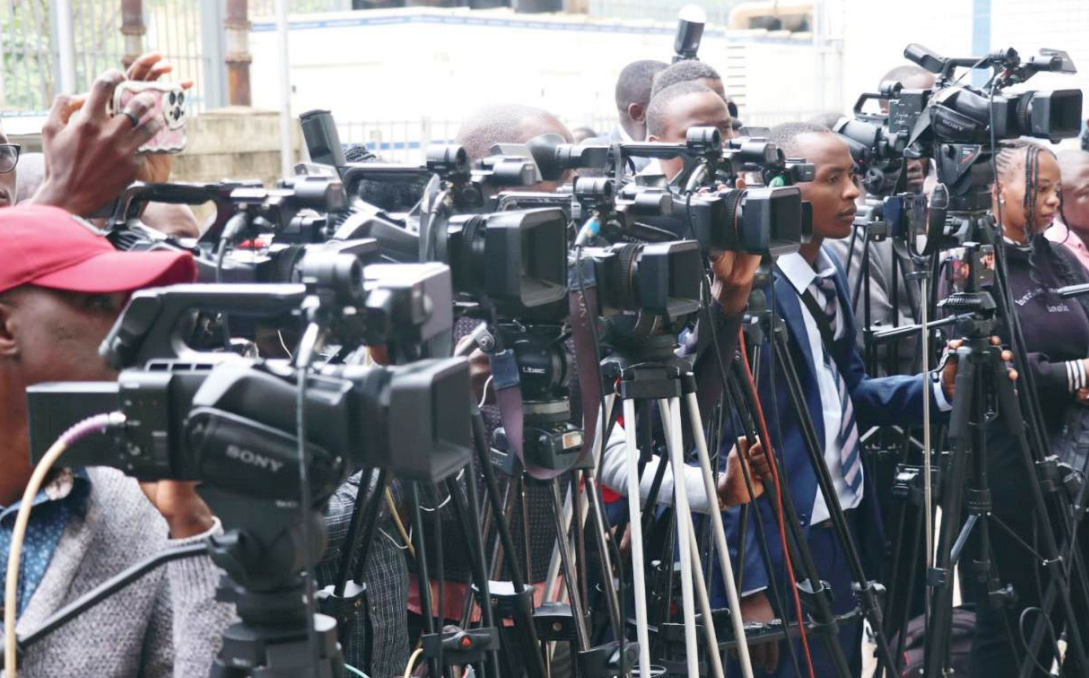
Speaking at a meeting in Nairobi on Thursday, IEBC commissioner Abdi Guliye said the manual system was grossly abused in 2017 and that the commission was keen to avoid a repeat in the upcoming polls.
The commissioner said the manual register is susceptible to electoral fraud and asked why Raila is hell-bent on its use.
"The manual register is prone to misuse,” Guliye said during the meeting with Kenya Private Sector Alliance, also attended by IEBC chairman Wafula Chebukati.
He went on, “So, anyone trying to criminalise us for not using the hard copy register, they must be asked: what is your reason for insisting on that."
Guliye spoke just a day after Raila declared there would be no election if IEBC would not use the manual register.
He said the IEBC learned lessons from the 2017 general election where he suggested the manual system was abused, leading to the nullification of the presidential election result by the Supreme Court.
Guliye appeared to suggest that the manual system was hugely abused in some regions where voters who did not turn up to vote were marked to have voted, especially for presidential candidates.
“If you say that you just use a manual register, you get a scenario like in 2017. The Supreme Court was asking how comes the votes for presidential candidates were much higher than voters for the other elective seats. How do you explain the difference ?” he said.
The country’s apex court had put the IEBC on the spot over the huge discrepancies between the numbers of votes cast for presidential candidates and other elective seats.
The commission’s failure to convincingly respond to the disparities largely anchored the nullification of the presidential election results.
“This is what we are trying to prevent. What the commission is trying to do is to ensure there is a level playing field,” Guliye said.
Raila has been at loggerheads with the commission after it announced that will it use the digital register to identify voters in the August 9 polls.
The Azimio boss has raised concerns about the digital system, arguing that many voters would be locked out of the crucial exercise in the event the technology fails.
On Wednesday, the former Prime Minister said there would be "no elections" if the manual register is not availed on the voting day.
“Manual register is a must at each and every polling station. It is not negotiable,” he said at a public rally in Kiambu.
Raila and his Azimio brigade also accused Chebukati of allegedly colluding with Ford Kenya leader Moses Wetang'ula whom they termed as his cousin to award a ballot printing tender to a Greek firm.
They claimed he had colluded to stuff ballot papers and then smuggle them into the country through Uganda.
But Chebukati denied the claims, saying it was regrettable that some political players had “stooped too low” in profiling the commissioners and setting them up against Kenyans.
Revealing that the commission has written to DCI to take action on the propaganda targeting staff and members, Chebukati said the unfounded claims could evolve into a security threat.
“It is unfortunate that people are profiling me with Wetang'ula (Bungoma senator). I know he is a Bukusu like me and we come from the same county, but I have never sat with any individual to discuss procurement,” the IEBC chairman said.
At the meeting, Guliye outlined measures undertaken by the commission to ensure the technology works on the voting day.
The technology, he said, will enable the commission reconcile the number of identified voters and the ballot papers issued in every polling station.
The commissioner further said the digital kits have captured 10 fingerprints for every voter which will be used to identify them at the polling station.
Should a kit fail, a spare one will be deployed. Six spare kits will be sent to every ward. The voters can also be identified by keying in their ID numbers in the kits.
Hard copy register, Guliye said, will be used as a last resort – after all the available kits fail to function.
(edited by Amol Awuor)
“WATCH: The latest videos from the Star”


![[PHOTOS] Linda Mwananchi takes Trans Nzoia by storm](https://cdn.radioafrica.digital/image/2026/07/0d132395-ad4b-4671-867e-880c9f8144f5.webp)