
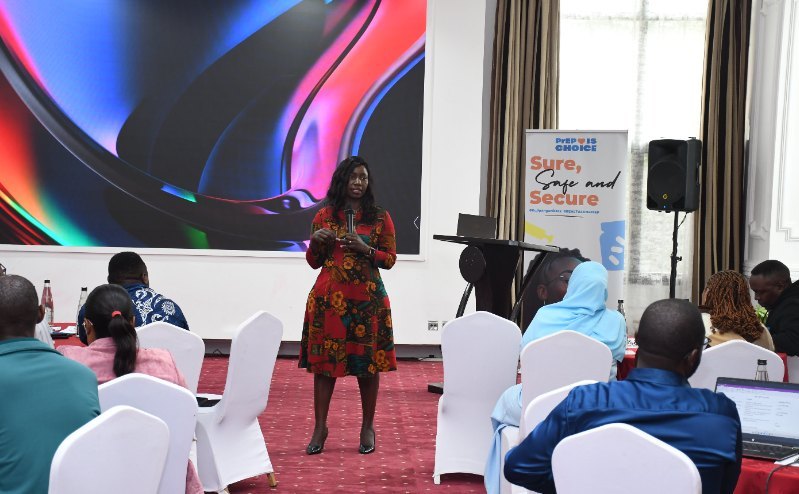
 Patriciah Jeckonia, head of policy and PrEP technologies at LVCT Health, speaks to participants in Nairobi on Thursday.
About 7,900 people in Kenya have received the injectable HIV prevention drug Lenacapavir since its rollout began in February this year.
The beneficiaries are all drawn from just 15 counties participating in the first phase of the programme.
The figures were shared during a two-day learning forum that brought together the 15 counties, the National AIDS and STI Control Programme (Nascop), LVCT Health and county governments to review progress, share experiences and address challenges.
The forum highlighted Kenya’s rapid uptake of the injectable drug, even as experts warned that gaps in awareness, data systems and demand creation could affect long-term access and equitable use across populations.
Lenacapavir rollout is part of a broader shift towards offering people more HIV prevention choices, including long-acting injectable options that reduce reliance on daily pills.
Patriciah Jeckonia, head of policy and PrEP technologies at LVCT Health, said the counties were supported to identify and address implementation gaps through monitoring visits and technical assistance.
“We came in to fill that gap by developing materials that resonate with communities, that connect with them emotionally, and then they’re able to choose,” she said.
The 15 phase 1 counties are Nairobi, Kiambu, Kajiado, Kisumu, Homabay, Siaya, Migori, Kisii, Kakamega, Busia, Uasin Gishu and Nakuru. Rollout to the rest of the country begins next month.
Jeckonia said one of the key challenges identified across counties was weak community awareness about HIV prevention choices, including Lenacapavir.
She said health communication materials were being redesigned with community input and will be rolled out nationally.
The forum also revealed wide differences in how counties are implementing the programme depending on cultural and social contexts.
“You will realize that the coastal region will have cultural and religious-based challenges more. You find, for example, the lake region, they’ve got issues around fishing, which is also different. Then when you go to the central side, you’ve got businesses, Nairobi, Kajiado, pastoral communities,” she said.
A key concern raised at the forum was that adolescent girls and young women, who remain among the most at-risk groups for HIV infection, are not yet adequately accessing the injectable prevention option.
Lvct Health executive director Dr Lilian Otiso, noted that new innovations succeed when communities are involved in designing their delivery within the health systems. “This is about working with counties and communities to make prevention options available in a way that makes it easy for people to access and use. So, we focus on supporting counties to integrate HIV prevention innovations into routine services and effectively respond to the needs of the people they serve,” she said.
Despite the promising uptake, Kenya’s rollout has also faced misinformation and stigma, especially in communities with limited understanding of the injectable drug.
Samson Mutua, the 26-year-old who in February became the first Kenyan to receive Lenacapavir, described himself as “Kenya’s guinea pig.”
Mutua, who began using oral PrEP in 2018 after high school, said stigma and misinformation have long surrounded HIV prevention.
He said switching to the injectable form did not immediately reduce stigma but instead introduced new misconceptions.
. “In fact, after I was injected, I switched off my phone for three days. No one was getting me for three days because of the misinformation. Many people said I got the injection so that I could become carefree.”
He said the experience exposed major information gaps in communities. Mutua said he has since dedicated himself to community education and peer support.
“So I go talk to them. They are friendly and they listen. I am the guinea pig of Kenya. I am a guinea pig. But I am really glad that we are having this conversation.”
Another participant, Joseph from Kiambu, also shared his experience, saying he joined PrEP services in 2021 before transitioning to the injectable option, which he said improved his confidence in HIV prevention despite lingering stigma in communities.
At the centre of the discussions was also a major concern over data gaps. Officials noted that some health facilities using electronic systems that do not include HIV modules are not fully captured in national reporting systems, affecting tracking and accountability.
Jeckonia said improving data systems was critical for planning and supply management.
“If we cannot account, say for example, if you lose a
thousand vials, and then you’re telling a donor we’ve run short, it becomes
difficult to trust you with more,” she said.
END