

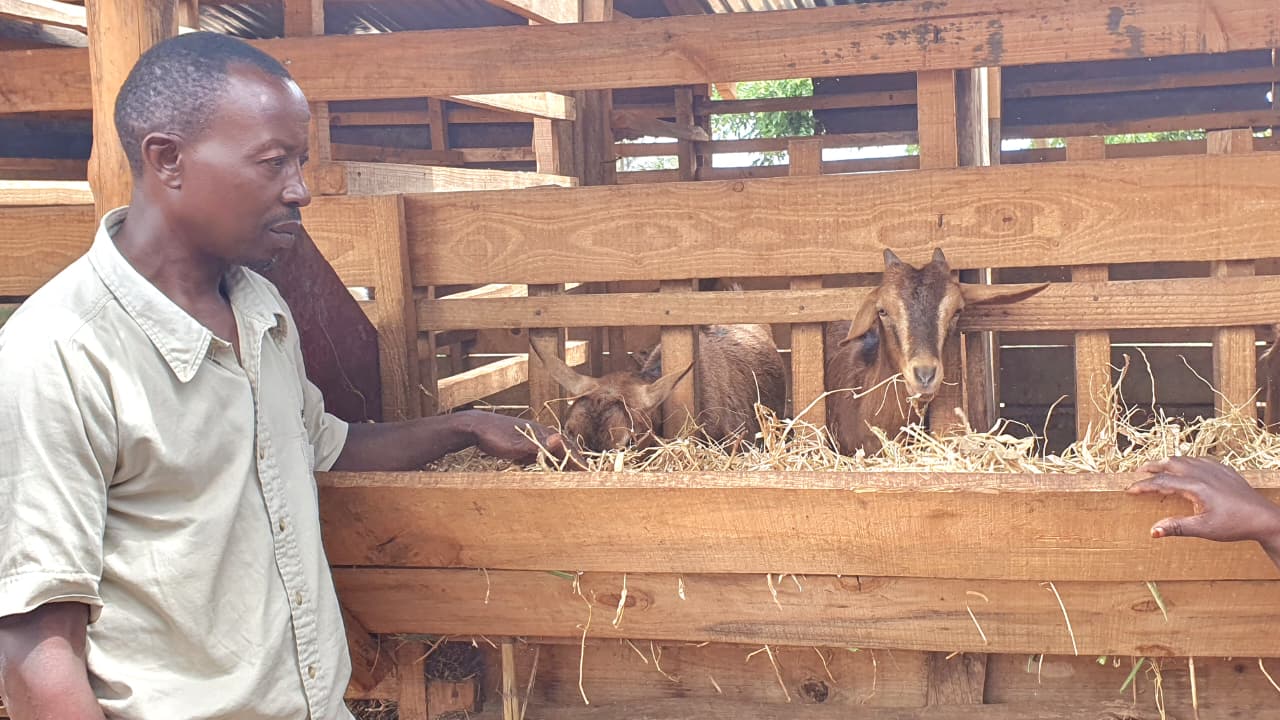
 Peter Kachwiri feeds some of the goats
 Self-help groups in Kajiado county are turning to nature-based solutions to strengthen their resilience against climate change, with initiatives aimed at combining sustainable livelihoods with environmental restoration.
Friends of Friends, a self-help group in Kuku ward, Oloitoktok subcounty, is among those leading the charge.
Chairperson Purity Karimi said the 15-member group, founded in 2023, has benefited from disease- and drought-tolerant dairy goats, tree seedlings and training on organic gardening provided by Care and the World Wide Fund for Nature alliance, called 'Sowing Change'.
“We were given three goats, which have multiplied to five, and we have also received training on dairy farming, kitchen gardening and tree growing,” Karimi said, adding that the interventions have significantly strengthened the group’s food security and climate resilience.
Member Peter Kachwiri highlighted the economic benefits. A drought-resistant goat can fetch up to Sh25,000, compared with less than Sh10,000 for local varieties.
He said the goats are being used for crossbreeding to improve local herds.
Another member, Winfred Wanaina, called on the county government for further support, saying the group hopes to establish a dairy to boost income and community well-being.
Jirani Mwema, a 40-member self-help group in Ipironi, has similarly embraced nature-based solutions. Chairwoman Leah Lepokori said the group has benefited from dairy goats, kitchen gardens and fruit tree seedlings.
Member Eunice Wambui said the group shares responsibilities, such as feeding the goats and distributing kids to members, reducing the need to migrate in search of pasture and water.
The initiatives are part of Sowing Change, a CARE-WWF Alliance programme that empowers women to lead sustainable, nature-based projects, while promoting green economic growth, climate resilience and biodiversity restoration.
Launched in Kenya’s Amboseli-Chyulu sub-landscape, the programme aligns with national goals, including planting one billion trees by 2030 and restoring thousands of hectares of degraded land.
WWF-Kenya manager for the southern Kenya landscape Martin Mulama said the programme focuses on economic empowerment and gender equality.
“We have provided up to 120 dairy goats to 40 women’s groups and 89 beehives to 13 groups across the Amboseli ecosystem,” he said.
"These are low-cost, productive and climate-resilient solutions."
Fruit trees and beekeeping have also been introduced to diversify livelihoods, he said.
Mulama said dairy goats mature faster than traditional livestock, allowing women to generate income within five months, compared with the nine months needed for calves.
“All these efforts ensure that women’s groups are resilient in the face of climate change,” he said.
Through these nature-based interventions, Kajiado county’s self-help groups are demonstrating how sustainable livelihoods can be a powerful tool for both economic empowerment and environmental stewardship.
INSTANT ANALYSIS
The CARE-WWF Sowing Change initiative empowers women to manage sustainable projects while restoring degraded land and promoting biodiversity. Low-cost, productive livestock and diversified activities like beekeeping enable rapid returns and economic empowerment. These efforts demonstrate that integrating environmental stewardship with livelihood development can deliver both social and ecological benefits, setting a model for other regions.